Lapis Philosophorum

As I’ve stated before (probably ad nauseum), I used to have a dim view of flash fiction. I’ve since learned better. For one thing, it’s the perfect medium for little offhand notions that are fun to play with, but probably not substantive enough to support longer work. Sort of like a feghoot, but without the pun. So here’s a new one, because it’s fun to play.

Lapis Philosophorum

“The problem with immortality,” Daniel said, “is it doesn’t last long enough.”

Daniel was my oldest friend, but he was prone to gnomic utterances. One simply had to play along or ignore him. I had learned that it was ultimately more fun and even occasionally enlightening to play along, which is why we’re still friends. It also likely explains his three divorces.

“You do realize what you’ve said is a total contradiction in terms? Immortality does not end. That’s why they call it immortality.”

“Oh, but it does. Mine ended about three weeks ago, when I had my first heart scare.”

The pacemaker was still a source of some discomfort to him, both physically and mentally. Maybe there was something at the heart—so to speak—of his nonsense aphorism.

“So you were immortal…and now you’re not?”

“How could I be otherwise? All the death in the history of the human race was an abstraction to me and therefore it did not and would not apply to me in any real way.  I was special…in the sense that I was just like everyone else who also believed themselves immortal.”

“Humans aren’t immortal.”

Daniel was in his element. “Ultimately? No. My point is the belief is almost always there. Death is something that happens to other people. So, if death is not real to you then, logically, you’re immortal.”

“The premise is flawed, ergo so is the logic. Death is absolutely real.”

“No doubt. But you must admit the belief in one is dictated by disbelief of the first. I knew I was mortal, but I didn’t believe it. Now I do. My immortality is at an end.”

“Tragic.”

He glanced at me. “Are you going to tell me that you never felt as if you’d never die? Seriously?”

I sighed. “As you say. I knew it, didn’t believe it. So I guess I was once immortal too. Is there a point to this?”

“I was thinking of the origins and practice of alchemy.”

This, too, was typical Daniel. “Are you changing the subject, or is there a connection I’m not seeing?” From my experience the odds were roughly fifty-fifty, so it was always best to ask.

“I think there is. Consider the Philosopher’s Stone, the ultimate goal of every alchemist worth his alembic. They believed it existed. Ergo they tried everything to find it. They failed. Why?”

“Because a substance that can transmute lead into gold and confer immortality does not exist, Nicolas Flamel notwithstanding, and all the futile mixing of tinctures and heating of mercury was never going to find it.”

“True. Yet in the pursuit of the Stone they collectively discovered the reactive properties of thousands of substances and laid the foundation for the very real science of chemistry. Their life’s goal was an delusion, but the result was not.”

“So you’re saying our delusions of immortality may serve a practical purpose? Such as?”

He smiled. “If I knew that, I really would be immortal.”

©2021 Richard Parks

Contemplating Forever

Today’s post is some idle musing on the concept of infinity. Disguised as a piece of flash fiction.

Contemplating Forever

He was washing dishes. She was reading. There was a dishwasher, but sometimes he just liked to get his hands wet and pruney. She wondered what the heck was wrong with him, but only briefly. There weren’t enough hours in the day to follow that particular road.

“Hey, come look at this,” he said.

“Look at what,” she asked, putting aside a really fascinating article on the rise of shamanism in non-indigenous cultures. Just because he asked her to. Maybe it was love, but she didn’t think about that. Over the years she’d learned that life went a lot smoother if you didn’t over-analyze everything.

“Bubbles!” he announced proudly.

“Bubbles in a sink full of dishes that would have been clean an hour ago if you’d used the dishwasher,” she said. “Imagine my surprise.”

“You’re cute when you’re sarcastic. No, I meant this particular arrangement of bubbles.”

He pointed to the glistening configuration in question, which was one large bubble…containing another bubble, which contained another, as far down as she could see.

“It’s almost…fractal,” she said.

“Indeed. Can you imagine? Bubble within bubble down to infinity?”

She shook her head. “Wouldn’t work. Fractals repeat in infinite iterations. A bubble within a bubble would eventually run up against electromagnetic barriers as it approached the atomic level. Besides, you can’t have a bubble with just one atom. That’s why I said ‘almost’ fractal. A pseudo-fractal, if you will.”

“I won’t. Either it’s a fractal or it isn’t. If the pattern cannot repeat to infinity and beyond, it’s not a fractal. Still darn remarkable, though.”

“There’s no “beyond infinity,” with all due respect to Mr. Lightyear. If there’s no end, there’s no beyond.”

“Semantics,” he said.

“Rubbish,” she said. “Either a word means what it means or it doesn’t, in which case it’s a different word. A fractal is one thing, infinity is something else…even though one has a relationship with another.”

“You mean like us?”

“That goes without saying. A fractal is a pattern each part of which is a representation of the entire pattern. Infinity means whatever you’re referring to goes on forever,” she said.

“Which I concede are different and yet related concepts. Drill down in a fractal, you get more fractal. It goes on forever yet is contained in finite space. It contains infinity, yet it is not infinite.”

“And your bubbles are not fractals,” she said.

“I believe you’ve already established that. Yet I’m still amazed at how casually we throw terms like ‘inifinity’ and ‘forever’ around. Does anyone really grasp what ‘forever’ means?”

“Sure do,” she said. “It’s the amount of time you’ve had me looking at soap bubbles instead of reading my article.”

“That’s in relative time. In actual time? Five minutes, tops,” he said.

“Seemed a lot longer,” she said.

“Naturally. That’s why it’s called relative time. Two different observers, two different perspectives.”

“Are we really going down that rabbit hole?”

“Nah. Linear time is an illusion anyway,” he said. “Besides, it would take forever.”

(c) 2021 Richard Parks

Knowing and Realizing

Related words, but not the same thing. In one final tribute to the departed Sterling, a rumination on the difference.

Requiem

There’s knowing, and then there’s realizing.

Just as the difference between the right word and the almost right word is the difference between the lightning and the lightning bug, the difference between knowing and realizing is on that level. Supposedly Mark Twain was the first to make that observation regarding words. Maybe he did. Maybe he didn’t. He usually gets the blame either way. It’s not fair, but then life isn’t fair, so I’ll blame him too.

I have to blame someone right now. For something. Doesn’t much matter what.

Knowing is the easy part. It’s all right in front of you. Your cat is sick; you know that. Your cat has an inoperable tumor, and you know that too. The steroids worked for a while, made his breathing easier, made him more comfortable, but wouldn’t fix the problem, and you knew that as well. There would come a point when the pills wouldn’t work anymore, and that a certain day would come. And it did.

Off to the vet because you’re out of options. The cat is suffering. You know it’s the right thing to do. Not easy, not pleasant, but right.

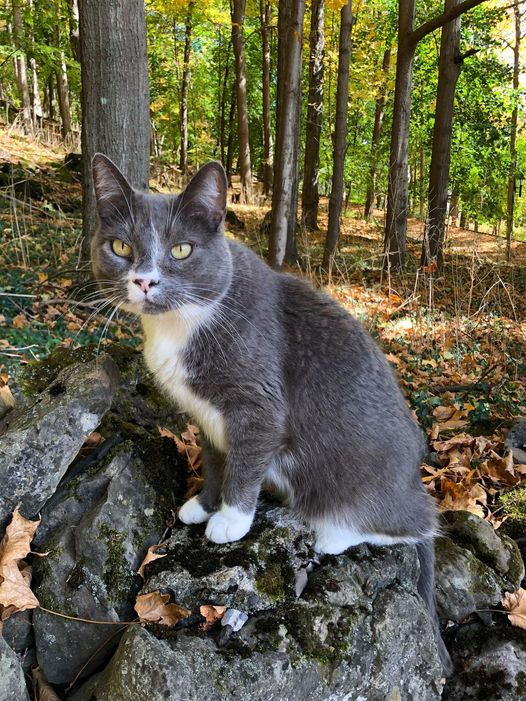
The cat has a name, by the way, and it’s Sterling. He’s gray with a little bit of white, like his brother. We named them Sterling and Sheffield because their coats reminded us of bands of steel. Together they were “Da Boyz.” Mighty hunters, even though Sheffield has delicate teeth and Sterling a congenital enlarged heart. Or maybe just a big heart. He was a sweetie.

We met them at the Mississippi Animal Rescue League. We hadn’t bonded with any of the other cats on display, and the lady said they had a pair of brothers that came in together. About ten months old, they reckoned. One or both climbed immediately into Carol’s lap. I think they may have drooled a little, and they both came home with us.

We knew then as we know now that cats have a certain range of lifespan, and that’s it. May be shorter, may be longer. But not forever, but you don’t think about that, you don’t realize that. It’s just one of those knowing things.

Like the hard decisions you know you’ll have to make. Sooner or later, it’s coming. And then it does, and you go to the vet, and you pet him one last time and you do not leave him, even for the needle. You say he’s a good boy and a brave boy and you’re telling yourself those things, because he doesn’t know, but you do.

Then you bring him home, and you bury him. And you know he’s gone because you dug the hole yourself and put him in it because it was the very last thing you could do for him.

Then it’s later. Sometime later. A day, a week, doesn’t matter how long. You’re doing dishes, mind wandering as it’s prone to do. You wash one kitty bowl, and then you automatically look for the other because they’re brothers, and there’s always two…

And then you realize.