A Very Fast Idiot

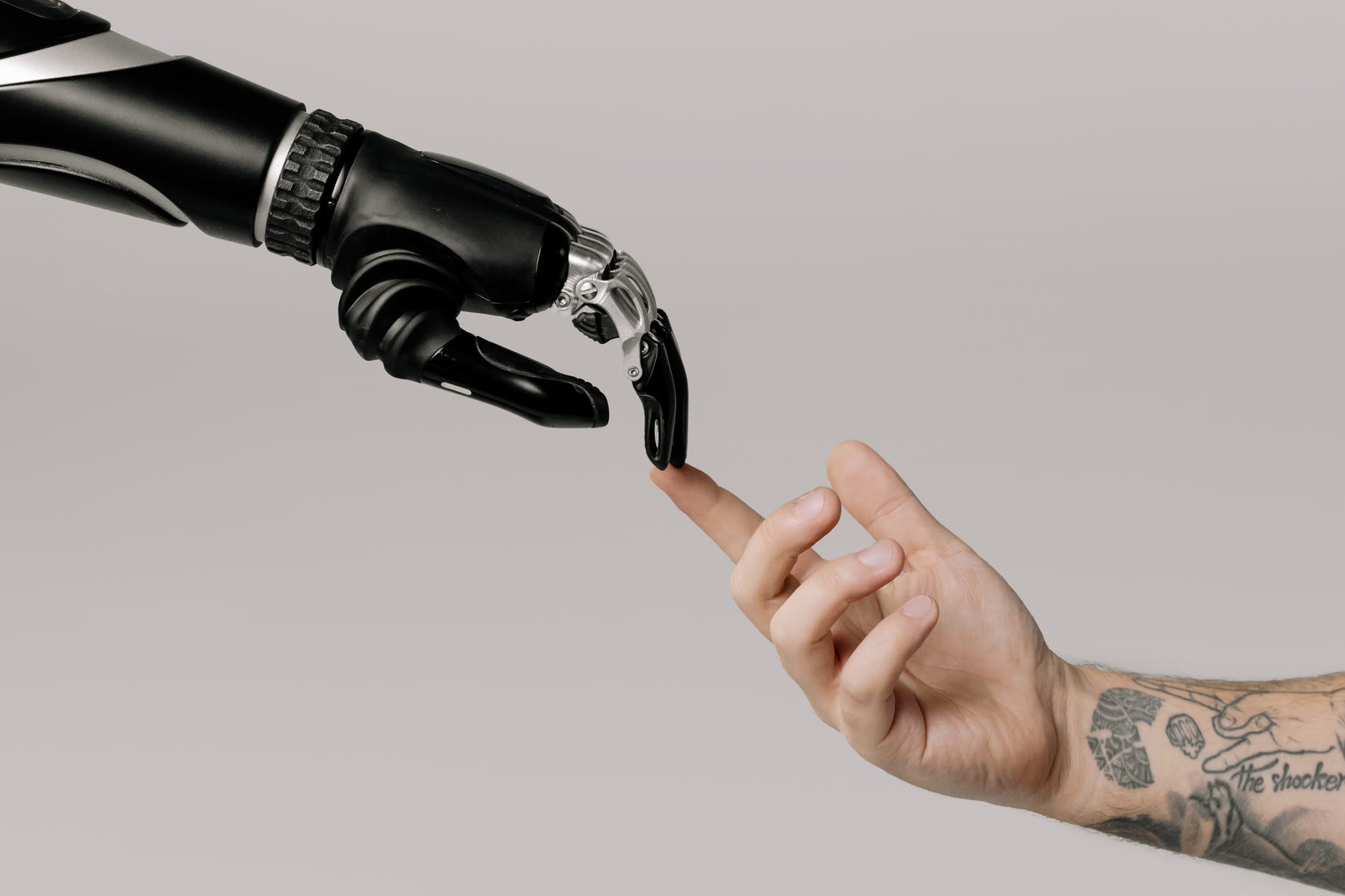
Photo by cottonbro on Pexels.com

Back in college my major was Polymer Science. Plastics, resins, that sort of thing. Even so, it was deemed necessary for undergrads in technical fields to gain some exposure to computers and programming.

Bear in mind, this was still early days in the computer revolution. Personal computers did not exist, nope, not so much as a Trash 80, though the Apple I was already on its way. What passed for a small computer was a DEC PDP-11, about the size of a large filing cabinet. Paper tape. Punch cards, which were bloody awful. Later, if you were lucky, a dumb CRT terminal. If you weren’t, a paper teletype machine. Our campus system was a XEROX mainframe (Sigma 9), 64K main memory (that’s K, not G or even M). The system took up an entire (and very large) room. Have I dated myself well enough? I should say so.

I knew nothing then, thinking computers were something almost magical a la Star Trek. Not these computers. You had to tell them everything, and I do mean everything, in precise instructions, in order, and they would do what you told them and nothing else. Problem was, what you think you told them wasn’t always what you actually told them, and since we were the last generation running batch jobs it sometimes took a long wait before you knew you’d messed up. They were, as the “elves” in charge of the Sigma referred to them, “very fast idiots.”

I loved it. One of the biggest regrets of my misspent youth was I didn’t change my major in my first year. Regardless, cut to the present. Narrow AI is progressing by leaps and bounds and used everywhere (not always a good thing); general AI is either imminent or impossible, depending on who you ask. I’m taking online classes in machine learning because I can and I want to.

My last lesson was was on gesture recognition. You film yourself on a webcam, and using prefab learning model libraries, teach the computer to recognize a human hand. For practice we created an updated version of Pong, only this time you point at the top of the screen and the computer has to know to put the paddle where you’re pointing to intercept the ball. So far so good, only mine was creating a paddle when my hand wasn’t even in the shot. Took me a moment to realize why: it was interpreting the headstock of my Peavey Predator hanging on the wall as a hand.

Still doing exactly what it’s told, if not exactly what you intended. Still a very fast idiot. I’m not holding my breath on that general AI thing.

Sometimes You Just Gotta

Photo by cottonbro on Pexels.com

As I’m sure I’ve mentioned before, I’ve been taking a self-paced online machine learning class in my abundant, nay even copious, free time. Not that I’m contemplating a career change or anything. I’m just interested in AI and want to have a better understanding of what it is and isn’t, what it can and cannot (yet) do.

The course has been fascinating and a little scary at times, both because of the subject and my rusty coding skills. But the last lesson was a bit of a mental hotfoot for an entirely different reason. We’ve moved into facial recognition tools to (you guessed it) identify people from photographs and video. To identify from video we had to use ourselves as test subjects, which involved using a webcam to take a selfie video and teaching my computer to recognize me and draw a rectangle around my face in real time to prove it. Weird but no more than that.

But then….

Next task was using a set of photographs of known persons to train the system to recognize them, then compare those to a series of unknown (as in unidentified) pictures. Pretty straightforward by comparison, with just one stumbler: to avoid copyright and privacy issues, we were using pictures of politicians and public figures. Once the figure(s) in the pictures were identified, we had the system display them onscreen with a rectangle around their faces and their name.

I think you can see where this is heading.

While there are many political figures I disagree with strongly, there is one I cannot even look at without throwing up in my throat a little. I will neither confirm nor deny the identity of this person, but needless to say, they were in there. The program found them, and displayed them as ordered with the aforementioned rectangle and name.

Funny thing about the rectangle command, though. Among the parameters there is one to control the line thickness. 1 for thin, 2 for thicker, etc. However, using -1 as the parameter draws a completely solid rectangle, obscuring the face entirely.

Acid reflux is bad on your throat, after all. It’s not politics, it’s a health issue.

Plot Bombs

I don’t remember where I first heard the term “plot bombs,” but I immediately understood what they were. They’re sort of like land mines, laid down in either a previous text or an earlier point in the current one. And then the reader hits them and perhaps stop for a moment to think, “Oh, so THAT’S what <blank> was all about.”

It can be a little more refined than that, but it’s the same principle, which I just ran across from the writer’s perspective. One of those multiple cases where my subconscious is clearly smarter than the rest of me. Those who have read Black Kath’s Daughter may remember a rather unpleasant creature called a craja. Marta thought she understood what they are, and the future danger she was in of becoming one.

In the scene I’m writing now, I was going to show Marta that she was entirely wrong about the craja. In preparation for writing it, I was referring back to their original appearance to make sure I was getting the details of my own creation right (happens all the time in a series).

So what did I find? I find that, way back then, the Power Amaet had already told her what a craja really was, and Marta, perhaps partly due to her loathing of Amaet, just wasn’t listening. In short, she’s about to find out what she already should have known from the beginning. All that worry…not exactly for nothing. Definitely something, but not the something Marta thought it was. Sure, I knew what they were, but I had no memory of the fact that Marta should also have known.

Will be something of a shock to her when she realizes this.

Something of a shock to me already.

For those already present, I’m on Pinterest now. If you’re inclined, come check me out there.

The Local Scene

The book cover above really has nothing to do with anything, except I’m a fan of both Andre Norton AND George Barr. Some people complain that Barr’s illustrations never looked like real people. To me that was a big part of his appeal as an illustrator. There was always an otherworldly quality to his art that set the mood for the books he illustrated. In short, it worked.

I recently made a trip to Keaton & lloyd Bookshop, an indie bookstore located in Rome, NY, for an open mike reading. Mike Cicconi was the emcee, and a member of our flash fiction group. He has a great booming voice that seldom needs a mic and kept things running smoothly despite the fact that about forty people were reading altogether. Time management counts.

Once the readings were done I was neck deep in the bookstore. It’s been a while since I’ve been in a really good one, and came away with a fair haul, mostly of books I’ve wanted to read but haven’t managed yet, to my shame: Howls Moving Castle by Diana Wynne Jones, The Bards of Bone Plain by Patricia A. McKillip, Tamsin by Peter S. Beagle, and Neverwhere by Neil Gaiman. I’m looking forward to a good time.

If you’re ever in Rome, NY, be sure to stop in and meet the shop cat.

Sacred Spring for Spring

Kateri Tekakwitha

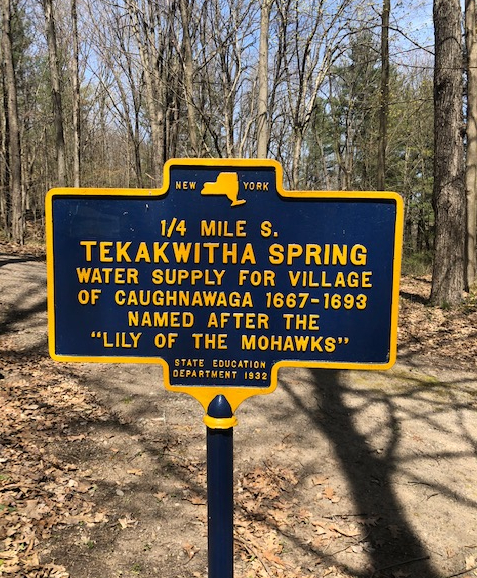
The lady shown above in the not-great statue was a 17th century Native American named Kateri, of Algonquin-Mohawk heritage. First Reader and I took a day trip out to the countryside near Fonda, NY, to visit a sacred spring associated with her. Whether the spring was sacred to the Mohawks is a separate question. It was originally the main water supply to the village where she lived for a time, as shown in the sign below.

Regardless, its sacred status was established once Kateri was made a saint, the first indigenous saint created by the Catholic church in 2012. By tradition she was baptized in this very spring. She was an early convert to Catholicism among the Mohawks and apparently used that fact to argue against an arranged marriage she didn’t want. After that she walked 200 miles to a Jesuit-run Native American Mission near Montreal, Canada, to make sure she didn’t get married. The spring itself is a much easier walk once you realize it is located some distance from the main complex dedicated to her on HWY 5 and on a separate road. The spring is in a wooded area near the original location of the village, now marked as an archaeological site, down a gorge apparently carved out by the spring itself over several thousand years of existence.

The spring still runs, though it was barely a trickle at the time we visited. The area around it is beautiful, and the hillside is covered in Trilliums. A few were in bloom, shown in the (unfortunately not great) picture below.

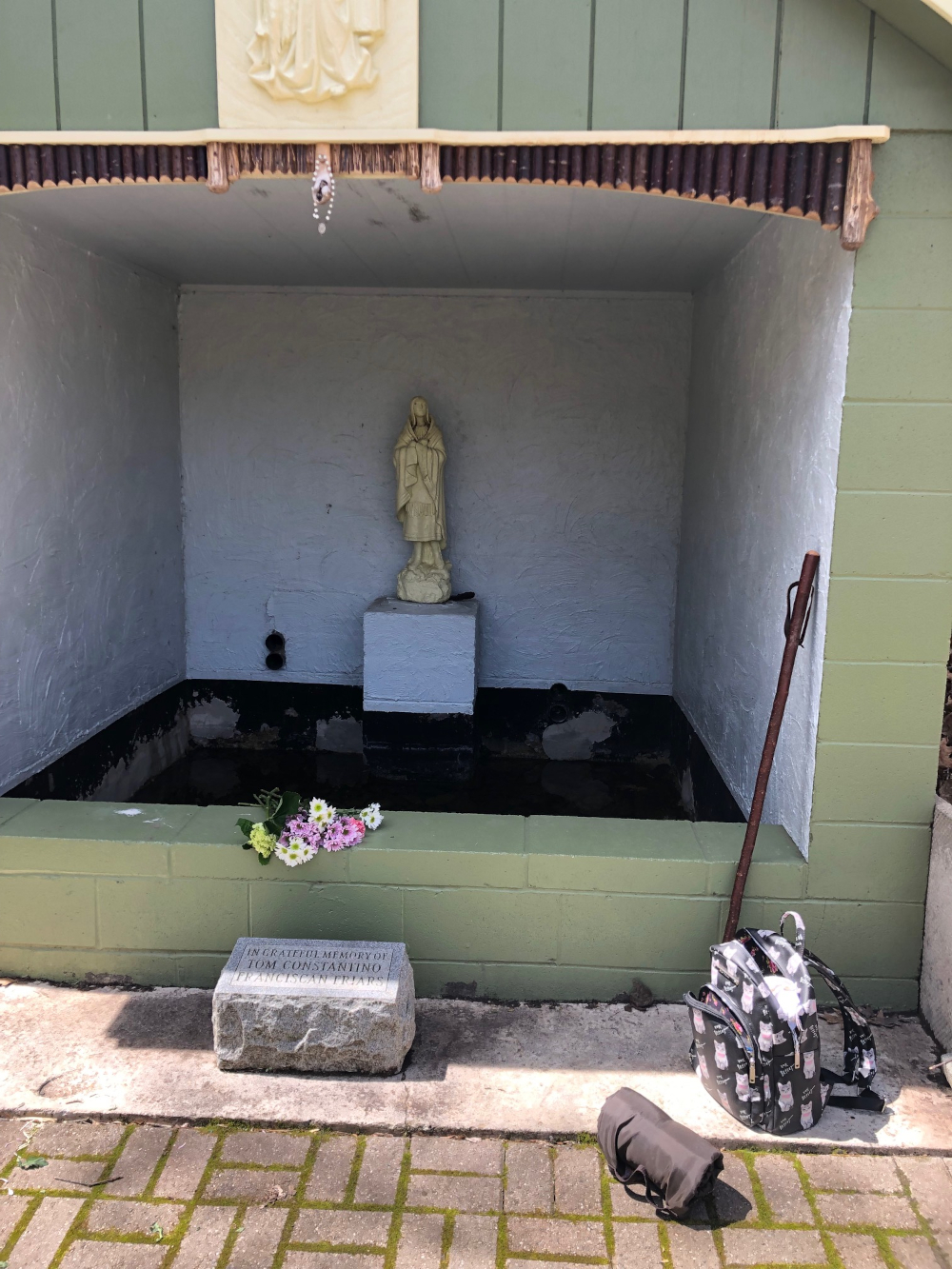
Since Kateri is a saint, the spring has a shrine built over it as shown below. The water runs through an artificial basin, under a viewing platform, and out finally to the gorge below.

Worth the trip for the nature hike alone. And the AI tree identification app on my phone got a workout.