Sacred Spring for Spring

Kateri Tekakwitha

The lady shown above in the not-great statue was a 17th century Native American named Kateri, of Algonquin-Mohawk heritage. First Reader and I took a day trip out to the countryside near Fonda, NY, to visit a sacred spring associated with her. Whether the spring was sacred to the Mohawks is a separate question. It was originally the main water supply to the village where she lived for a time, as shown in the sign below.
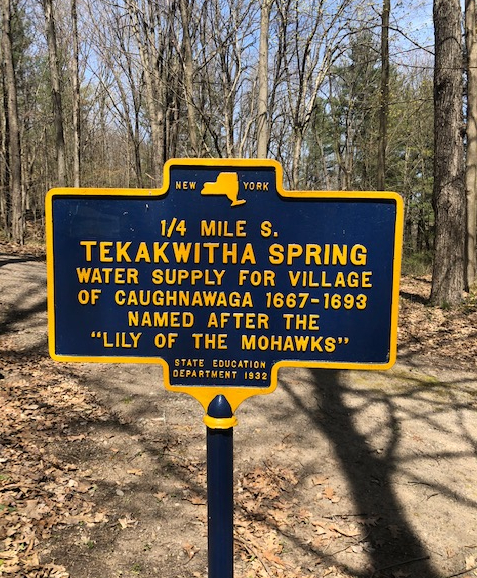
Regardless, its sacred status was established once Kateri was made a saint, the first indigenous saint created by the Catholic church in 2012. By tradition she was baptized in this very spring. She was an early convert to Catholicism among the Mohawks and apparently used that fact to argue against an arranged marriage she didn’t want. After that she walked 200 miles to a Jesuit-run Native American Mission near Montreal, Canada, to make sure she didn’t get married. The spring itself is a much easier walk once you realize it is located some distance from the main complex dedicated to her on HWY 5 and on a separate road. The spring is in a wooded area near the original location of the village, now marked as an archaeological site, down a gorge apparently carved out by the spring itself over several thousand years of existence.

The spring still runs, though it was barely a trickle at the time we visited. The area around it is beautiful, and the hillside is covered in Trilliums. A few were in bloom, shown in the (unfortunately not great) picture below.

Since Kateri is a saint, the spring has a shrine built over it as shown below. The water runs through an artificial basin, under a viewing platform, and out finally to the gorge below.
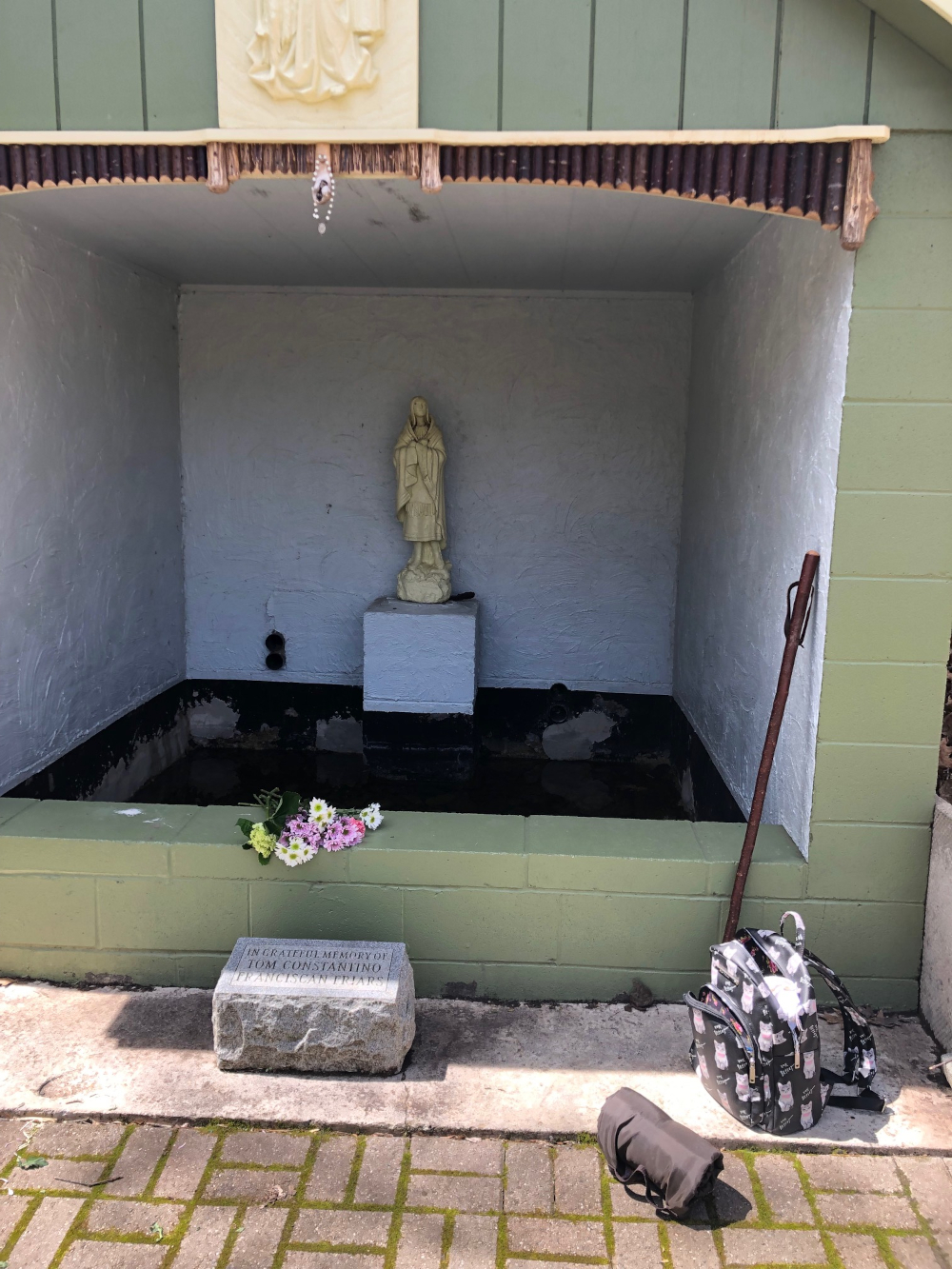
Worth the trip for the nature hike alone. And the AI tree identification app on my phone got a workout.
April Really is the Cruelest Month

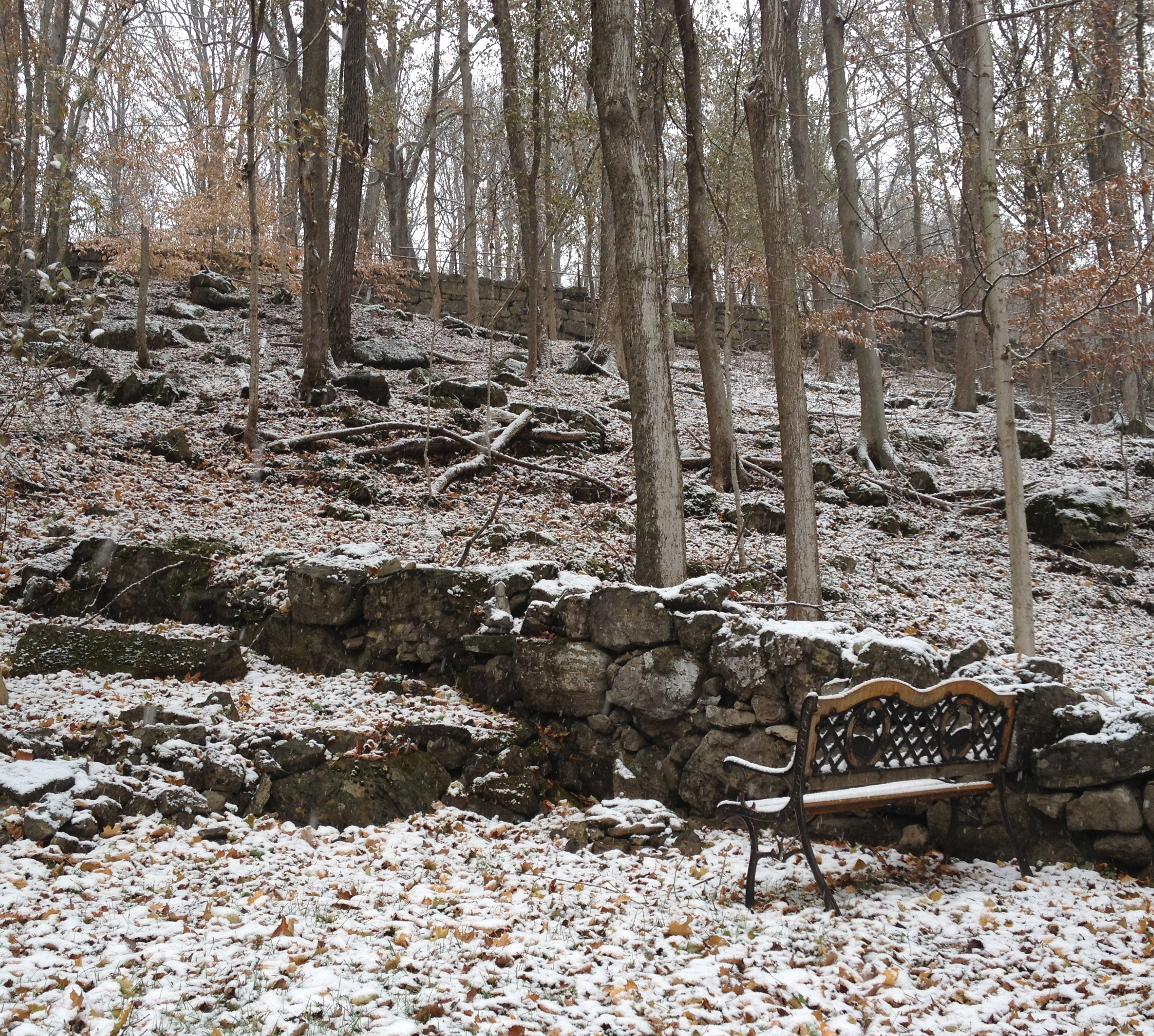
This shot from a few years ago was pretty much what the hillside looked like just a few days ago. Today? Sixties, sunny, and warm…if a little breezy. So it was all hands on deck to clean up winter debris, fallen limbs, leaf piles, etc., before it either a)rains or b) turns cold again.

In short, I’m knackered. I’ll try to do a proper post after I’ve had some rest.

For Whom the Bell Tolls

It snowed in bands yesterday all day. That is, we’d have 20-30 minutes of bright sunshine followed by the same of either snow or sleet. Tonight they’re predicting an actual snowstorm, maybe 5-11 inches. None of yesterday’s snow stuck because, well, April. After tonight, we’ll see.

My uncle Jimmy’s service is today, and I won’t be able to attend. He passed away in the wee hours of Thursday morning. He must have been in his eighties by then but he never seemed old to me. He was the “fun uncle,” to borrow the term from “the fun aunt.”(Not to be confused with the “funny uncle,” which is another thing entirely). Always a bit of a kid himself. (Our aunt loved to tell the story of the neighborhood kids coming around and asking if “Jimmy could come out and play.”) Always looked forward to my aunt and uncle visiting when I was growing up. Uncle Jimmy usually found interesting and fun things to do when he wasn’t off hunting or whatnot. He could even make chores less of a trial, though an incident with a botched dismount from a Tarzan swing once left me with two sprained wrists. It was worth the price.

Also, my father’s second wife passed away last week. We had…a complicated relationship, to the extent that we had one at all…mostly when I lived with them briefly while attending Jr. College before Southern. Interesting times.

No need for condolences, or rather I’m not the one who needs them. Or to again fall back on the wisdom of Captain Cloud:

“Time’s a trip, man.”

Even if it is one-way.

Observations on the Good Neighbors

Anyone with an interest in either the literal or the more general “fairy tales,” specifically writing them, needs references. For one thing, a good reference is chock a block full of story ideas waiting to be discovered. For another, and just as important, they help you avoid the Dunning-Kruger Effect of thinking you know more about a subject than you actually do. So with that in mind, I’m going to list my own top five references for information about fairyland (in the very broadest sense) and legends.

Number 1, as should be obvious, is An Encyclopedia of Fairies: Hobgoblins, Brownies, Bogles, and Other Supernatural Creatures by Katharine Briggs, Pantheon Books, 1976.

As far as I’m concerned, this the Bible on the subject. I’ve lost count of the story notions I’ve gleaned from it, and if there’s a supernatural denizen of the British Isles and Ireland that’s not gotten its due somewhere inside, I’ve missed it. It not only described what is believed known about such creatures, but includes at least some stories/foklore surrounding them to place them in proper context. It’s not going to say much about, say, kitsune, but what it covers it covers very well.

Number 2: A Field Guide to the Little People, By Nancy Arrowswmith w/George Moorse, Hill and Wang, NY, 1977.

This book goes a little further afield, with stories from Britain, Ireland, Russia, Scandinavia, Italy, Germany, etc. Like Briggs’ book, Arrowsmith includes illustrative stories about each creature, and divides the book into sections concerning Light, Dark, and Dusky folk, depending on their temperament. It is not as comprehensive as Briggs, but far wider reaching and a great complement. If I want to get information on a folletti or rusalka, this is where I go.

Number 3: The World Guide to Gnomes, Fairies, Elves, and Other Little People, Thomas Keightly, Crown Publishers, 1978, reprint of 1878 edition.

A bit more archaic in style but covers well what it does cover, mostly Persia, Scandinavia, Germany, Ireland and Britain. Again, illustrates the folklore of the individual creatures rather than giving a simple description. A good book to get lost in.

Number 4: A Field Guide to Demons, Fairies, Fallen Angels, and Other Subversive Spirits, Carol K. Mack and Dinah Mack, Henry Holt, 1998

Don’t let the title fool you. “Demons” in this context mostly refers to ancient spirits and gods which were demoted when later religions moved into the area. Sometimes fairies suffered the same fate, but the book does try to distinguish between the two. Not as exhaustive as the earlier books, but covers an even broader swath of the supernatural, including creatures from the Middle East, Asia, Australia, South America, etc. If what you’re looking for isn’t in any of the previous references, this is the place to go.

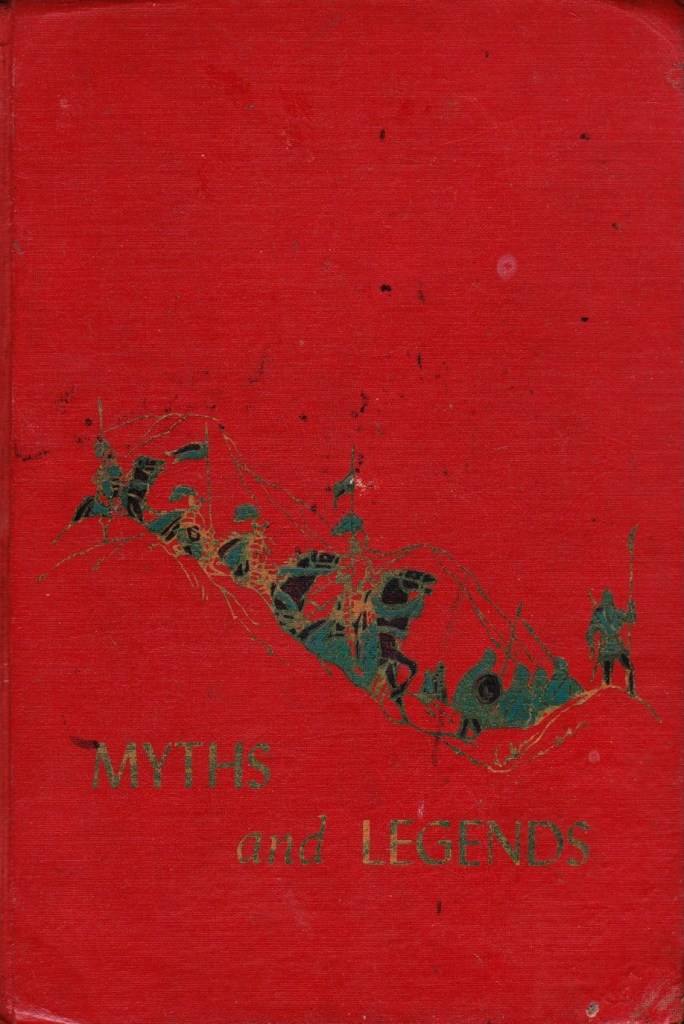
Number 5: The Children’s Hour, Volume 8: Myths and Legends, Marjorie Barrows, Editor., Spencer Press, 1953 edition.

I apologize for the poor quality of the scan, but it’s an old, well-read and well-loved book. Likely hard to find but I’m including this because it’s still a useful reference, and is exactly what the title describes. It’s a compendium of folklore and stories from around the world, including the New World. There’s Paul Bunyan and John Henry, tales from Africa, tales from Greek Legend, Robin Hood, The Apples of Iduna from Norse legend, King Arthur, Cuchulain, The Song of Roland…you get the idea. This is the book is that gave me an early love for the myths of the world. You can see where that led.

I regret nothing.

Where It’s At

All right, full disclosure. If it isn’t already obvious, the fourth and final volume of The Laws of Power series is taking longer than it probably should have. I’ve written some books in as little as three months, which is blazing speed for me. A year or less is more normal. Then again, I know some people who can write one in a week. On the other hand, the first novel I ever wrote took about five years. Maybe because I didn’t know what I was doing.

I still don’t know what I’m doing, but have since learned this is not an obstacle. You learn as you go, and by the time you’re done, you know how to write that book or that story. Then there’s the next one.

All by way of saying I’ve been going by fits and starts, and sometimes there were days when I couldn’t even look at the thing. For the sake of my own sanity, I finally had to ask myself why, and the answer was obvious:

I didn’t want to say goodbye.

The first story that eventually became the Laws of Power series was “What Power Holds,” published way back in 1994 in Dragon. These characters have been with me for a long time, even when I was writing other books and hundreds (yes, by now it is hundreds) of short stories. It was well past time to close the loop. I was able to do it (mostly) with Yamada, and Marta and company deserve the same consideration.

I will get there, assuming I’m not scheduled to drop dead beforehand. I am finally making progress at a more sustainable rate, losing the mental block. I appreciate those who haven’t lost patience just yet. I hope I can finish before that happens.

PS: I had done an excerpt or two here, but I’m not sure that’s the best idea. I was thinking of moving any future episodes to the more private mailing list. If you have an opinion on that, let me hear it.