 Where the heck was I? Oh, right. Heroes.
Andre Norton. For those too young or otherwise disadvantaged to know, Andre Norton was a prolific science fiction & fantasy writer who started publishing in the 1930s and continued to do so into the next century (at the moment, this one). I’m not going to even attempt to summarize her career, since this is about one of my writing heroes, and therefore this is Andre Norton in relation to me. If you’re curious, and you should be, a decent place to start is her entry in the Encyclopedia of Science Fiction.
Now then, here was the situation—I grew up in a very small southern town, and I was a reader. This was a problem for many reasons, not least of which being there was no bookstore within twenty miles and little money for buying books in the first place, and no library. Well, okay, the local school I attended had a library…only, for the first few years of its existence, students weren’t allowed to use it. And no, you don’t need to tell me how &%%# crazy that was. I know. In my one glorious term as a member of the Student Council, I complained about this in our very first meeting. The principal thanked us, and never called another meeting. He learned his lesson and I learned mine. The problem remained.
My only salvation was the county library eight miles away. Every week they sent out a bookmobile to the less fortunate towns in the county, mine included, and there…
Robert Heinlein
Isaac Asimov
Andre Norton
Ray Bradbury
Those were the top four authors I first discovered in the Newton County Bookmobile, so for better or worse, that mobile library is part of the reason I am the way I am. That’s a debate for another day. Yet as much as I enjoyed Heinlein and Asimov and especially Ray Bradbury, it was Andre Norton’s work that resonated the most with me at that time and place, at least partially because there was so much more of it.
I’m not really sure when I discovered that Andre Norton was born Alice Mary Norton. It’s not as if I was plugged into sf fandom or even knew it existed, but it was well before I graduated High School. I don’t even remember for certain which of her many, many books I read first. I believe it was either Galactic Derelict or The Time Traders. Not that it particularly matters. I got my hands on every single one of her books I possibly could, but to this day I have read barely a fraction of her work. So I’d like to talk about one in particular—Perilous Dreams.
This was from a time I was in college and buying my own books, when DAW Books was the place to be for the type of work I was looking for. John Brunner. Tanith Lee. Thomas Burnett Swann, for heaven’s sake. Those yellow spines and George Barr illustrations were practically a trademark. Perilous Dreams was a book about a woman who could move between worlds through dream. It wasn’t so much a novel as a series of linked novellas, given a handwave of genetic dispositions and technology, but basically pure fantasy and I read it that way.
This was a key book, and what I mean by that is this book was one of the ones that opened the door between the reader I was and the writer I was going to be. It resonated, as did The Gods Abide, Lord of the Rings and The Earthsea Trilogy a little later. It was one of the books that made me think about being a writer. Why? If I could explain that I’d be a lot smarter and wiser than I know I am. It wasn’t a perfect book by any means. Perhaps overly romantic, a bit disjointed. Don’t care and didn’t matter. Anyone who’d read both would know that my own A Warrior of Dreams, while certainly different, is me paying tribute to Perilous Dreams. You assimilate your influences and move on, sure, but it serves one best to understand what they are and who they are.
Andre Norton is one of mine.
Brief Update: Yesterday I passed the 60,000 word mark in Yamada Monogatari: The Emperor in Shadow, so I’m about 2/3 done, if I’m right about what’s left to tell, and I think I am.

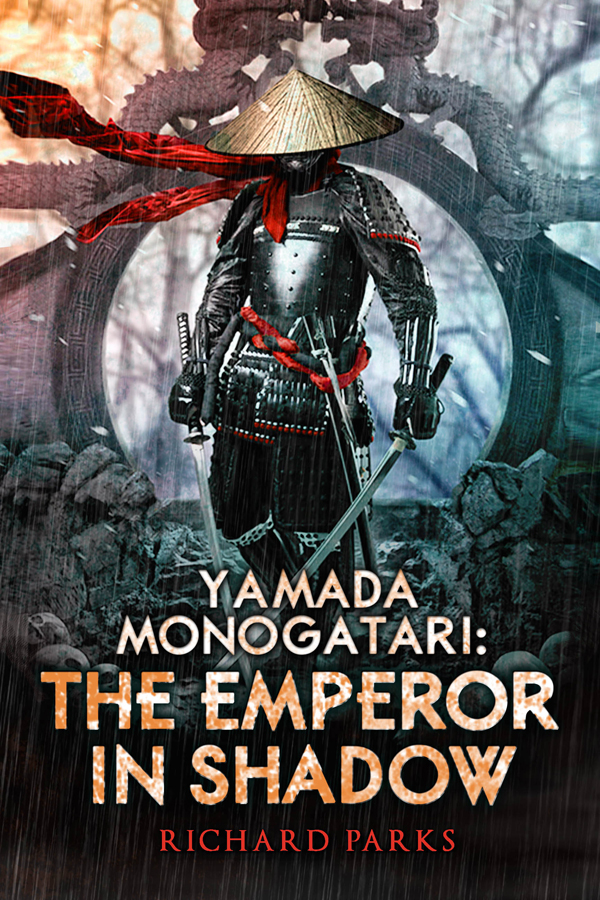 If I ever knew who said it first, I’ve long forgotten. But the phrase had reason to kick me in the butt again this week—“I don’t know how to write a novel. I only know how to write the last one.” Which in my case is profoundly true. Every book is different, even if they’re in the same series concerned with—mostly—the same characters. It is a different book, or else why bother to write it at all? Yet writing other books in the Yamada series does not help very much with this one. Ask me how to write The War God’s Son and I could tell you, because I’ve already done it. Ask me how to write The Emperor in Shadow and I’d have to say, honestly, I’m still figuring that one out. Worse, I’m putting obstacles in my way.


 Richard Parks