Unknown's avatar

About ogresan

Richard Parks' stories have have appeared in Asimov's SF, Realms of Fantasy, Fantasy Magazine, Weird Tales, and numerous anthologies, including several Year's Bests. His first story collection, THE OGRE'S WIFE, was a finalist for the World Fantasy Award. He is the author of the Yamada Monogatari series from Prime Books.

Recommended Reading

WRITING 02It’s that time again—the Locus Recommended Reading List has been published at their web site. If you don’t know what this is, Locus has more or less been the trade magazine of the Science Fiction and Fantasy field for a lot of years. Every year they do a recommended reading list of the previous year’s fiction in several categories – novels, YA, collections, novellas, etc. You can see the entire list here. This time, my story from Beneath Ceaseless Skies, “Cherry Blossoms on the River or Souls” is included. Keep in mind that the LRRL acts as the unofficial “long list” for the 2013 Locus Awards, which will be decided by the votes of readers and subscribers. And yes, it’s always nice when your work is noticed in a positive way. Or, really, noticed in a negative way. The trick is to be noticed at all.

If you think I’m kidding, I invite you to take a look at the Locus reading list for 2013. Notice something? Yep. There’s a reason it’s referred to as a long list. Do you know how one gets a story or novel or collection on the Locus list? Two of the magazine’s contributors/editors/reviewers have to agree it belongs there. Sometimes, I am told, if a person argues passionately enough, it only takes one. Now, think of all the stories/novels whatever that did not make the list. For example, Yamada Monogatari did not make the list for collection. I’m disappointed but not surprised. It wasn’t reviewed by Locus and so didn’t come to their attention in any meaningful way. But there’s a lot of work out there in that same boat. And a significant percentage of it is of comparable or even better quality to what did make the list.

All this is not to complain but simply to point out a very basic reality—not every piece of fiction published in a given year is going to get any significant notice, regardless. There is simply too much of it. Great from a reader’s standpoint—there’s an embarrassment of riches out there. Not so good from the writer’s perspective. It’s hard not to feel like one snowflake in an avalanche. I mean, you’re there, but so what? Almost no one would miss you, and certainly not that small group of skiers you’re aiming at. If you’re lucky, maybe you’ll graduate to the status of one drop in a bucket. If you melt really well.

Put away the knives and nooses, this isn’t about despair. It’s about why we do what we do. If you’re writing to please other people, stop that. Find something more useful to do with your life while you still can. If you’re writing for posterity, for your own sake knock it off. Seriously. Posterity doesn’t give a damn. I’ve pointed out this fact before and it bears repeating—most writers, good, bad, and brilliant, are completely forgotten within fifty years of their shuffling off their mortal coils. I’d even go so far to say that most of them don’t even make it that long. If you’re doing it to make a living and you’re accomplishing that, great. You’re one of a rare breed.  If you’re writing fiction for yourself, if writing makes you a better, saner human being than you would otherwise be, also great. I can think of few better reasons

Otherwise, you’re wasting your time.


Inaccurate, But True

Snow-Jan-2014That ½ inch of snow on the left represented major disruption yesterday, because this is the Deep South and we simply don’t know how to cope with cold weather. Or rather, cold weather that makes snow. For a lot of schools and businesses in the area, this represents a snow day. That’s right, schools were closed. Businesses went short-staffed. We’ll pause a moment for the readers above the 38th Parallel North to stop laughing. Continue reading

Muse and Writer Dialogues #11- Imping Perversely

FADE IN: Writer’s home office. You know the drill. WRITER is at the desk.
MUSE enters from somewhere. Since she has no corporeal form, egress and exeunt are rather flexible concepts to her. She appears to be wearing a sari.

MUSE: How was the kirtan last night?

WRITER: Great. The first chant was to Sarasvati, the goddess of the arts and music, and I need all the help I can get in both areas. It gave me an excuse to sing in a group where no one could hear me. Plus the instrumentation was much better than the first one.

MUSE: You’re just saying that because guitars were involved.

WRITER: How did you–?

MUSE: Don’t finish that, unless you’re a bigger idiot than I think you are. You were there, so I was there. It’s not complicated.

WRITER: Okay, fine. That was a bonus. All three of the performers were good, and two were playing classical style. I don’t get to see that very often. Amazed that I could tell that one of the chants was just a G, Cadd9, and A. I could probably play that.

MUSE: Should I even point out that you’re neither Hindu nor Jain?

WRITER: True, but what has that got to do with anything?

MUSE: Absolutely nothing. Not unlike what you’re writing now. Because, like your current project, the kirtan had little to do with getting the next novel written.

WRITER: Very funny. I just finished a novel, remember? I’m taking a break from them for a little while.

MUSE: Bull. You’re working on short stories instead because you’re being perverse.

WRITER: ?!

MUSE: Perverse in its correct, original meaning. Remember Edgar Allan Poe’s “Imp of the Perverse”?

WRITER: Yes, it was an imaginary creature that kept him procrastinating on writing projects until it was too late. Unlike imaginary creatures who bug me about writing. Well, I’m writing. Doesn’t apply.

MUSE: Wrong, as usual. You know you should be doing one thing, so you insist on doing something else entirely. It’s exactly the same. That the thing you shouldn’t be doing is also writing doesn’t change that fact.

 WRITER: Neither the next novel nor the short story is under contract, so how do you figure I “should” be doing one of them as opposed to the other?

MUSE: You said you’d work on the novel next. You’re not. That’s perverse.

WRITER: Merely contrary. And I will get the novel done, but right now is not its turn.

MUSE: That’s not the point. You’re not doing what you’d said you’d do. You broke a promise. To yourself, if no one else.

WRITER: True, but only to avoid breaking a greater one. The first one.

MUSE: ?

WRITER: I promised myself that, since I was never going to make a living doing this, I was free to write exactly what I wanted to write, when I wanted to write it. If I do anything else, I break that promise, and that one I’m keeping.

MUSE: Oh. That one.

WRITER: The ur-promise. I keep that one, or there really is no point to all this. Or you, for that matter.

MUSE: Hmmm, good point. Okay, but there are people who want to read that novel, you know, and have told you so.

WRITER: There are people who want to read this short story. They just don’t know it yet.

MUSE (sighs): You really are perverse.

WRITER: And damn proud.

FADE OUT.


Review – Way Station by Clifford D. Simak

1964 McFadden Ed.

Way Station – Clifford D. Simak, Doubleday, 1963 (Originally published in Galaxy Magazine as “Here Gather the Stars” in a two-part serial. Hugo Award, best novel, 1964. (Amazon).

The premise of Way Station is about as simple as it gets—alien races in our galaxy have long since solved the interstellar travel problem by means of a device that transports individuals instantly from one planet to another, and it doesn’t matter if that planet is in the same solar system or halfway across the galaxy. The trick is that the transportation signal degrades under certain conditions and so some jumps require a temporary stopping point where the transport signal can be renewed and the traveler sent on their way, thus the Way Stations of the title. Every Way Station requires a station keeper, someone who can run the machines and greet the travelers and make sure they are sent on their way properly. When the aliens expand into our spiral arm of the galaxy, Earth is the perfect place for such a station, but it needs a keeper. Galactic Central chooses a local, Enoch Wallace, a recent Civil War veteran. His home is converted into one such station, which provides for all his physical needs and is a safe haven from the outside world. As long as he remains inside the station, he does not age at all, and brief errands outside only take a few minutes or hours off of his lifespan. Over one hundred years later, Enoch is still on duty. Continue reading

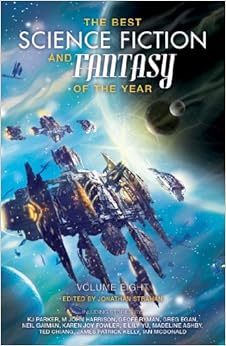
TOC – The Best Science Fiction & Fantasy of the Year: Vol 8

From JonathanStrahan.com.au. As always, it’s an honor to be in such company. As has already been pointed out elsewhere, a fairly large percentage of the stories are drawn from online sources, venues that didn’t really exist just a few short years ago. I don’t know if I’d call it a trend, but I do think it is significant.

•Introduction, Jonathan Strahan
•“Some Desperado”, Joe Abercrombie (Dangerous Women)
•“Zero for Conduct”, Greg Egan (Twelve Tomorrows)
•“Effigy Nights”, Yoon Ha Lee (Clarkesworld)
•“Rosary and Goldenstar”, Geoff Ryman (F&SF)
•“The Sleeper and the Spindle”, Neil Gaiman (Rags and Bones)
•“Cave and Julia”, M. John Harrison (Kindle Singles)
•“The Herons of Mer de l’Ouest”, M Bennardo (Lightspeed)
•“Water”, Ramez Naam (An Aura of Familiarity)
•“The Truth of Fact, the Truth of Feeling”, Ted Chiang (Subterranean)
•“The Ink Readers of Doi Saket”, Thomas Olde Heuvelt (Tor.com)
•“Cherry Blossoms on the River of Souls”, Richard Parks (Beneath Ceaseless Skies)
•“Rag and Bone”, Priya Sharma (Tor.com)
•“The Book Seller”, Lavie Tidhar (Interzone)
•“The Sun and I”, K J Parker (Subterranean)
•“The Promise of Space”, James Patrick Kelly (Clarkesworld)
•“The Master Conjurer”, Charlie Jane Anders (Lightspeed)
•“The Pilgrim and the Angel”, E. Lily Yu (McSweeney’s 45)
•“Entangled”, Ian R Macleod (Asimov’s)
•“Fade to Gold”, Benjanun Sriduangkaew (End of the Road)
•“Selkies Stories are for Losers”, Sofia Samatar (Strange Horizons)
•“In Metal, In Bone”, An Owomoyela (Eclipse Online)
•“Kormack the Lucky”, Eleanor Arnason (F&SF)
•“Sing”, Karin Tidbeck (Tor.com)
•“Social Services”, Madeline Ashby (An Aura of Familiarity)
•“The Road of Needles”, Caitlín R Kiernan (Once Upon a Time: New Fairy Tales)
•“Mystic Falls”, Robert Reed (Clarkesworld)
•“The Queen of Night’s Aria”, Ian McDonald (Old Mars)
•“The Irish Astronaut”, Val Nolan (Electric Velocipede)