Unknown's avatar

About ogresan

Richard Parks' stories have have appeared in Asimov's SF, Realms of Fantasy, Fantasy Magazine, Weird Tales, and numerous anthologies, including several Year's Bests. His first story collection, THE OGRE'S WIFE, was a finalist for the World Fantasy Award. He is the author of the Yamada Monogatari series from Prime Books.

Handy Man is…Doing the Best He Can

I took a personal day yesterday to work on a plumbing problem, and do the taxes. I think the taxes were easier, and I worked on those for about seven hours straight.

I often have to pretend, but the truth is that I just don’t have the DIY gene. I do have a nail gun. And a table saw. Only someone who grew up with me can fully appreciate what a scary thought that is. See, I was raised in a family where DIY was not a lifestyle choice but an absolute necessity. If you couldn’t buy it, you built it yourself.  If you couldn’t build it yourself, you did without it. If it broke, you fixed it. There were exceptions but not many, and this covered everything from military surplus jeeps to jon boats, from garages to storage sheds and workshops. 

My maternal grandfather and uncle were simply amazing. If, for whatever reason, they had decided that they needed a high-energy particle accelerator, by damn they’d have built a high-energy particle accelerator, and likely did it with whatever scrap happened to be handy.  Ok, maybe I’m exaggerating, but not by as much as you might think.  All by way of saying that, whatever that gene is that they had in abundance, they didn’t leave any for me. I am, no other word for it, a klutz.  I learned how to do a few things with great difficulty, but as a general rule I wasn’t allowed near power tools, and it was a wise policy. Carol, otoh, thinks I can do anything. I’ve replaced light fixtures and fencing, installed ceiling fans and laminate flooring, built retaining walls and box lids. Basic stuff. Once she wanted a rose arbor, so I designed and built one.  It was ok. It even stood up to the elements for several years. She thought it was great.

All I could think was that, if either my grandfather or uncle saw it, they would laugh themselves silly. And yet I consder, could either of them write a story? Novel? I don’t think so. So whatever gene I did get, I’ll take it. And make do for the rest.

Witches: Wicked, Wild, and Wonderful

Somehow I let the publication date on this one slip by me. 

Prime Books, March 2012 ed. by Paula Guran

“Surrounded by the aura of magic, witches have captured our imaginations for millennia and fascinate us now more than ever. No longer confined to the image of a hexing old crone, witches can be kindly healers and protectors, tough modern urban heroines, holders of forbidden knowledge, sweetly domestic spellcasters, darkly domineering, sexy enchantresses, ancient sorceresses, modern Wiccans, empowered or persecuted, possessors of supernatural abilities that can be used for good or evil—or perhaps only perceived as such. Welcome to the world of witchery in many guises: wicked, wild, and wonderful. Includes two original, never-published stories.”

Content (alphabetically by author):
“The Cold Blacksmith” by Elizabeth Bear
“The Ground Whereon She Stands” by Lean Bobet
“The Witch’s Headstone” by Neil Gaiman
“Lessons with Miss Gray” by Theodora Goss
“The Only Way to Fly” by Nancy Holder
“Basement Magic” by Ellen Klages
“Nightside” by Mercedes Lackey
“April in Paris” by Ursula K. Le Guin
“The Goosle” by Margo Lanagan
“Mirage and Magia” by Tanith Lee
“Poor Little Saturday” by Madeleine L’Engle
“Catskin” by Kelly Link
“Bloodlines” by Silvia Moreno-Garcia
“The Way Wind” by Andre Norton
“Skin Deep” by Richard Parks
“Ill Met in Ulthar” by T.A. Pratt (original)
“Marlboros & Magic” by Linda Robertson (original)
“Walpurgis Afternoon” by Delia Sherman
“The World Is Cruel, My Daughter” by Cory Skerry
“The Robbery” by Cynthia Ward
“Afterward” by Don Webb
“Magic Carpets” by Leslie What
“Boris Chernevsky’s Hands” by Jane Yolen(less)

It’s Better Than That

Late last night I was watching a rather obscure Japanese movie (though filmed in Hong Kong in 2007)  called Dororo. It’s based on a manga series by Ozamu Tezuko (he of Astro Boy fame). Here’s the pitch/teaser: “A female warrior who was raised as a man joins a young samurai’s quest to recover 48 of his body parts from 48 demons and to avenge her parents death.”  There’s a longer version, but it’s still a variation on this basic premise, and as the movie played I realized that I had a problem with the way it was pitched. It’s not that the pitch was inaccurate—as a capsule summary it covers the basics of what they movie’s about fairly well. The premise is, of course, ridiculous. No one’s going to lose 48 body parts (some fairly important like, say, the heart) and still survive long enough to be discovered by just the right magic shaman who knows how to replace body parts. Even in a pure fantasy like this one it stretched credibility past the breaking point.

Regardless, I didn’t come here to review the movie, as such. I am here to make the point that, despite the nonsense premise, despite the rather gruesome imagery of the pitch, I liked the movie quite a bit. Which was when I realized that I had a problem with the movie’s pitch itself. It wasn’t that, as I said, it was inaccurate. No, I think it’s mostly that it managed to be both accurate and very misleading. Why? Because the movie was so much better than that. The hero’s plight manages to be both grotesque and sympathetic at the same time. The heroine in her own way is as much damaged as the hero, and yet is just as heroic, plus by turns poignant, amoral, and laugh out loud funny. The cgi is a bit lacking at times, but it captures the esthetic of the Japanese monster tradition beautifully—the group soul ghost baby is almost worth the price of admission itself. And yet the pitch, brief as it has to be, conveys absolutely none of this. Pitches tell you what a movie/story is about and simultaneously tell you almost nothing.

Continue reading

Face Value

 I’ve been thinking about the concept of surprise as it relates to fiction and specifically the relationship between writer and reader. Readers like to be surprised, as a general rule, but it has to be the right sort of surprise. We’re all familiar with the iconic “Twilight Zone” story where the payoff is an ironic twist. That works in small doses, but do it time and again and it becomes too much like a parlor trick everyone’s seen once too often. The punch goes away and the surprise is no longer surprising. I’ve talked about ending before, and how it has to be the “right” ending for the story. The right ending will always have a sense of inevitability about it, whether the reader sees it coming or not. But is it really better if they don’t? And, if so, what can be reasonably sacrificed to make that happen?

This is the balance that concerns me, because I find it’s one aspect of storytelling that we have to deal with all the time. Fiction is a consensus illusion created between the writer and the reader. As a writer you craft a dream that the reader, for a while, shares. Yet their experience reading will never be the same as yours writing. They will never quite see the characters as you do, and they will interpret intent and meanings with their own perspective. That’s not a problem, that’s just the way the game works and all writers have to be aware of it. But the writer who goes for surprise has to be especially aware of and, in a sense, manipulate that perspective, and the primary tools are omission and misdirection. Continue reading

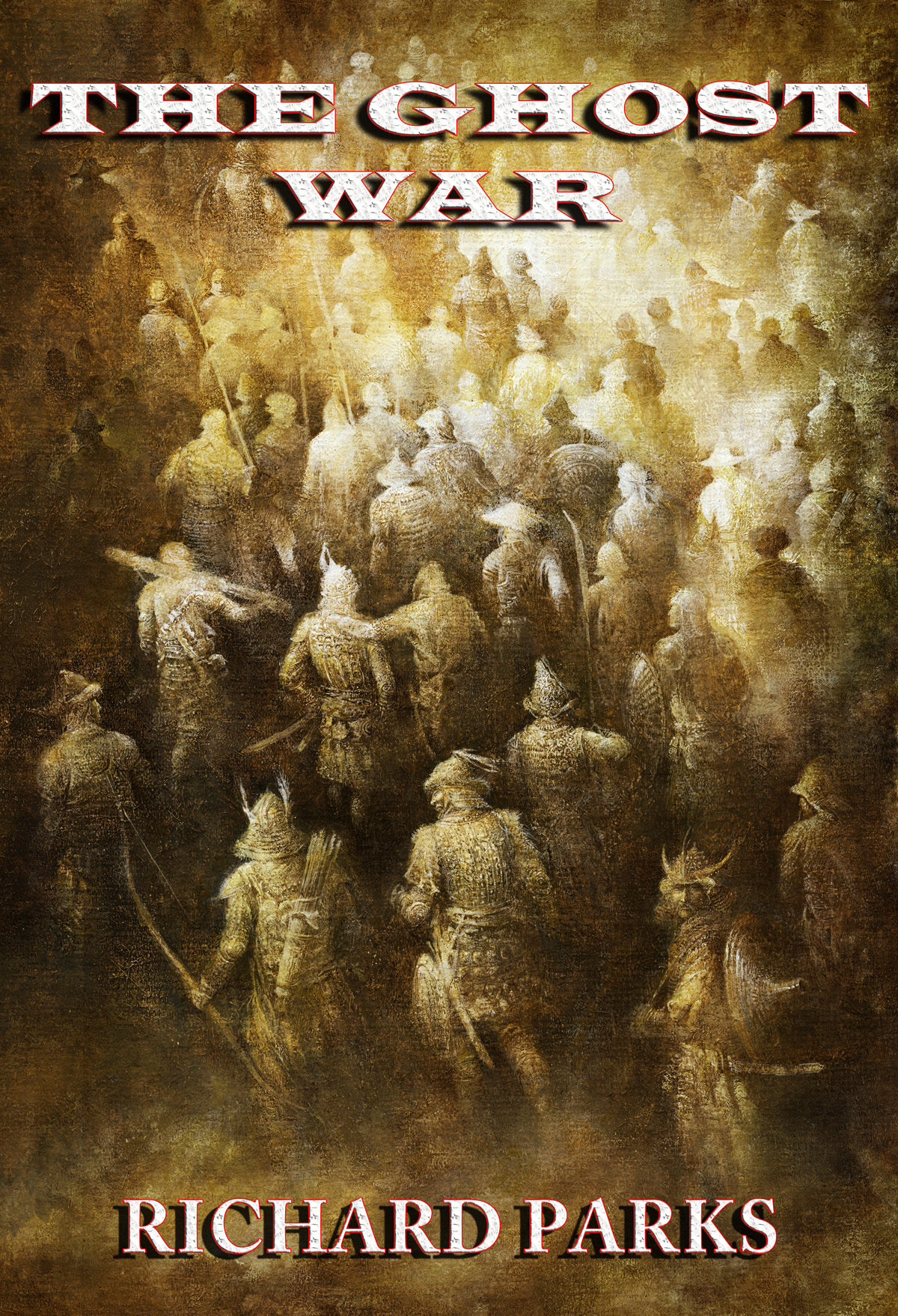
Working Cover

I had one more project to finish before getting back to the sequel to Black Kath’s Daughter. The working (and likely final) title is The Ghost War, and I’m not too far from done, just a few line edits and minor corrections left. It’s a stand-alone, which most of my novel-length work is, the Laws of Power sequence being the only exception so far. I know a few people are actually waiting for the next novel in the series and I promise I’ll get it done. In the meantime, have a look at the eerily appropriate working cover for the new project.