Unknown's avatar

About ogresan

Richard Parks' stories have have appeared in Asimov's SF, Realms of Fantasy, Fantasy Magazine, Weird Tales, and numerous anthologies, including several Year's Bests. His first story collection, THE OGRE'S WIFE, was a finalist for the World Fantasy Award. He is the author of the Yamada Monogatari series from Prime Books.

Words I Hate, Continued

Writers are among those weird groups of people who actually care about words. We’re a long way from the only ones, of course: Language professors, lawyers, English/French/Spanish/etc  majors…the point being that there are people who actually believe that words matter. How they’re used and misused, what power they have. So when I say, as I have before, that there are certain words I absolutely despise, understand it comes from a place of caring. You have to care about something in order to despise it properly. Works for hating something, too. As in the old illustrative exchange:

“He hates me!”
“He doesn’t hate you. He doesn’t care enough about you to hate you.”

I’ve already talked about “impacted” vs “affected.” Today I’m going to mention another one.

“Consumer.”

I really hate that word. Or rather, I hate the usage it’s been put to by every shill marketer in the whole damn world. Whenever some Conglomerate goes on the tv and pitches “Products for the discriminating consumer” I don’t picture a discriminating anything. I picture this mindless maw gobbling down every piece of crap thrown at it.

Do writers look at readers that way? I doubt it. While “consuming” might be a useful metaphor for a certain type of reader at a certain stage of their awakening(me included), it is literally not true. You read a book, anyone’s book or story, and the book/story is still there. Anyone could still read it. You can pass it on to another (and we love you if you do) saying, “You gotta read this.” Maybe that next person would become our customer/reader too. Readers have tastes. They either like your stuff or they don’t, given the chance to try it, but there’s nothing mindless about their reactions.

I’ll give farmers a pass because we really do consume their products, and bless them for their service. But then, except for the occasional farmer’s market, we rarely do this directly where I live. It usually goes through distribution and into a grocery store. Whose customers we are, not consumers.

I understand why “consumer” is a useful term for the average marketer. I know that’s how they want us to think of ourselves, which is why they say “consumer” rather than “customer.” I know that’s exactly how their customers are viewed. It’s easier to think of a mindless, indiscriminate consuming maw rather than people, who have quirks and want something better than is usually on offer. Sorry, but I am your customer, not your bloody consumer. Though if you keep pitching crap at me I won’t even be that. Fire is a mindless consumer. I’m not, and neither are the rest of us.

Forget that at your peril.

 

Walking the Tightrope

You know all those “author bios” you see when you read a story or book and have something like this pop up at the end?

“Johnny Authorboy is the author of many novels, of which he is the author. He likes cats and chocolate, but not together. He lives somewhere in Wyoming, but he’s not sure where because the road isn’t marked.”

Or maybe: “Elizabeth Page-Turner is the author of the bestselling “Empirical Empress” series for Goshwow Books. In her spare time she collects celebrity belly-button lint.”

Yeah, those things? We have to write them ourselves. Continue reading

“Typical”

In these divisive times, most people of whatever political bent do tend to agree on one thing—other people’s dreams aren’t that interesting. Proper dreams are full 3D VR experiences, complete with touch, smell, sound, color, emotion, the full range of human sensory experience. Telling the dream loses that, unless you’re a good enough writer/storyteller to shore up the gaps, and even then you’re down to something like “I flew from one mountaintop to another! It was amazing!” And the listener nods politely and changes the subject.

So I will tell you about a dream I had and immediately change the subject. Sort of. The dream, in its odd way, was the subject. It was a fairly prosaic dream which I will not embellish. Essentially, there was a writer’s group I was part of and we were looking for a place to meet. We eventually found a venue where dozens, if not hundreds of writers were already meeting, so we joined in. There was an invited Guest Speaker. I was listening to what he had to say, or trying to, because every other person in the room immediately broke up into small, intimate groups of five or six and started discussing their latest works. One woman was even narrating her most recent story via interpretive dance and method acting. No one was listening to the speaker except me, and I just thought, “Well, that was rude.”

Once awake again, I revised that comment to one word­­—“typical.”

What I was seeing in the dream was an overt example of writerly ego out of control. Never mind you. What about me? It’s sometimes called Writer’s Arrogance (WA) and it’s not always a bad thing. Sometimes it’s essential. Especially in the white heat of creation, where you must believe, to the bottom of your soul, that you’re making something worth another person’s time to read. Not to mention that it takes a great deal of self-confidence to face down the other writerly emotion, Crippling Doubt (CD). Which is likewise not always a bad thing, especially when it comes time to revise. There CD has to edge out WA so you can take a good hard jaundiced look at what you’ve written, and pinpoint the flaws so you can fix them. However, CD cannot be allowed to beat WA during the creation process, or nothing gets written. There’s a balance, or should be if this thing is going to work.

The dream was an example of WA run amuck. No one in the dream was capable of listening to anyone except themselves. I’ll give the Guest Speaker a pass because he had been brought there specifically to talk about his work. Only no one except the “I” of the dream was listening. Hmmm. According to several psychological theories, everyone in a dream is just a reflection of the dreamer. All those aspects of me, not listening? Then again, if the Speaker was just me talking, maybe I wouldn’t listen either.

There could be a lesson there, or not. I don’t pretend to know. Maybe I should listen more and talk less. Or at least not be so rude about it. It’s a thought.


Patterns

On my desk is a picture (artist’s rendering, duh) of Amaterasu, the Japanese goddess of the sun. I keep it there because it’s a cool picture, but also because, in very general appearance, it reminds me of the character Mei Li, who is the Chinese snake-devil (or snake-spirit, depending on the translation and your point of view) in the series of stories I’m working on now. So how did I get from a Japanese sun goddess to a Chinese snake-devil?

Good question, to which I do not have an answer. Different origins, different—though distantly related—cosmologies. Yet I can glance up from working and think, “Yep. That’s her.” Even though it isn’t. Yet the picture helps me connect to the character. I do not know how this works, but I think it has something to do with patterns.

I’ll take for example something not related at all, except it is. I don’t have a very good handle on time at the moment, so late every evening when I’m too ragged to write, I try to put in at least ten minutes or more guitar practice. Since I am a slow study where music is concerned, I have to spend a lot of that interval on basic things like switching chords cleanly and in time. Which is a lot easier when you grasp how different chord patterns are related, say when you realize that a G major chord and a Cadd9 are the same shape (hand held in the same position) the only difference being what strings the middle and index fingers are on.

It’s sort of like that. Amaterasu and Mei Li are not the same (obviously), but in one I see elements of the other. I have never to my knowledge based my understanding of a character’s appearance on a picture of someone else. This time I did. Because…patterns?

It’s as good an explanation as any.

Freeing the Ladybugs

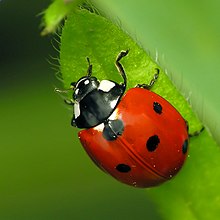
Ladybugs don’t belong inside. Nothing I’ve read so far reports on this habit of theirs, but I’ve noticed that sometimes Ladybugs apparently find a way inside a house to lay eggs (or the larvae crawl in), and then, when these hatch, can’t find their way out again. Too often I find their sad little dried out exoskeletons in a windowsill, inches away from freedom and whatever they had planned for their lives. Eating aphids? Probably. Spawning? Surely.

The last few days have involved painting the area around certain windows in preparation for removing the nasty old blinds that came with the house and replacing them with clean modern shades. Which has dictated a lot of time futzing around windowsills, and finding the ladybugs congregating there in twos and threes or whatever. So I have to pause whatever I’m doing and free them. I used to do the same thing at my old place of work, again in the spring when they start hatching out. It’s kind of annoying, really, and the ladybugs aren’t usually cooperative, but I have the compulsion. I probably don’t do a lot of good. Maybe it does no harm.

I think of the story of two people walking along a beach where thousands of starfish have been washed up in a storm. As they walk, one paused to pick up a still-living starfish and toss it back into the sea. “Wait a minute,” says the other. “There are many thousands of starfish here. Do you really think that made a difference?” The first just shrugs. “Sure made a difference to that one.”