Unknown's avatar

About ogresan

Richard Parks' stories have have appeared in Asimov's SF, Realms of Fantasy, Fantasy Magazine, Weird Tales, and numerous anthologies, including several Year's Bests. His first story collection, THE OGRE'S WIFE, was a finalist for the World Fantasy Award. He is the author of the Yamada Monogatari series from Prime Books.

Well, That Was Just Careless

After getting a couple new submissions under my belt I thought perhaps I should take another stab at organizing my story files a little better. I tended to let that slip a bit when I was concentrating mostly on novels, but since I want to do both, it doesn’t help to neglect one in favor of the other. Anyway, I was going over my submissions files, cross-referencing with my finished stories and noticed something odd.

I have lost a story. Completely. Gone. Poof.

I have no idea of how I managed this feat. I’m usually pretty careful about keeping copies and backups and such. I did have that one scare last year when I was certain I’d lost everything, but fortunately it didn’t turn out that way when I found, you guessed it, a current backup, so I was at least reasonably certain that the story I was missing could be found in my files.

Nope.

I knew I wasn’t imagining writing that story. I wrote the bulk of it during a meeting of my old writer’s group. It wasn’t anything earth-shattering or such; it was just a fun story that I hadn’t done anything with as far as subs go, since I couldn’t think of the right market for it. I’m still not sure there is one, only now I’ll have to rewrite the thing–literally. I can do it. I remember enough of the plot and tone so that I’m at least reasonably confident I can recreate it. Still, more work for something that should already be done.

In penance, I’m putting up a new Story Time. I was about due anyway. This one is “A Pinch of Salt” from MYTHIC #2, edited by Mike Allen.

Spring Ritual

This morning I spent a couple hours at a nearby auto shop doing the spring ritual—swapping out the winter tires for the summer tires. So now my wheels are studless and the winter tires are bedding down in the garage until next November. I look around at all the snow remaining and wonder if this was a good idea, but the rules are “no studded snow tires after March,” so we do what we have to. Come winter, though, you can bet I’ll have the snow tires back on. I’m a southern boy. I KNOW I do not yet grasp how to drive on ice, so I need all the help I can get.

Last night I finished the rewrite of the second story in the new series and sent it out. No idea yet what the third will be, but it’s out there. I’ll find it. It would be good for the series if I can place them all with the same publisher, but time will tell. There’s a limit to how many stories by the same author any given market can absorb in a year, and if I get on a tear I could easily overwhelm it. I remind myself there are other projects that need attention. None of which will mean a darn if these are the stories that want to be written now; I’ve learned to just go with it when that happens, even if, professionally, it may not be the wisest course.

Regardless, now that the first is written and sold and the second is complete, I feel confident enough in its reality to say this much about it: Set in China (or rather, what will one day be China) during the early Warring States period, about 500 BCE. I’d been thinking about these characters for a while, but never got a good handle on how to tell their story until now. I’m a little excited. Once the first has been scheduled I’ll say more, and more to the point, where to find it.

I’m Late…Again

I’m late again. Yesterday was filled with getting taxes finished and dealing with a long-overdue ophthalmology appointment. (Odd fact—I have better close-up vision in my left eye than even bifocals could give me. The right…not so much). But apparently I’m not going blind anytime soon, which is a good thing.

I need my eyes to do things, like look over old blog posts to remind myself of subjects I’ve already covered…and covered…and probably covered again. That’s the problem with interests and pet peeves and such. You tend to repeat yourself. Boring, for you and everyone else. Plus it’s easy to see how badly certain subjects will age. I just spent a few minutes on a report of my hunt for a new agent several years ago. Back then I was convinced I needed one, even though I’d been through three very reputable agents who hadn’t been able to do a thing for me. I only started selling novels when I forgot about the agents and just did it myself. So that was a lesson hard learned, but all water under the bridge.

One subject that apparently has not aged is the subject of a writer’s “odds.” It came up again just a few days ago when a well-respected editor blogged about it and I read that and thought “Wow. Déjà vu.” Does it still need to be said? Apparently, so once more from the writer’s side which, oddly enough, is pretty much the same as the editor’s side. This applies to novels as well as short fiction, but my more immediate examples are from the short story side. It goes something like this: new writers trying to break into one of the major short story markets (and the specific ones vary, depending on the time and the writer’s interests) look at the submission/acceptance ratios and get all discouraged. A publication might get anywhere from 500-1000 submissions a month, from which they accept maybe three. So your odds of being one of the three are either 1 in 167 or 1 in 333, depending on how many subs the market got that month, right?

Wrong.

Those odds would only be accurate if everyone submitting a story had an equal shot at one of those three slots, and the fact is they don’t. Most stories are rejected out of hand for a multitude of reasons: wrong length, wrong genre, general incompetence, misspellings—or worse, being autocorrected to the wrong word. Sloppy work. Their odds are never higher than zero.  Maybe about fifty stories a month get serious consideration, and those are the real odds you have to beat, about 1 in 17.Even those odds don’t matter if your story is just what the editor is looking for, in which case the odds are 1 in 1.  Provided, of course, you can get your story past the first hurdle. Right length, right market, at least competent writing professionally prepared according to manuscript guidelines. Do your homework, polish and hone your craft, and the odds get a lot better.

There now. I trust there will be no reason to repeat this ever again? Yeah, that’s what I thought.

Speaking of things that shouldn’t need to be said, I just glanced at my bookshelves and realized I’ve never read either Planet of Exile or City of Illusion, both by Ursula Le Guin, one of my all-time favorite writers. I have to correct this soonest.

I’m rambling and there’s a rough draft to rewrite and painting to do. Time to stop.

Unhinged Usage

For those interested, I’ve probably started a new series. Short stories so far, but then that’s how both The Laws of Power and the Yamada series started. I’ve already sold the first one and finished the first draft of the second. Otherwise there’s not a lot to say about it right now. I’ll give more details when we’re closer to publication day. Of course things can get derailed; that’s always a possibility, but so far it looks promising.

I’ve never been a member of the grammar police (no segue for you); which is probably a good thing, as my punctuation usually doesn’t meet ALA standards, and I’m okay with that. My bugaboo, my pet peeve and constant irritant is usage. This started early. Back in the stone age there was such a thing as Saturday Morning Cartoons, and one of my earlier memories was fussing at the intro to one of my favorite cartoons which always used “transferred” when they meant “transformed.” I knew they couldn’t hear me, but I fussed anyway. Which, looking back with 20-20 hindsight, was probably my first hint that I was going to write. Mark Twain talked about usage in the context of writing effectively: “The difference between the almost right word and the right word is really a large matter—’tis the difference between the lightning-bug and the lightning.”

Twain was right on this, just as he was right about a lot of things. But to this quote I’d add another: “The difference between the right word and the wrong word is the difference between a well-oiled machine and a machine with sand in its gears.” Not “almost right” word. WRONG word. Not only does the machine not work, the sand gets into everything and is extremely irritating. Continue reading

The Joys of Revision

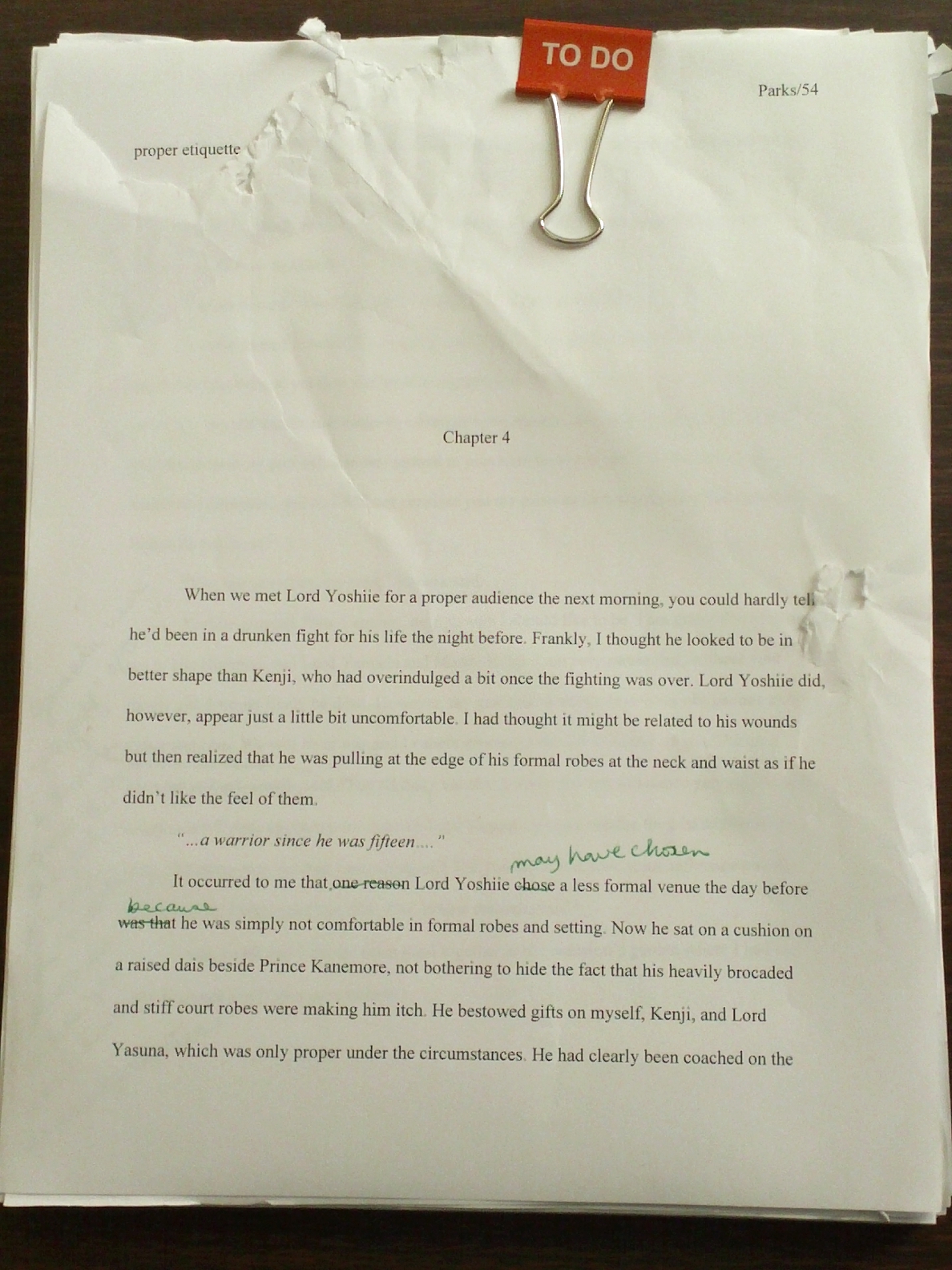
WRITING 02In the olden days—maybe no further back than the sixties and seventies—writers used to brag about never having to revise. “First drafts are final” was the saying. Which made sense only a little further back in time during the pulp era when you were trying to make a living writing for 50+ different pulp magazines at a penny a word. Spend too much time revising and you’d spend the rest starving. I imagine a lot of that attitude was a holdover from those halcyon days but, as a more recent wisdom has it “Writing is revising.” Also not completely true on the face of it. Without a first draft, there is no revising. It’s more accurate to say writing begins with the first draft, it just doesn’t end there. It’s called “first draft” for a reason. Continue reading