TCB, No Flash

WRITING 02Last week I signed the official contracts for the first American edition of Yamada Monogatari: To Break the Demon Gate. The title will be shorter in the UK limited edition, since for them it’s a single book, but to Prime it’s the second book in a series. Assuming the stars align and nothing blows up, I should see the contracts for the third book—Yamada Monogatari: The War God’s Son sometime next month. I say “should” advisedly, because nothing IS signed yet and the stars might not align and something may very well blow up. I will point out here that I am not being pessimistic at all, merely realistic. Books may be imagination and dreams given corporeal form (and is that a neat trick or what?) but publishing is a business, and when it comes to business, being realistic is the order of the day.

I could be wrong, and often am—but I think it was Mike Resnick who first said “Writing is art until the piece is finished. Then it’s a business.” Selling a piece—short story, poem, novel, whatever—is just the first step in that business. It’s a tricky first step for a lot of people, which in part explains why so many go to self-publishing from the start. That works for some people, and there’s no denying it. Good for them. For most, however, it just means that it’s not the editors who are rejecting them now, but rather the readers who get to do it later. I can’t imagine that delayed anguish feels any better than the more immediate sort. And it lasts longer. Regardless, for the traditional route, it’s the initial acceptance that brings the stardust and trumpets. Contract time, on the other paw, is proper and necessary but one thing it isn’t is exciting. It almost feels like homework, or doing taxes. Read each clause, be sure you understand it. You do that whether or not you have an agent, because no one—no one—is looking out for you the same way you yourself are, or darn well better be. It’s your career, if you want to have one.

Important, yes, even crucial, but anti-climactic too. I always feel just a little bit depressed after I sign a contract. Maybe it’s the feeling that “It all comes down to this?” That feeling starts to pass by the time the check arrives. But when I see my book in my hands? That’s the excitement part again, and then the book is off to the readers for final judgment. And what it’s really all about.

Review — Dororo, 2007

Director:  Akihiko Shiota

From an Original Manga by Osamu Tezuka

Cast: Satoshi Tsumabuki, Ko Shibasaki, Kiichi Nakai, Yoshio Harada, Eita

Here’s our nutshell premise—in a fantasy version of Japan, the warlord Kagemitsu Daigo is on the losing, soon to be annihilated side of a clan war. To save his clan and gain revenge, he makes a deal with 48 trapped demons—he will let each one claim a part of his infant son in return for the power to defeat his enemies. The part could be an arm, a leg, a liver, a heart, whatever. Possession of this bit of humanity will allow them to free themselves from the temple where they are trapped. They agree and do, the Daimyo does, and from there embarks on a campaign of conquest to bring the rest of the country under his twisted, evil rule, setting free the 48 demons in the process.

Now, here’s where it gets weird–the child doesn’t die. After the demons get through with it, what’s left of the child is merely placed in a basket like Moses and sent down a river. Continue reading

From Kudzu to Shizu, Part 3

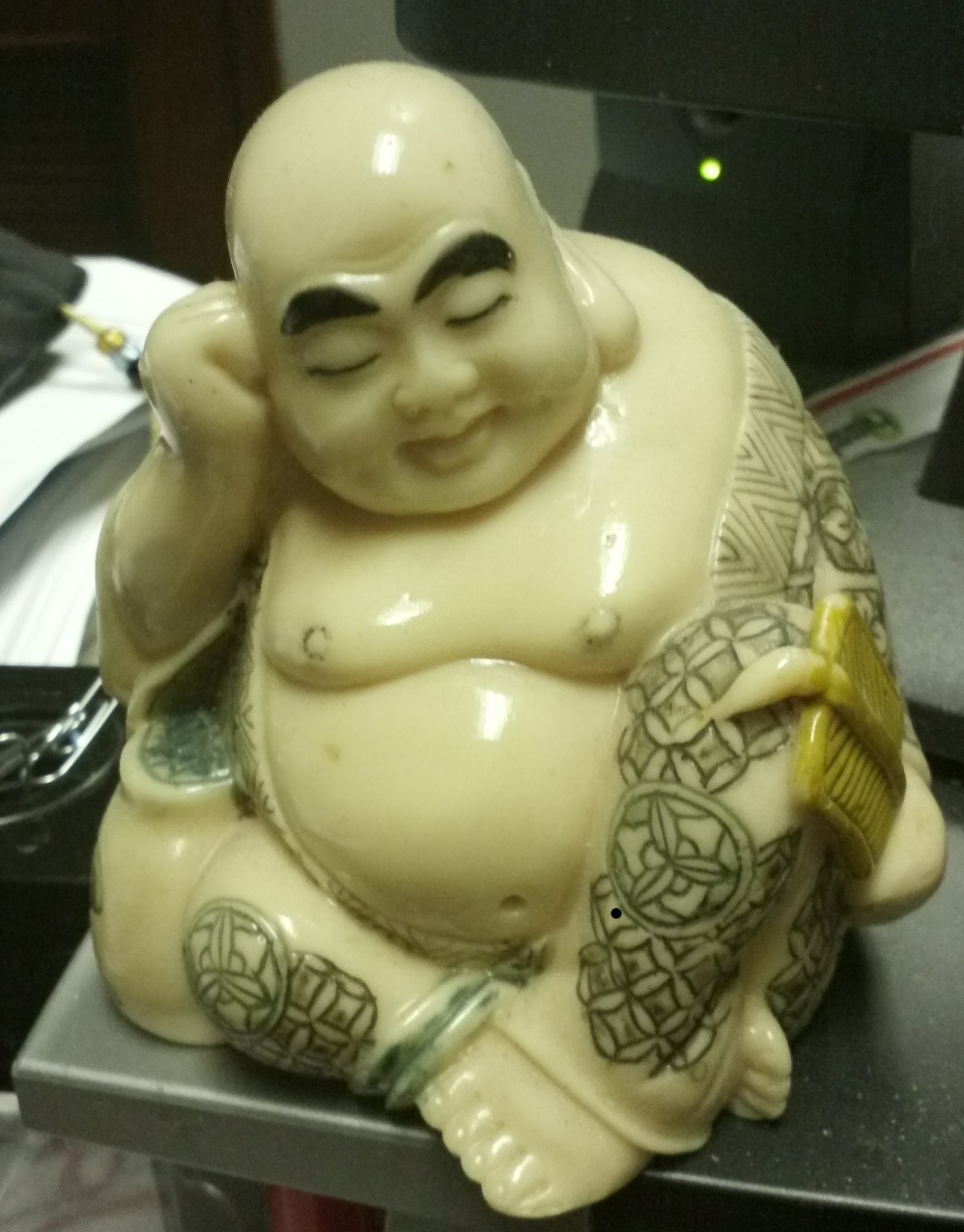
SleepingBuddhaOn Guard Forever or “The Emperor wants me to do what?!!”

We exit the Circle of Heaven and proceed down a corridor to the symbolic heart of the Imperial Tombs of China exhibition: the terra cotta tomb warriors of the Emperor QinShiHuang. QinShiHuang wasn’t an emperor, he was the emperor. The first. He was the one who overpowered every other Chinese kingdom, bringing about the end of the Warring States Period of Chinese history. The modern name “China” is even derived from Qin (pronounced “chin”). His dynasty only lasted about fifteen years, but the Empire he creatd pretty much stayed together with temporary lapses–during the succeeding dynasties.

QinShiHuang’s tomb was rediscovered in 1974 by some farmers digging a well in Shaanxi province. The burial pit covered at least 5 1/2 acres (I say “at least” because they’re not sure they’ve found it all yet). The entire Necropolis including walls and standing wooden buildings was supposed to have covered 22 square miles. The pit contained over 8000 pottery figures of warriors, charioteers, and horses. The warriors were in perfect battle formation, as confirmed by military texts of the time that have survived. They were originally brightly painted and carried real weapons of bronze (swords, spears, falchions, halbards, crossbows), many examples of which survived. A spearpoint and a long straight-forged sword blade of bronze were on display. The fittings had all rotted away, but the blades were in an incredible state of preservation, and, after treatment, gleamed like new steel.

It was also reported in the “Basic Annals of Qin” that the tomb itself was boobytrapped with spring loaded crossbows set to go off if the tunnels were disturbed. Since the actual burial chambers have not yet been excavated, no one knows for sure, though it was also reported that the tomb was in fact looted soon after the fall of the Qin dynasty. Also note: the terra cotta figures were included instead of real people because the custom of human sacrifice was dying out by this time. It wasn’t completely dead. The “Basic Annals” lists a report that the orginal craftsmen who created the tomb traps and such were sealed in the tomb to help keep the secrets safe.

There were four of the tomb warriors present, including a foot soldier, two officers, and a general. All of the figures are shown with brigandine armor (bronze or leather scales); rank was indicated by the type (or lack) of head covering, as well as ornateness of dress. The general was 6’2″ and looked larger. All the faces were very individual and expressive. The heads were done separately and then attached later, but the bodies were created from the same basic shape and then further molded/ individualized before being put in the kiln. Across the corridor was a chariot horse (full size, gad) rendered with the same great artistry.

The last part of the exhibition was a recreation of a throne room from the time of the Qing Dynasty (1644-1911 A.D.) It was full of marvelous stuff as you can imagine. Particularly striking (no pun avoided) were the freestanding bell and chime frames. The construction was different of course, being in gilt wood instead of bronze, and they were much larger (7-9 feet high at least) but the same basic design appeared in the Marquis Yi’s stone chimes from 2000 years earlier. These had a phoenix and dragon design throughout, and the chimes were made of several pounds of jade each. They could be played only when the emperor was present.

The throne was more like a loveseat, of wood lacquered in gold. This gave it a more reddish-coppery hue than what you normally think of as “gilt.” Carved with dragons, of course, but there was a surprisingly playful quality to the sculpture, with dragons entwining on the arms and frame and climbing over the back of the throne as if they were playing chase and tag like impudent children while the Emperor brooded his broods and decreed his decrees.

There were several robes on display, of silk and satin with dragon, phoenix, and bat motifs in gold, blue, yellow, and black (bats were thought to be a sign of good fortune). The guide book only mentioned one of the robes having the bats, but Carol says they were on all of them (Being a weaver, she paid close attention to the textiles). Calling them gorgeous is true enough but lame, so let me just say that, yep, they were suitable attire for the Emperor and his Lady. Not bad duds at all.

Besides the robes and jewely and cloissonne cranes and ceremonial weapons, there also a pair of really interesting supernatural critturs called _luduan_. These look like a cross between a pot bellied stove and a gorilla. There were done in brass partly covered with blue and green cloissonne, and had big grins that wrapped halfway around their heads. According to legend, these creatues had the natural ability to distinguish between good and evil upon hearing them, and they had ears shaped like funnels to indicate to all present that they Missed Nothing. Personally, I wouldn’t trust the pair of them as far as I could throw them, but then I wasn’t the Emperor

So much for Saturday. Sunday was occupied with an exhibition of Chinese Art (private collection) at the Pink Palace. Jade. Lots of jade. And a 12-14 inch lion carved completely out of rose quartz. After that we went to the (at the time) newly renovated Memphis zoo and saw real lions, and other marvelous cats.

In more recent news, I’m working on some story revisions. Announcement may or may not follow, since nothing’s firm yet.

This is a Conversation, Not a Speech

Rusalka by Ruth Sanderson

Notice the lovely painting to the left, “Rusalka,” by the amazing artist, Ruth Sanderson. I was reminded of it by a FB post by the writer Theodora Goss, said post being about a different matter altogether (we can discuss serendipity on another day). But I recognized the painting she’d referenced immediately. Partly because I’m fond of Sanderson’s work, but mostly because that very painting was the original illustration for “The Swan Troika,” (Realms of Fantasy, February 2011) my final story in that much missed magazine (Seriously. Show me a current fantasy magazine with the same ecumenical spirit toward the genre that ROF had).  If you’ll look in the left background, the guy in the funny-looking sleigh is Pyotr on his way to his fateful meeting with the rusalka in question.

Ahem. Yes, I’m getting off of the subject. Of which there is one, implied in the blog title. Ursula Le Guin once said something to the effect that a story is just marks on wood pulp (or pixels on a screen) until someone reads it. That reading is an act of creation itself and the story isn’t complete until it’s read. I have no argument with that. We want people to read our work, complete it, create their own inner vision to echo the one in our own heads. It won’t be the same vision, but that’s kind of the point. There aren’t just two sides to every story, there are as many sides as there are readers for that story, and the more the merrier.

Sometimes, though, it goes even beyond that. “Rusalka” exists because I wrote a story and the editors at ROF commissioned an illustration of it. You cannot fathom how pleased I was when I saw its original appearance in ROF. After all, I’m no artist. I could never have created my vision of that scene the way Sanderson did. Instead, she showed me hers. I was and am thrilled.

I will now contrast that with an incident from a writer’s group I was involved with. The Heavenly Fox had just been published and another writer in the group really liked it. So much so, that he announced that he was going to write a Springshadow story of his own, at which point I was forced to stand on his head until the impulse passed. Okay, not literally. But you get the idea. I was not thrilled. A little flattered, sure. But not thrilled.

So why the difference? Well, one is an act of re-creation. The other was copyright infringement. As in any conversation, you know when one party has crossed the line. Granted, it’s a fine line. Or rather a tightrope that we all walk when it comes to what happens to a story once it’s out in the world. In a sense, to send a story out into the world is to cede control of it. Legally it may belong to you, but practically? Things will happen that you didn’t count on. My own opinion goes beyond legalities though. As I’ve mentioned before, I don’t care who has the right to continue the Hitchiker’s Guide to the Galaxy series. So far as I’m concerned, that series ended when Douglas Adams died. Sure, I know that’s unrealistic. Knowing that doesn’t change the way I feel.

Yes, reading is a creative act in itself, and stories were designed to be read. That’s kind of the point of them, but another thing they are is a conversation between the writer and reader. It’s an act of communication that, in the right context, creates something grander than the sum of its parts, witness that painting. Experience that a few times and you won’t wonder why we get cranky when someone tries to turn the conversation into a monologue.

Another Quick Update

Yamada_DH_FinalCover_smlAccording to Locus, the hard cover limited edition of To Break the Demon Gate from PS Publishing is now scheduled for March of next year. The trade paper reprint should follow next December from Prime Books. That is, of course, if PS keeps that schedule. Otherwise Prime may wind up doing the original and the ltd edition becomes the reprint. Publishing is funny like that.

A story of mine, “Cherry Blossoms on the River of Souls,” (Beneath Ceaseless Skies #131, Fifth Anniversary Issue) has scored a “Recommended” rating from both Lois Tilton and Rich Horton. First time that’s ever happened. Wonder if I can do it again…

The rewrite on The War God’s Son has been delayed slightly by domestic issues, but I still expect it to be finished before the end of the year. I was shooting for the end of November, but obviously didn’t make it. As it stands, it’s pretty much eaten all my writing time for the entire year of 2013. Novels are a huge commitment, and a huge gamble. The potential of course is that one which is well-received can advance your readership by leaps and bounds because there is a large category of readers who never touch short stories. The potential for losing ground is there also, simply because it takes just as long to write an unsuccessful book as it does to write a successful one, and in the meantime you’re not writing anything else. You’re both out of sight and possibly out of mind with your readers during that period.

I think I’ve written a good book, a worthy follow-up for To Break the Demon Gate that continues Yamada’s journey and shows the inevitable changes in the character. It was worth doing. How well it does or doesn’t do is almost beside the point. Yes, I know, but I did say “almost.” Yamada Monogatari: Demon Hunter sold better than anyone expected (me not least of all), and that was nice, but I need To Break the Demon Gate to do well also so that the publisher will want The War God’s Son. I need it to do well so that…well, you get the idea.

But I promise to get back to Power’s Shadow (sequel to Black Kath’s Daughter) next, whatever happens. I’ve been telling Marta’s story for a long time. I think she’s a little tired of waiting, too.

PS: An update to the update–First Reader finished the final section of the book last night and pronounced it Good. Which for First Reader is like fireworks and party hats. I took care of the last revisions this morning so, short of any editorial revision requests, I’m calling The War God’s Son done. So I wrote a page of Power’s Shadow to celebrate.