“I Don’t Think it Means What You Think it Means”

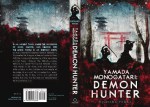
Final-CoverThe pre-publication prep on Yamada Monogatari: Demon Hunter is drawing to a close. So far the manuscript has been proofread by two people other than myself, and if any typos remain it wasn’t for lack of effort in hunting them down. It’s always best to have a pair of eyes other than your own when cleaning up a book—it’s far too easy to read what you expect to be there and what should be there rather than what actually is there. And no matter how long a manuscript sits, you’re never going to be able to review it with the objectivity that someone from the outside brings. That’s just the way it is.

Speaking of the way things are, the book already has its first review. From a reviewer who couldn’t finish it. You see, all the chapters “read like short stories.”

I know I heard a few of you snorting your coffee, or whatever beverage of choice, just now. “There’s a reason for that,” you might say, as did I when I first read the review. And it would be easy enough to slag on a reviewer who massively missed the point, but that itself would be missing the point. See, this is the exact opposite of the problem above. The book/story whatever it is, it’s your baby. You know it better than anyone. So well, so involved that you can never be completely objective about it. That’s when you’re trying to make it presentable to show the world, but then comes the next step—you show the world. And not anyone out there is going to know, to the core of their beings, as you do—just what is in front of them. Sure, it’ll look like a book, and have pages and words and things like, you know, a book. After that you’re into the realm of interpretation. Inevitable, completely out of your control, interpretation. Your book has left your world, where it was cherished and understood, and gone out into a world that, frankly, isn’t inclined to cut it any slack at all. They might read the cover copy about what your or another reader might have believed the book was about, but everyone knows that this much of it is hype and pitch. They will make up their own minds, thank you very much.

Here’s the thing—whatever your intention in creating it, you don’t get to decide what the book is. People who are not you are going to read the book (or attempt to). More to the point, they’ll compare it to their inner framework that tells them what a book is. Maybe that inner framework can’t take into account the fact that the book is a collection of short stories. Maybe they never read short stories. Maybe they don’t even know magazines and short stories exist. Don’t laugh, I’ve come across a few readers like that. Or they know about them but never read them. A book of fiction is a novel, and that’s how they’ll read your work, and find it lacking because it’s not a very good novel. Saying “It’s not a novel!” won’t melt any ice, because what you say the book is has no framework in their world, and you’re not going to be there to explain it anyway and it wouldn’t matter if you were.

I learned a long time ago that what I wrote wasn’t always what people read. Listening to reader interpretations of a story or book of mine over the years has been–and I hope continues to be–fascinating. If you’re a writer, you’ll probably see the same thing. There’s no point griping about it because, even though people will always read the book they think they’re reading and seldom the one you wrote, they’re not wrong. They decide what your work is for them: joyous or depressing, deep or ordinary. That’s their right.

What matters is that, now and then, you connect with a reader or two who is ready to read the book or story you actually wrote. They’re the ones you’re really writing for, and all you can hope for is that you find them.
And then the Claws Came Out

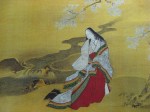
Heian LadyPreviously I’d given the suggested reading list for material on the Heian period, and it reminded me of my second re-read of Lady Murasaki’s Diary (I can remember when I read fast. What the heck happened?) Anyway, there’s a poetic exchange that the translator puzzles over that makes me wonder as well. It was the time of the Chrysanthemum Festival, and one of the customs of the time at Court was to lay out raw silk coverings over the flowers at night to protect them. Chrysanthemums were also associated with longevity, so It was also believed that to wipe the dew from those coverings on oneself the next morning would restore youth. I don’t have the text in front of me to quote the poems, but the first was from the Chancellor (Michinaga?)’s wife to Murasaki, with a gift of one of these cloths and a flower branch, to “restore her youth.” Murasaki was set to reply that she had only wiped a little off her sleeve to to restore a little youth, but was sending the cloth back “so that His Excellency’s wife might get the full benefit.”

As the translator notes, there are two obvious ways to read this:

1) Face value. It was a thoughtful gift, requiring an equally courteous response or…

2) His Excellency’s Wife: “You’re getting old, Dearie.” Murasaki: “Not as old as you,  Dearie.”

The diary notes that the response was never sent, since by that time His Excellency’s Wife had returned to her apartments, and so Murasaki thought there was no point pursuing the matter. Which I want to read as “Eh. You ain’t worth my time.”

Which interpretation is the right one? As the translator admits, there’s just no way to know.

I do, however, know which way I’m betting.

Approaching Yamada

New ImageLast Friday was pretty busy in terms of getting the book ready. We wound up with a couple of blank pages to fill and it was almost time to send the book to the printers, so I put together a quick glossary of terms and a suggested reading list. I’ve included the reading list below. These are just some of the books I found very useful when trying to recreate Yamada’s world. Yes, it’s fantasy, but it’s fantasy set in a specific time and place and  I’ve always tried very hard to stick to the facts of history when those facts are known, as a lot of them are when speaking of Heian Japan. An amazing number, considering that it was a thousand years ago. Anyone with a prior interest in that era won’t find the below list terribly surprising, and I don’t claim that it’s complete, even for my own research. But there’s a lot of good stuff there.

Suggested Reading 

AS I CROSSED A BRIDGE OF DREAMS: Recollections of a Woman in 11th Century Japan, Translated by Sarashina and Ivan Morris (Penguin Classics, 1989)

THE CONFESSIONS OF LADY NIJO, Translated by Karen Brazell (Stanford University Press, 1973) 

THE DIARY OF LADY MURASAKI, Translated by Richard Bowring (Penguin Classics, 1996)

THE GOSSAMER YEARS: The Diary of a Noblewoman in Heian Japan, Translated by  Edward Seidensticker (Tuttle Classics, 1989) 

THE PILLOW BOOK OF SEI SHONAGON, Translated by Ivan Morris (Columbia University Press, 1991)

THE TALE OF GENJI by Murasaki Shikibu, Translated by Edward Seidensticker (Knopf, 1978) 

THE TALE OF THE HEIKE, Translated by Helen McCullough (Stanford University Press, 1990)

AN INTRODUCTION TO JAPANESE COURT POETRY by Earl Miner (Stanford University Press, 1968) 

A HISTORY OF JAPAN TO 1334 by George Sansom (Stanford University Press, 1958)

THE WORLD OF THE SHINING PRINCE: Court Life in Ancient Japan by Ivan Morris (Kodansha USA, 1994) 

HYAKUNIN ISSHU edited by Fujiwara no Teika, Translation by Larry Hammer, Cholla Bear Press, 2011

Weird Detectives: Recent Investigations

Paula Guran at Prime Books just released the contents of her Weird Detectives anthology. I’ve got a story in this one. Note that this is an alphabetic listing, not necessarily the final order of the stories. You can see a more complete description at the Prime Books web site.

“Cryptic Coloration” by Elizabeth Bear
“The Key” by Ilsa J. Blick
“Mortal Bait” Richard Bowes
“Star of David” by Patricia Briggs
“Love Hurts” by Jim Butcher
“Swing Shift” by Dana Cameron
“The Necromancer’s Apprentice” by Lillian Stewart Carl
“Sherlock Holmes and the Diving Bell” by Simon Clark
“The Adakian Eagle” by Bradley Denton
“Hecate’s Golden Eye” by P.N. Elrod
“The Case of Death and Honey” by Neil Gaiman
“The Nightside, Needless to Say” by Simon R. Greene
“Deal Breaker” by Justin Gustainis
“Death by Dahlia” by Charlaine Harris
“See Me” by Tanya Huff
“Signatures of the Dead” by Faith Hunter
“The Maltese Unicorn” by Caitlín R. Kiernan
“The Case of the Stalking Shadow” by Joe R. Lansdale
“Like a Part of the Family” by Jonathan Maberry
“The Beast of Glamis” by William Meikle
“Fox Tails” by Richard Parks
“Imposters” by Sarah Monette
“Defining Shadows” by Carrie Vaughn

Continue reading

Yeah, Though I Walk Through the Valley of Uncanny

Our text for today is “The Uncanny Valley.” No, it’s not the title of the latest pseudo-scientific romance or a herald of the return of the gothic novel. It’s a rather intriguing theory proposed by the Japanese computer scientist Masahiro Mori in 1970, and it goes something like this: as robots are made more and more human-like, they are perceived more and more positively by actual humans until they reach a point in the curve where they are almost but not quite fully human-appearing, and it is at that point that the positive reaction quickly changes to feelings of revulsion, repulsion, even horror. It is only when the robot is fully human in appearance does the effect reverse itself. This sudden sharp drop in the graph is what Mori referred to as “the uncanny valley.”

Considering mankind’s very slow progress in robotics, it shouldn’t be a surprise that the bulk of anecdotal confirmation for Mori’s theory came first from computer graphics rather than robotics. It’s almost trivial these days for a good CGI artist to make a realistic-looking human figure rendered in 3D, but animating that figure equally as realistically? That is another story and it turns out Mori might have been on to something—there’s something wired into our lizard-brains that means humans are extremely sensitive to perceptions of “almost but not quite right.” Something wrong with the way the mouth moves, the sheen on the skin, the eyes that forget to blink, and we’re thinking alien, undead, pod-person, whatever. More recently, computer scientists have come to question the entire notion of “the uncanny valley,” saying there’s no scientific evidence for it. True. All anecdotal, as I said. Still, I tend to think there’s something there.

It also explains the effectiveness of some approaches to dark fantasy and horror, where there’s someone there who isn’t quite right. The protagonist can’t quite get a grip on it, but there’s something wrong with the new neighbor. Unease builds on little incidents, little hints, until the secret is revealed—OMG, he’s a vampire! Or Democrat. Or Republican Or vegetarian. Some inexplicable OTHER. Probably overused, but then cliches get repeated for a reason.

All of which is a round the world way of saying that now I finally understand why I can’t stand to play Elder Scrolls: Oblivion on my PS3, and why I haven’t picked up Skyrim. Despite the game’s many good points, I can’t bear to look at it for long. All the characters creep the heck out of me.

*Nothing says “Monday” like starting a post with a typo.