Day at the Museum

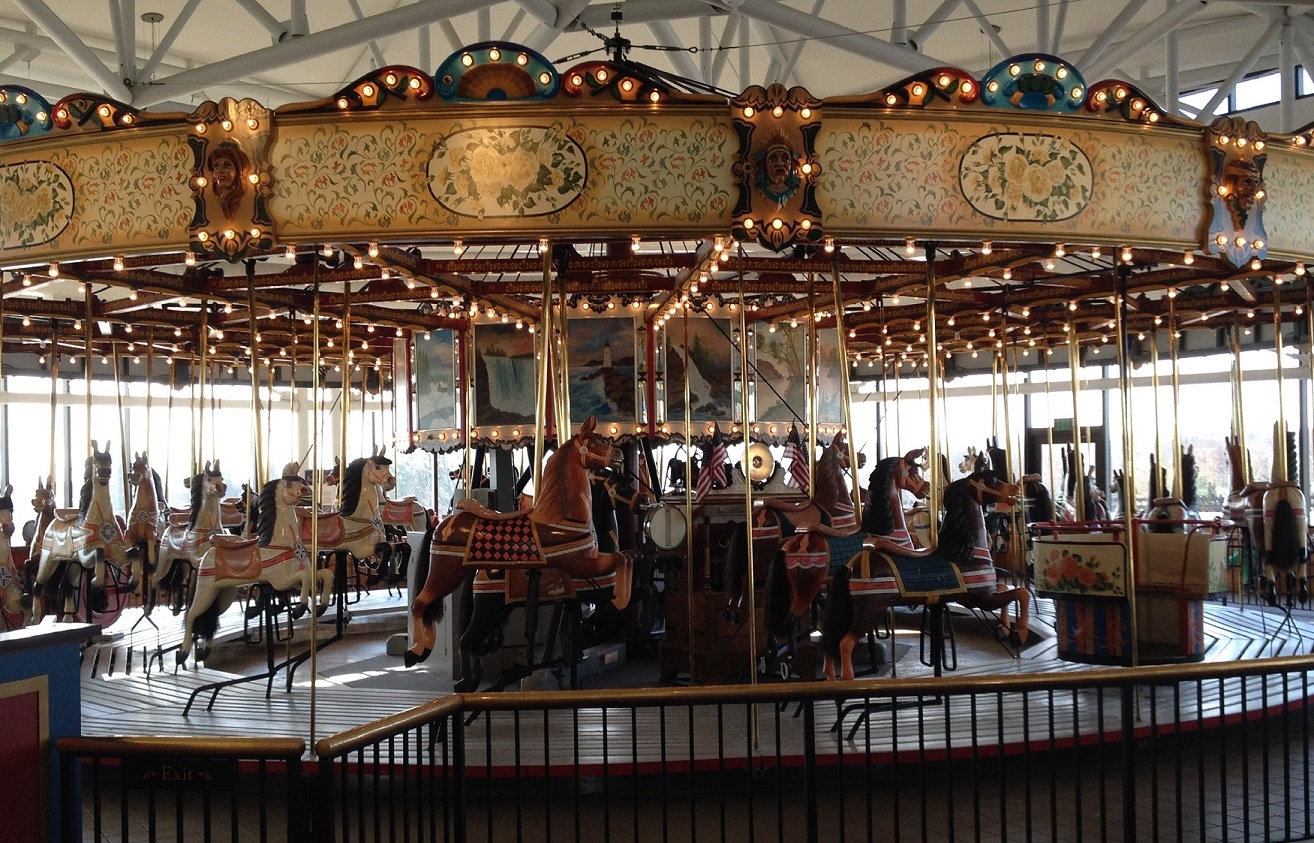
Herschell-Spillman Carousel-1915

Herschell-Spillman Carousel-1915

For Valentine’s Day Carol and I decided to brave the 0 Degree weather and make a trip to the New York State Museum in Albany for a gem and mineral show. This took no small measure of courage on my part, because I’m a Mississippi boy still trying to wrap my head around the idea of No Degrees Whatsoever as a temperature reading. Never mind that it got to -17 F that night–I could sleep through that and pretend it didn’t happen. When you’re out in it? Not so much.

Regardless, we made it. The gem show, frankly, was nothing we hadn’t seen before. Nice, some cool pieces, but crowded and fairly typical of such things. We were still glad we came, but didn’t feel the need to add any new pieces. What drew my attention after awhile was the display of a Herchell-Spillman Carousel from 1915, shown in upper left.

I’ve talked about my serial obsessions before, how they come, dominate my (hah) free time for a while, then fade to the point I can move on to something else, but they never quite go away? Yeah. Wood carving was one of those, so naturally I had an interest in the late 19th, early 20th century carvers and companies that produced carousels and especially the carved horses and other creatures that stocked them. If you’re curious at all you can start Googling just about any starting point (Herschell-Spillman, Carousel Horses, etc) and probably find out a lot more than you’d ever want to know. I’m just going to talk about a few things that grabbed my notice.

First of all, the Herschell-Spillman company did not carve the animals on this carousel. They were all made earlier, and attributed to a company located in Brooklyn. When I say “earlier,” it was probably around the 1890’s, according to the museum’s information. Herschell-Spillman made the carousel frame and mechanism in 1915, and surviving animals from earlier rides were retro-fitted on to it. The horses were originally “standers,” meaning they didn’t go up and down (“jumper”), and part of the retro-fit was to convert some of them.
Closeup

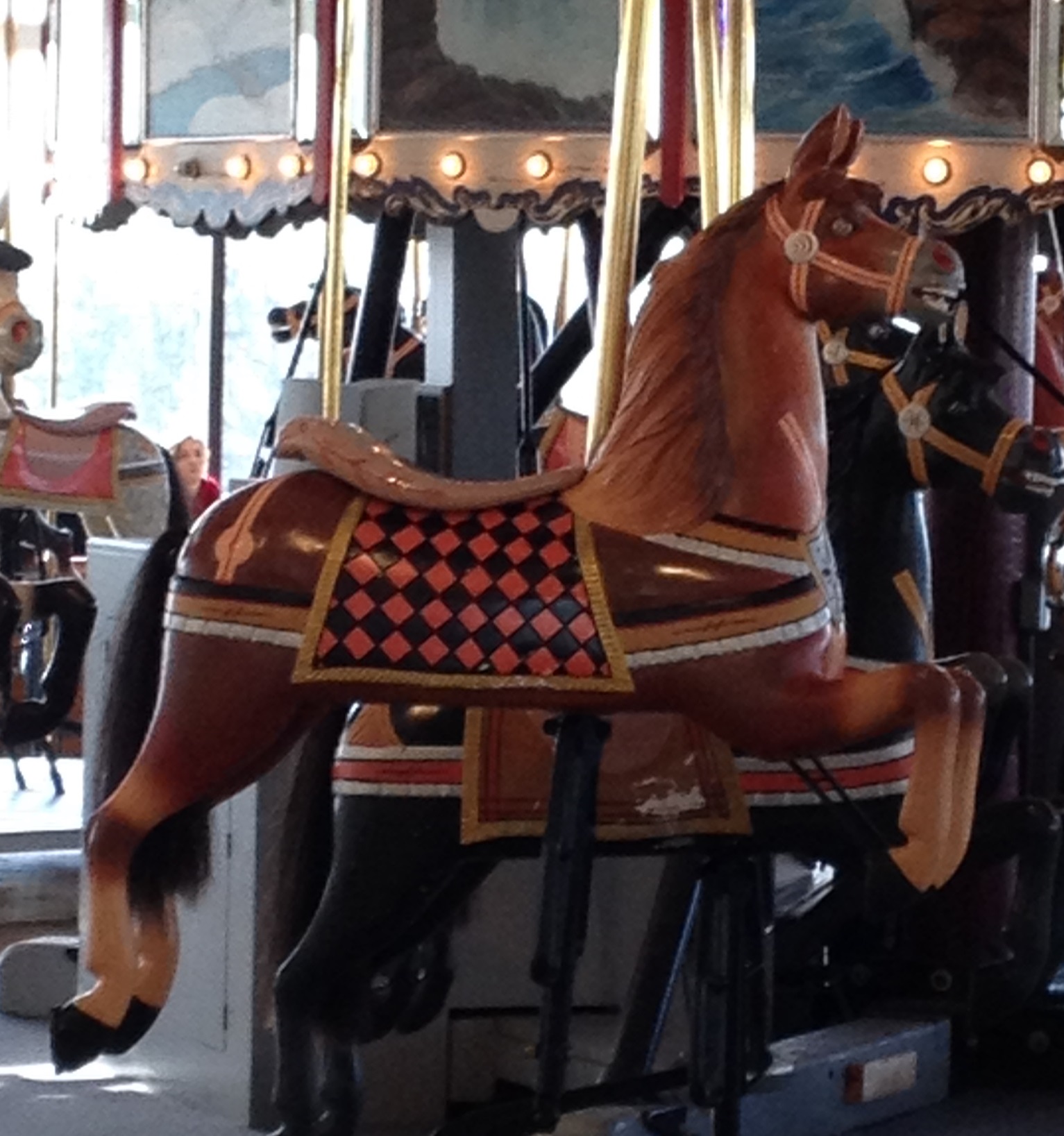
Closeup

Now, take a look at this detail shot. Very nice, but you’ll note that the horse is fairly simple and stylized, strongly built but without a great deal of detail. This is sometimes called the “Country Fair Style.” The idea was that the horses would be sturdy, relatively small, and easy to pack up and transport from one fair to another. (There were other styles as well, but that’s beyond the scope of this blog. I’ll just mention the Philadelphia Style and the Coney Island Style as two others with their own characteristics.) Even though Herschell-Spillman didn’t carve these horses, they did work a lot in that style. Horses that were designed as outside row horses for stationary carousels that would not be moved (in theory, though in practice they sometimes were) were far more elaborate and, well, I want to show you a Dentzel company carousel from about the same period.
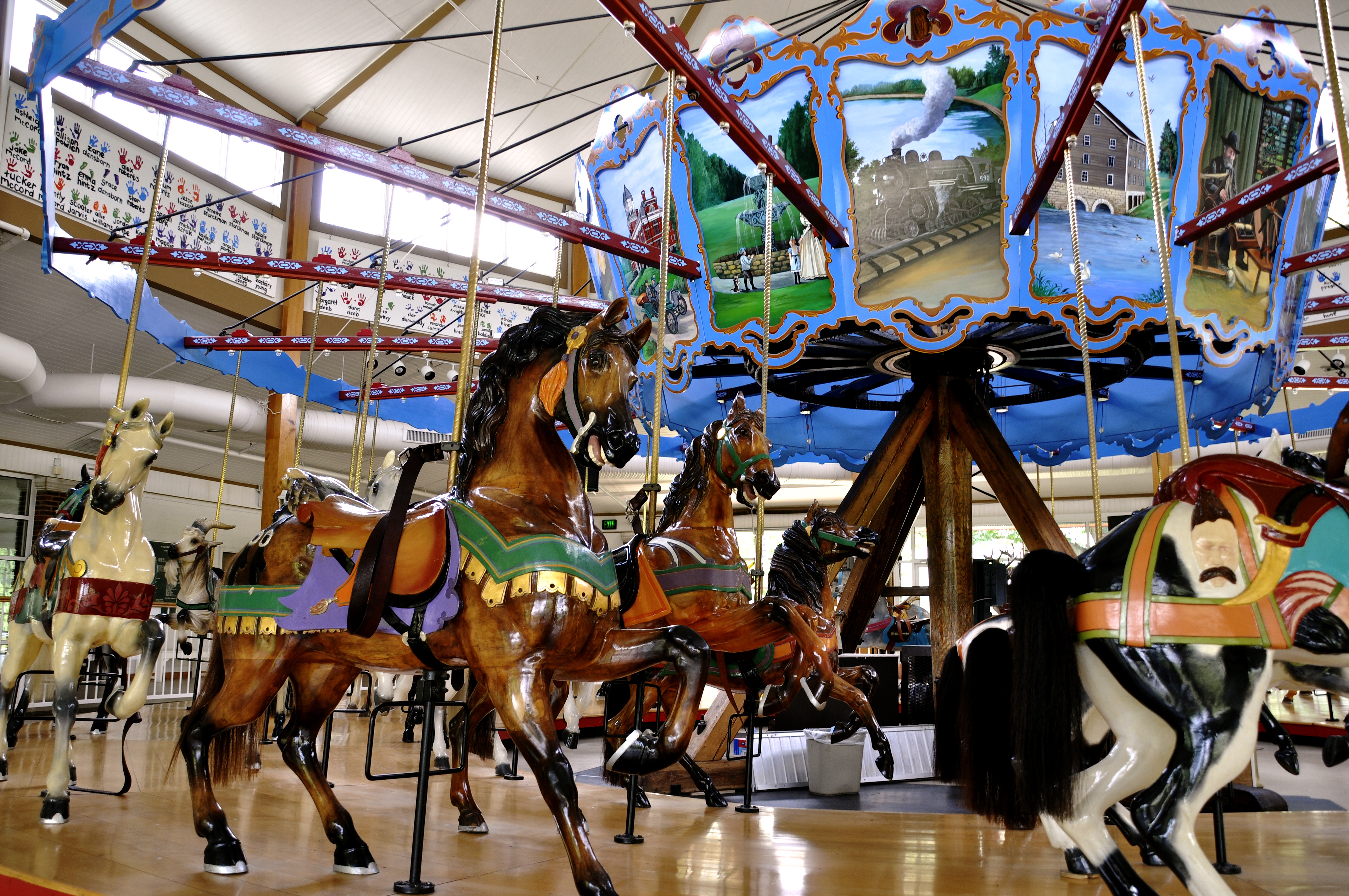
Original Photograph-Kevin Burkett http://www.flickr.com/people/kevinwburkett

Original Photograph-Kevin Burkett
http://www.flickr.com/people/kevinwburkett

This Dentzel company carousel is located in Logansport, Indiana. There is another one in Highland Park in Meridan, MS, near where I grew up and I got to ride it as a kid. I’d show you that one, only I haven’t been able to locate a good picture. This one will certainly do. As I said, this was not a later style or something that represented an evolution in the development of carousel animals. This carousel was built 15 years before the Herschell-Spillman example above, and was pretty typical of the Dentzel company’s work.

Detail From Spencer Park Dentzel Carousel - Kevin Burkett http://www.flickr.com/people/kevinwburkett

Detail From Spencer Park Dentzel Carousel – Kevin Burkett
http://www.flickr.com/people/kevinwburkett

The most elaborately carved horses/animals would naturally be on the outside row, as that was the first thing visitors would see and were often “standers,” as this magnificent example shows. If you look closely at its right hind leg, you can see the glue line where it was attached to the body. The body (carcass) would be built as a hollow box with enough thickness on the outside to carve the details, and the legs and head would be roughed out separately, then attached and the finish carving done. Some of the most famous carvers, like Gustav Dentzel and Daniel Muller (famous for carving standers with military trappings) and Salvatore Cerniglario were either German or Italian immigrants.

Muller Horse from Forest Park Carousel, Queens NY

By 1930 the so-called “Golden Age” of the carousel was waning. Out of the thousands made, only a couple hundred still survive, some in museums like the Herchell-Spillman, others like the Dentzel above and the one in Meridian, still in public parks, still on duty for rides as they have been for 100 years.

There. Assuming you got this far, probably still more than you wanted to know. As I said, the old interests never go away. Not completely.
History Lesson

Library

Library

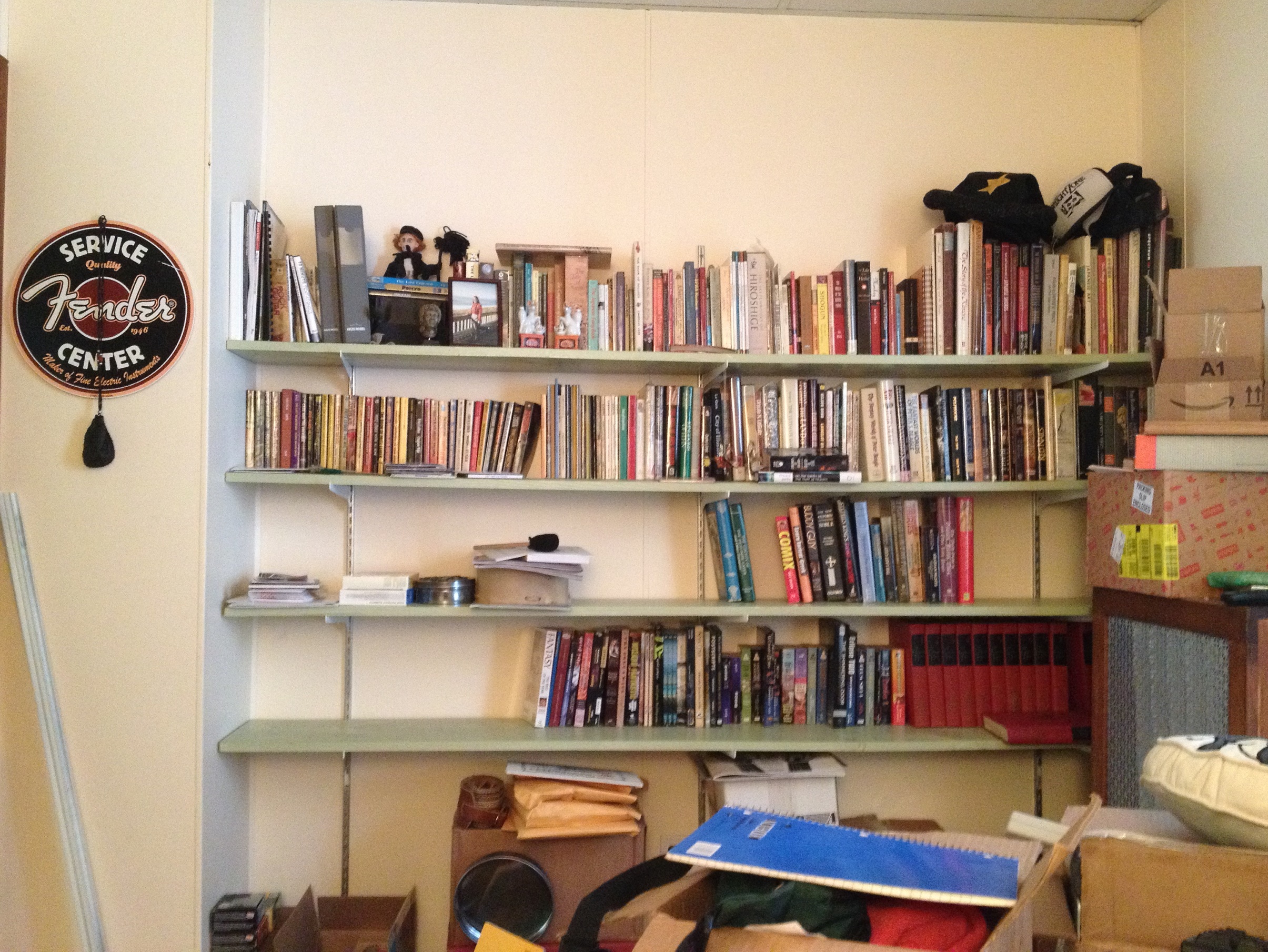
Believe it or not, that mess on the left actually represents progress. There hasn’t been a lot of that, at least in the library. I can see about a third of the bare floor now. I also know that, judging the remaining books with the remaining shelf space, the numbers just don’t work, and I can’t add more shelves…well, maybe one.

That’s for later. Part of the point of at least attempting to get organized is that I have a book to finish, a book set in a specific historical period and at a very important historical crisis point. In short, my references—and one specifically—were packed up, and I needed them. Not to get into many details, but there was a particular point in the story where Imperial and clan politics interacted in a very specific way, and in order to understand how that all fit into the narrative, I needed a specific book. That is, I thought I did. Until I was able to unpack said book.

Funny thing about that—what one person considers important, another just skims past. In other words, the book I was depending on was no help at all. I shouldn’t have been too surprised. What I was looking for was a fairly obscure series of events that happened over nine hundred years ago. Unless you happen to have a large university reference library at your disposal, you’re probably not going to find what you’re looking for. I don’t happen to have that. Nor do I have the shelf space to stock every reference I might possibly need, even if they did exist in translation, and usually the ebook edition in any language simply doesn’t exist.

What I do have is Google. I’m almost embarrassed to admit it, but online it took me maybe twenty minutes, tops, to track down what I was looking for, thanks to a Japanese site pulling from primary sources, with English translation provided. The internet does make some things more difficult with its constant distractions. But it also makes a lot of things possible. The information I needed simply wouldn’t have been available to me without it. Fortunately, I am not without it, so no problem.

Also no excuses. Funny how that works.

Whispering Pines

WRITING 02

One thing I’m going to miss up here. Have you ever heard the expression, “Whispering Pines”? It’s a real thing. The wind makes a distinctive sound when it blows through a forest of Southern Longleaf Pines. Listen long enough and you’d swear they were talking. There are evergreens here, too. Maybe one day I’ll find a grove and try them out, but I don’t think it’s going to be the same.

Still adjusting to life in central New York. In some ways it’s a lot different. In others, not so much. For instance, “redneck” is apparently a lifestyle choice. Now, in a sense I’ve always known that. Wherever I’ve been in the country, I’ve run into them. Remember, I’m from Mississippi, where the dichotomy was much simpler—you either were, or you weren’t. And birth, education, economic level, etc. had almost nothing to do with it. Like the alleged Progressive/Conservative split, it had a lot more to do with how your brain was wired than any well-reasoned philosophical position. However, I had always thought that the particular manner in which it expressed itself in the South was, pardon the expression, our own saltire to bear. So imagine my surprise the first time I saw the Confederate Battle Flag proudly displayed on a local pickup truck.

I have to admit, my gut reaction was WTF???

I figured it must have been another transplant from my general area, shrugged, and went on my way. Then I saw it again. And again. One? Okay, sure. Two? Maybe. Three? Hmmm. I’m seeing a pattern here. Granted, there were not nearly as many around as I was used to, but it was throwing me for a loop that I saw any at all. After all, this is New York. I mean, aside from New England, could you get more Yankee? What could the Battle Flag possibly mean to the people here?

Where I come from, people have given lots of reasons for flying the flag. Other than the real one, I mean, but “Heritage” is the favorite these days. So? From that standpoint it really is my heritage. I own that. I respect the people who fought and died for a cause they believed in. The Cause itself? Not so much. Bigotry and fear convinced a bunch of poor whites to ignore their own best interests to protect the livelihood of a bunch of rich slave owners who, to be charitable, didn’t give a tinker’s damn about them. Looking at the current political situation, you start to see that not a lot has changed. So that whole “Heritage, not Racism” thing? Yeah. Gonna have to call bullshit on that.

Unless by “Heritage” you mean “Got Fooled Again.”

David G. Hartwell

7b0d3f0e5b-fc2e-4ffe-b6f1-a01ee1f81da57dimg400  I, along with pretty much everyone who works in science fiction and fantasy, got the word yesterday that David Hartwell was in very serious condition and not expected to survive, and unfortunately so it proved. It’s not my place to give details, partly because I’ve only heard specifics second and third-hand, but mostly because that is for those closest to him to do or not as they see fit. I’m here for a different reason.

I only met David Hartwell once, at World Fantasy Convention 2003 and doubt we exchanged more than 20-30 words total then, but the reason I’m writing today is to say a long overdue (and in Mr. Hartwell’s case, sadly too late) thank you to both him and his wife and editing partner, Kathryn Cramer. The reason I spoke to David Hartwell that one time was because he was making sure he received a copy of my first collection, The Ogre’s Wife. I was on my way to give a reading at the time and had one copy with me. Not being a complete idiot, I gave that one to him. I should have thanked him then, since he and his wife and editing partner Kathryn Cramer had shown an interest in my early stories, taking two to reprint in their first two yearly editions of their Year’s Best Fantasy. In another incident where I wasn’t present, a (reliable) friend reported that, on a panel about newer and emerging writers, my name had come up as Ms. Cramer reportedly said something to the effect that, “If you haven’t read him yet, you should.” Such kindnesses were a huge boost to me at the time. Maybe writers shouldn’t need validation other than the work itself, but as human beings we savor it as much as anyone, and getting those two reprints at that point in my writing career was a big deal for me. So I should have said “thank you” to David Hartwell when I had the chance.  It never occurred to me at the time that life and circumstances would dictate that I never spoke to him again.

So I’ll say it now, and especially to his widow Kathryn Cramer who is still with us and I hope will be for a long time: Thank you.


SnowNuts

SnowNuts

I’m learning about snow. In Mississippi, snow was a fleeting acquaintance at most. In all my childhood I can only remember two really significant snows, that is, accumulations great enough to scrape together a half-way decent snowman. One weird winter we had the local equivalent of a blizzard. Nine inches. Us kids had a ball, though I don’t remember the grownups being too keen on it.

So far this January it has snowed more here in NY than it did in the last five years in Mississippi. Yet snow is different here. In MS the snow was damper and tended to stick to itself. Easy to make snowballs and snowmen on the rare occasions when there was enough of it. Here in central NY there’s plenty, only it’s mostly what I think is referred to as “powder.” Very light and fluffy. Doesn’t stick together worth a darn, or at all, really. Good for shoveling. Good, apparently, for skiing, since there are several ski resorts in the area that were really bummed at the mild December. Not enough snow then. Mother Nature’s making up for it now. I am learning how to shovel snow. I can’t say it’s a skill I had ever aspired to, but it’s part of the deal. Fortunately, the snow is light and fluffy. It’s not that hard to move.

Another odd thing: when small animals make tracks, the snow is compressed in the middle and pushed up on the outside. When it partially melts, the pushed up area melts last, leaving these almost perfectly round “snownuts” along the animal’s path. They look like a trail of frosted doughnuts, just left there on the ground. Doubt they would taste as good, though.

The Emperor in Shadow proceeds. I have a long way to go, but I still think I can finish in time. I’m still in the section which I refer to usually as the “churning” section. Plot elements are being created, characters introduced, and the writing itself shows how they all fit together. Eventually. For the moment, it churns. Soon the pace will pick up when, well, I won’t say when I figure it all out, because that’s not quite how it works. Ray Bradbury is alleged to have said, “Plot is no more than footprints left in the snow after your characters have run by on their way to incredible destinations.” That makes sense to me, but as for the actual day to day writing part, I say rather that the story triggers some sort of self-organization principle which is one of the keynotes of life in general. Life wants to happen, and so does story. For a book to live, it has to do something similar. At those times I feel more like a photojournalist than a writer, just trying to record the life as it happens. In this case, it just happens to be a novel.

If it’s not alive, well, there’s nothing to record. Just words. Like empty holes in the snow where maybe a living thing should have been.