Muse and Writer Dialogues #11- Imping Perversely

FADE IN: Writer’s home office. You know the drill. WRITER is at the desk.

MUSE enters from somewhere. Since she has no corporeal form, egress and exeunt are rather flexible concepts to her. She appears to be wearing a sari.

MUSE: How was the kirtan last night?

WRITER: Great. The first chant was to Sarasvati, the goddess of the arts and music, and I need all the help I can get in both areas. It gave me an excuse to sing in a group where no one could hear me. Plus the instrumentation was much better than the first one.

MUSE: You’re just saying that because guitars were involved.

WRITER: How did you–?

MUSE: Don’t finish that, unless you’re a bigger idiot than I think you are. You were there, so I was there. It’s not complicated.

WRITER: Okay, fine. That was a bonus. All three of the performers were good, and two were playing classical style. I don’t get to see that very often. Amazed that I could tell that one of the chants was just a G, Cadd9, and A. I could probably play that.

MUSE: Should I even point out that you’re neither Hindu nor Jain?

WRITER: True, but what has that got to do with anything?

MUSE: Absolutely nothing. Not unlike what you’re writing now. Because, like your current project, the kirtan had little to do with getting the next novel written.

WRITER: Very funny. I just finished a novel, remember? I’m taking a break from them for a little while.

MUSE: Bull. You’re working on short stories instead because you’re being perverse.

WRITER: ?!

MUSE: Perverse in its correct, original meaning. Remember Edgar Allan Poe’s “Imp of the Perverse”?

WRITER: Yes, it was an imaginary creature that kept him procrastinating on writing projects until it was too late. Unlike imaginary creatures who bug me about writing. Well, I’m writing. Doesn’t apply.

MUSE: Wrong, as usual. You know you should be doing one thing, so you insist on doing something else entirely. It’s exactly the same. That the thing you shouldn’t be doing is also writing doesn’t change that fact.

 WRITER: Neither the next novel nor the short story is under contract, so how do you figure I “should” be doing one of them as opposed to the other?

MUSE: You said you’d work on the novel next. You’re not. That’s perverse.

WRITER: Merely contrary. And I will get the novel done, but right now is not its turn.

MUSE: That’s not the point. You’re not doing what you’d said you’d do. You broke a promise. To yourself, if no one else.

WRITER: True, but only to avoid breaking a greater one. The first one.

MUSE: ?

WRITER: I promised myself that, since I was never going to make a living doing this, I was free to write exactly what I wanted to write, when I wanted to write it. If I do anything else, I break that promise, and that one I’m keeping.

MUSE: Oh. That one.

WRITER: The ur-promise. I keep that one, or there really is no point to all this. Or you, for that matter.

MUSE: Hmmm, good point. Okay, but there are people who want to read that novel, you know, and have told you so.

WRITER: There are people who want to read this short story. They just don’t know it yet.

MUSE (sighs): You really are perverse.

WRITER: And damn proud.

FADE OUT.


Review – Way Station by Clifford D. Simak

1964 McFadden Ed.

Way Station – Clifford D. Simak, Doubleday, 1963 (Originally published in Galaxy Magazine as “Here Gather the Stars” in a two-part serial. Hugo Award, best novel, 1964. (Amazon).

The premise of Way Station is about as simple as it gets—alien races in our galaxy have long since solved the interstellar travel problem by means of a device that transports individuals instantly from one planet to another, and it doesn’t matter if that planet is in the same solar system or halfway across the galaxy. The trick is that the transportation signal degrades under certain conditions and so some jumps require a temporary stopping point where the transport signal can be renewed and the traveler sent on their way, thus the Way Stations of the title. Every Way Station requires a station keeper, someone who can run the machines and greet the travelers and make sure they are sent on their way properly. When the aliens expand into our spiral arm of the galaxy, Earth is the perfect place for such a station, but it needs a keeper. Galactic Central chooses a local, Enoch Wallace, a recent Civil War veteran. His home is converted into one such station, which provides for all his physical needs and is a safe haven from the outside world. As long as he remains inside the station, he does not age at all, and brief errands outside only take a few minutes or hours off of his lifespan. Over one hundred years later, Enoch is still on duty. Continue reading →

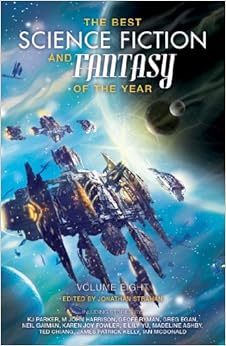
TOC – The Best Science Fiction & Fantasy of the Year: Vol 8

From JonathanStrahan.com.au. As always, it’s an honor to be in such company. As has already been pointed out elsewhere, a fairly large percentage of the stories are drawn from online sources, venues that didn’t really exist just a few short years ago. I don’t know if I’d call it a trend, but I do think it is significant.

•Introduction, Jonathan Strahan
•“Some Desperado”, Joe Abercrombie (Dangerous Women)
•“Zero for Conduct”, Greg Egan (Twelve Tomorrows)
•“Effigy Nights”, Yoon Ha Lee (Clarkesworld)
•“Rosary and Goldenstar”, Geoff Ryman (F&SF)
•“The Sleeper and the Spindle”, Neil Gaiman (Rags and Bones)
•“Cave and Julia”, M. John Harrison (Kindle Singles)
•“The Herons of Mer de l’Ouest”, M Bennardo (Lightspeed)
•“Water”, Ramez Naam (An Aura of Familiarity)
•“The Truth of Fact, the Truth of Feeling”, Ted Chiang (Subterranean)
•“The Ink Readers of Doi Saket”, Thomas Olde Heuvelt (Tor.com)
•“Cherry Blossoms on the River of Souls”, Richard Parks (Beneath Ceaseless Skies)
•“Rag and Bone”, Priya Sharma (Tor.com)
•“The Book Seller”, Lavie Tidhar (Interzone)
•“The Sun and I”, K J Parker (Subterranean)
•“The Promise of Space”, James Patrick Kelly (Clarkesworld)
•“The Master Conjurer”, Charlie Jane Anders (Lightspeed)
•“The Pilgrim and the Angel”, E. Lily Yu (McSweeney’s 45)
•“Entangled”, Ian R Macleod (Asimov’s)
•“Fade to Gold”, Benjanun Sriduangkaew (End of the Road)
•“Selkies Stories are for Losers”, Sofia Samatar (Strange Horizons)
•“In Metal, In Bone”, An Owomoyela (Eclipse Online)
•“Kormack the Lucky”, Eleanor Arnason (F&SF)
•“Sing”, Karin Tidbeck (Tor.com)
•“Social Services”, Madeline Ashby (An Aura of Familiarity)
•“The Road of Needles”, Caitlín R Kiernan (Once Upon a Time: New Fairy Tales)
•“Mystic Falls”, Robert Reed (Clarkesworld)
•“The Queen of Night’s Aria”, Ian McDonald (Old Mars)
•“The Irish Astronaut”, Val Nolan (Electric Velocipede)

“Is This the Five Minute Argument or the Full Half-hour?”

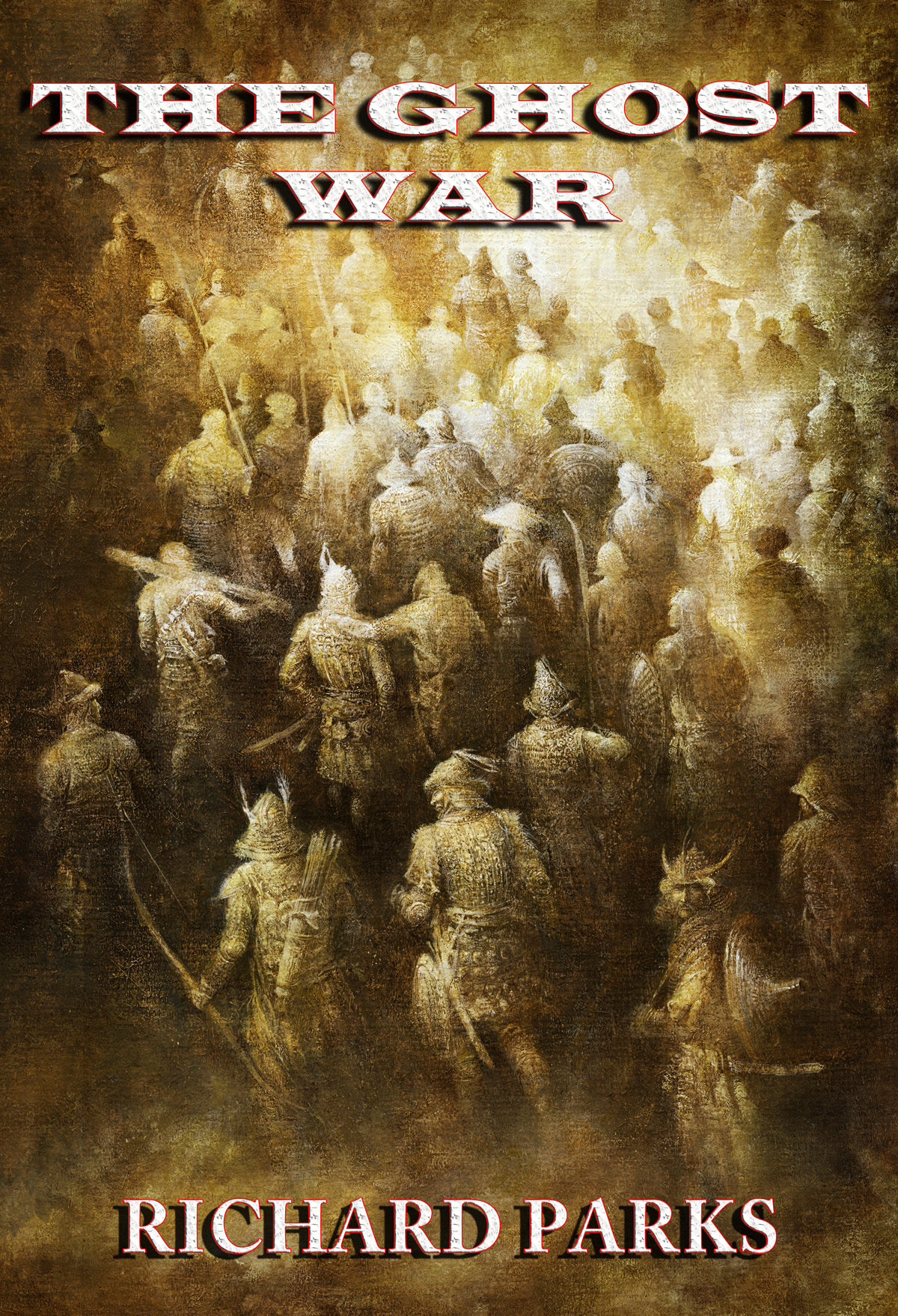
The Ghost WarThe subject came up for me because I got briefly involved in an online discussion, which on the surface was about Ursula Le Guin’s Earthsea trilogy. The instigator of the discussion readily admitted that the books were classics, but by implication wondered why they were classics. After all, there was very little overt action, the pacing was slow, and thus the books weren’t that entertaining. My first reaction was something along the lines of WTF??? After I picked my jaw up off the floor, I had to think about that for a bit.

I’m not going to get into a discussion of reading protocols. I’m not qualified, for one thing. However, there is something I have known for a long time, and the ancients knew long before I did—and so I shouldn’t have been at all surprised by that reader’s reaction to a series I did and still do think is brilliant. The proper response is not “What the hell is wrong with you?” The proper response is to shrug and remember “De gustibus non est disputandum.” More or less, “You can’t argue matters of taste.”

Of course, people can and do argue matters of taste. All the time. People like to argue, and for people who do like to argue, matters of taste are simply perfect. For as humanity has understood for a long time and the Romans expressed so succinctly, it’s a completely and utterly pointless exercise. There’s no logic to express, no preponderance of evidence to introduce, no real case to be made. Every such argument starts with one basic position by both (or all) disputants, and that is “Why don’t you like what I like?” The simple and obvious answer does nothing to derail the argument. It’s pointless, but only if you don’t realize that the argument itself is the point. Nothing is settled and no one is persuaded. Arguing in its purest and most honest form.

The thing is, we never read the same books, see the same plays, hear the same music, because we can’t. In order for me to do that, I would have to be you. And frankly, I have more than enough on my plate just trying to be me. My perspective and experience are not yours, and vice versa. If someone says the Earthsea books are slow paced, I would say they are thoughtful. If someone says that there’s no overt action, I would say that most of the conflict is internal but expressed beautifully in the text. If someone says that nothing really happens I’d say nothing but an entire world changing in front of our eyes. And whoever that theoretical someone was, we’d both be right.

Sometimes I think the real miracle is that we ever agree on anything.

A Picture is Worth…

Heavenly Fox - eBook1This weekend I received the preliminary sketch for the cover of To Break the Demon Gate. It promises to be pretty cool. I’d post it here, but first of all I don’t have the rights, and second, the artist would kill me, and rightly so. Like a rough draft, the job of a preliminary sketch is not to be good, but to be done, mainly to show the artist’s concept and whether those in a position to decide (mostly PS) think it’ll work. I do, and said so. If you’ve seen the cover art to The Heavenly Fox, you know the artist, Ben Baldwin. There will also be endpapers, because there will be a separate, signed edition. I wasn’t sure about that, but apparently it’s happening. For the endpapers he’s probably going to do one of my favorite scenes, Lady Snow dancing outside the Gion Shrine. I can’t wait to see what he comes up with.

Which brings me or leaves me at the subject of illustrations. I have to say that I have been very fortunate in my illustrators over the years. I mean, consider the list: Ben Baldwin, Jon Foster, John Berkey, Tiffany Prothero, Steve Fabian, Steven Gilberts, Ruth Sanderson. Heck, my first ever professional story was illustrated by Alicia Austin. And if you’re unfamiliar with any of these, a good Google search will quickly explain how chuffed I am about it all. Granted, the artist’s vision is never going to match your own, but that’s kind of the point. You get to see your work reimagined, and find out what it triggers in another creative perspective. Not everyone gets that chance.