
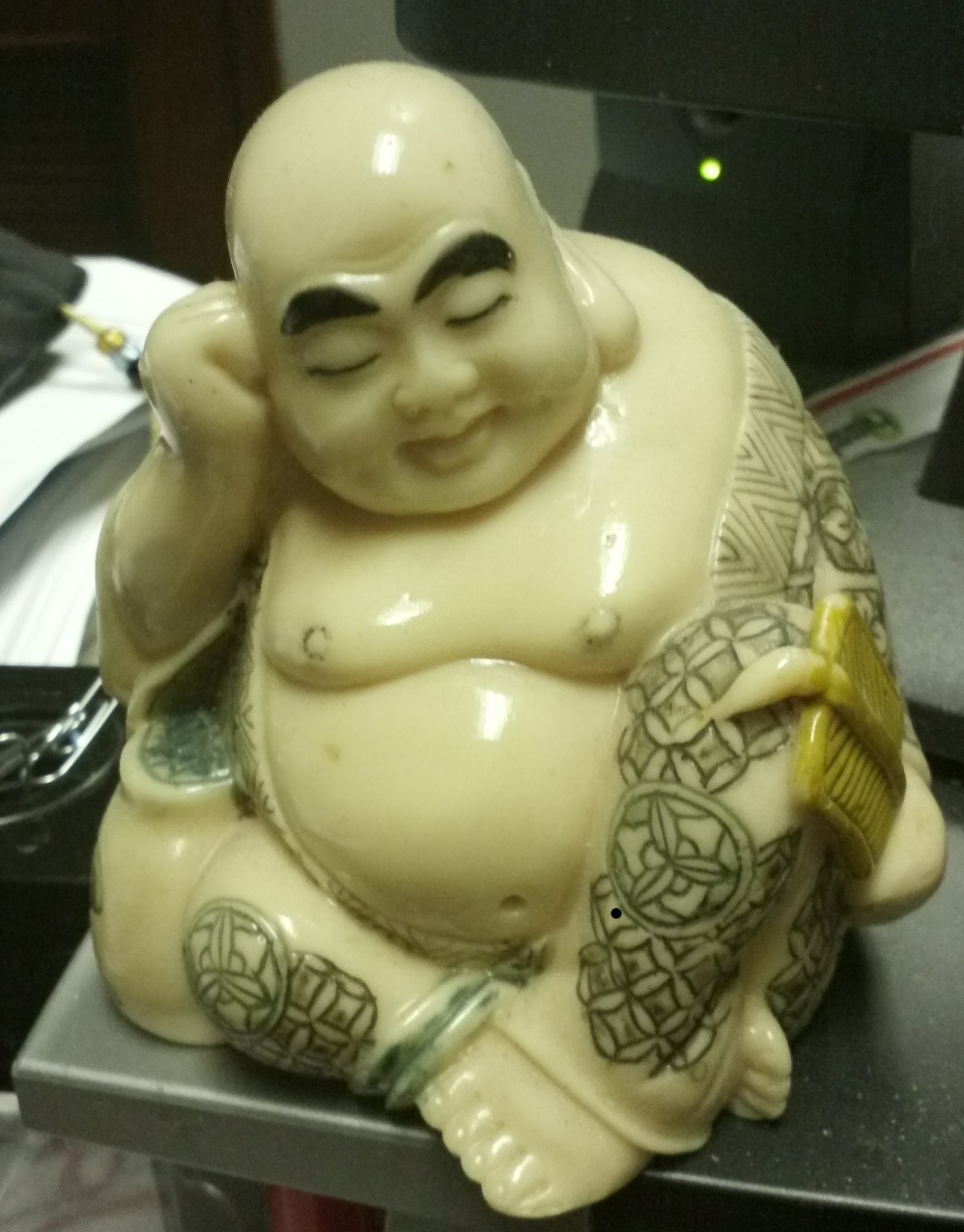
 When I was going through some of my old files looking for something else, I stumbled upon a report I wrote several years ago about a trip my wife and I took to Memphis to the see the “Imperial Tombs of China” exhibition. Since that was the trip that inspired one my favorite early stories, “Golden Bell, Seven, and the Marquis of Zeng,” I decided to reprint the trip report here. It’s pretty long, so I’m going to break it up over the next few days. Continue reading
Author Archives: ogresan

Everything Happens All at Once Slowly
 To Break the Demon Gate proceeds to manifest. One thing most everyone agrees on as to the nature of the traditional publishing paradigm is that everything happens at a pace somewhere between “Don’t Hold Your Breath” and “It’ll Possibly Happen in Your Lifetime.” The exception, of course, is when it comes time to check a copyedit or sign off on a proof. That always had to happen yesterday, or possibly the day before.
I don’t know exactly where we are in the process. So far as I know, we’re still on track for the PS Publishing edition to come out next month. It’ll be close, but still that’s the plan. The cover art is done and approved. The text has been copyedited and proofed. I’ve supplied bio, cover copy, and (gag) author picture. There may or may not be a signed edition. Right now I just don’t know. That was the original plan, but time may argue against it. Since the Prime Books reprint is already set for December, any more delays are not to anyone’s advantage. Still, publishing is like that.
I’ve always been a big believer in traditional publishing, and I still am. I sell a lot more books and get a lot more readers when I go through regular channels rather than when I go it alone. That said, it’s good to have options. I try to be selective about what I do on my own, mostly the kind of stuff that I enjoy but isn’t terribly commercial. I keep my expectations low and I’m rarely disappointed, but It does, however, have the advantage of not driving me loopy.
Waiting tends to do that.
It’s Not That Complicated
 “Everything you want is on the other side of fear.” – Jack Canfield
It’s a little simplistic, but then Occam’s Razor steers us away from the complicated and toward the simple, despite the fact that many of our challenges are not simple at all. Some can be quite complicated: family dynamics, relationships, to name just a couple. Yet when I consider this, I also remember the reverse, a fact demonstrated early on by the Artificial Life hobbyists when computers and their potential for mirroring the “real world” were first being explored, and it is simply this: Simple Behaviors Give Rise to Complicated Systems.
I explored this myself a bit, back in the day. Continue reading
There and Back Again
 So no blog posts for last week. Some of you may have noticed, and for those who did, I figured I owed an explanation. For those who didn’t notice, you can safely ignore this entire first paragraph and skip to the next. Saves time. The blog was interrupted by the real world last week, in that I had to take a trip to a site in another state to help close it down. Sad work, that, and also very physically demanding. By the time I got back to my hotel room each day I was too wiped out to do anything constructive. I only managed to get in my guitar practice once, and that barely so. The one time I got finished a little early, it was off to a Teavana® and Godiva® stores, respectively, to make sure I didn’t return home empty-handed on Valentine’s Day. I also stopped at Guitar Center to look at acoustics out of my price range. I’m only a little ashamed of that.
After that, it was home to a different sort of worry. I received an email from PS Publishing telling me it was cover copy, bio, and picture time for To Break the Demon Gate. Cover copy and bio time isn’t a big thing. I can usually find something to say about a book after I’ve written it. It’s when they want such things before it’s written that I usually have trouble. No, the thing that gets me every time is when publishers want a picture. And I think why? Don’t you want to sell books? All by way of saying that I am not the most photogenic person I know. Cameras haven’t liked me since the first time I went to college. I don’t know why. I can’t recall anything I’ve ever done to them, but there it is. The last decent picture of me was taken around 1977, when I had long hair and looked slightly stoned even though I almost never was. Since then it has been all downhill. I keep hoping publishers will forget about wanting a picture. They never do. So it goes.
Yes, that it is a high class sort of worry. It doesn’t rank anywhere near “I don’t know where I’m going to sleep tonight” or “Am I going to eat tomorrow?” but it still manages to be a concern. I should be a better person than that, but I’m just shallow that way. Feet of clay, soul of washi. I am, like everyone else, still a work in progress. Maybe one day I’ll do better.
This is a Conversation, Not a Speech

Rusalka by Ruth Sanderson
Notice the lovely painting to the left, “Rusalka,” by the amazing artist, Ruth Sanderson. I was reminded of it by a FB post by the writer Theodora Goss, said post being about a different matter altogether (we can discuss serendipity on another day). But I recognized the painting she’d referenced immediately. Partly because I’m fond of Sanderson’s work, but mostly because that very painting was the original illustration for “The Swan Troika,” (Realms of Fantasy, February 2011) my final story in that much missed magazine (Seriously. Show me a current fantasy magazine with the same ecumenical spirit toward the genre that ROF had). If you’ll look in the left background, the guy in the funny-looking sleigh is Pyotr on his way to his fateful meeting with the rusalka in question.
Ahem. Yes, I’m getting off of the subject. Of which there is one, implied in the blog title. Ursula Le Guin once said something to the effect that a story is just marks on wood pulp (or pixels on a screen) until someone reads it. That reading is an act of creation itself and the story isn’t complete until it’s read. I have no argument with that. We want people to read our work, complete it, create their own inner vision to echo the one in our own heads. It won’t be the same vision, but that’s kind of the point. There aren’t just two sides to every story, there are as many sides as there are readers for that story, and the more the merrier.
Sometimes, though, it goes even beyond that. “Rusalka” exists because I wrote a story and the editors at ROF commissioned an illustration of it. You cannot fathom how pleased I was when I saw its original appearance in ROF. After all, I’m no artist. I could never have created my vision of that scene the way Sanderson did. Instead, she showed me hers. I was and am thrilled.
I will now contrast that with an incident from a writer’s group I was involved with. The Heavenly Fox had just been published and another writer in the group really liked it. So much so, that he announced that he was going to write a Springshadow story of his own, at which point I was forced to stand on his head until the impulse passed. Okay, not literally. But you get the idea. I was not thrilled. A little flattered, sure. But not thrilled.
So why the difference? Well, one is an act of re-creation. The other was copyright infringement. As in any conversation, you know when one party has crossed the line. Granted, it’s a fine line. Or rather a tightrope that we all walk when it comes to what happens to a story once it’s out in the world. In a sense, to send a story out into the world is to cede control of it. Legally it may belong to you, but practically? Things will happen that you didn’t count on. My own opinion goes beyond legalities though. As I’ve mentioned before, I don’t care who has the right to continue the Hitchiker’s Guide to the Galaxy series. So far as I’m concerned, that series ended when Douglas Adams died. Sure, I know that’s unrealistic. Knowing that doesn’t change the way I feel.
Yes, reading is a creative act in itself, and stories were designed to be read. That’s kind of the point of them, but another thing they are is a conversation between the writer and reader. It’s an act of communication that, in the right context, creates something grander than the sum of its parts, witness that painting. Experience that a few times and you won’t wonder why we get cranky when someone tries to turn the conversation into a monologue.
 Richard Parks