Unknown's avatar

About ogresan

Richard Parks' stories have have appeared in Asimov's SF, Realms of Fantasy, Fantasy Magazine, Weird Tales, and numerous anthologies, including several Year's Bests. His first story collection, THE OGRE'S WIFE, was a finalist for the World Fantasy Award. He is the author of the Yamada Monogatari series from Prime Books.

In Which I Diss Zombies

I’m having a bit of an internal monologue, which I’m going to share here in lieu of actual content. Sometimes I have to think about these things, whether there’s any good reason to do that or not. My thought for today is a mediation on why I’ve never written about zombies.

Yes, why? Good question, and I’d like to thank me for asking it. Not that I have a good answer; I don’t fully understand my motivations for doing or not doing anything. But if I had to guess, I’d say it’s for the same reason I have never written a story about werewolves or unicorns: they just aren’t very interesting. Ok, I know that some people who read here are very fond of zombies and/or werewolves and unicorns, so before you get the knives out, let me explain: They just aren’t very interesting. ‘Kay. Now you can get the knives out.

 Is there a point buried in this pile of nonsense somewhere? No promises, but maybe I can borrow a few knives to dig it out, as we seem to have a few handy. I could dwell on why zombies aren’t interesting–there’s the lack of complex motivation (ala Romero) or the lack of any higher brain function (ala traditional). Scary? Sure. Horrifying? You betcha! Interesting? Not so much. Yet I know that these are simple rationalizations after the fact. It’s perfectly possible to write a zombie story where neither of those restrictions apply, just as it’s quite doable to write a good werewolf or unicorn story. I’ve read a few. One or two I’d rate as classics in the field, so it can be done and has/is being done. Just not by me.

Why? They just aren’t very interesting.

And here we are again. It’s not even that, as subjects, they’re pretty cliché. Subjects become cliché for a reason, and just because their ubiquity level has been raised to cliché it does not mean that new and interesting work can’t be done. As penance for my lack of appreciation, I will now inventory fantasy clichés in my own work:

  • Fairies/fey? Check.
  • Vampires? Only twice, but check.
  •  Dragons? Multiple offenses.
  • Witches/Wizards? Ditto.
  • Sphinxes? Yep.
  • Ancient Gods/Goddesses? Darn right.
  • Demons? Uh-huh. Just ask Yamada.
  • Monsters? Duh.
  • Ghosts? All the time, and Eli Mothersbaugh’s specialty.
  • Deal With the Devil? And proud of it!
  • Mermaids? Of course.
  • Personifications, as in Death or Fate? Guilty.

Let’s face facts here—anyone who’d willingly write a “Deal with the Devil” story is capable of anything. So why no zombie, unicorn, or werewolf stories? They just aren’t – [Visual of the blogger being whapped on the nose with a rolled-up newspaper. Heaven knows where they found one] Besides being painful, that interruption reveals the true answer. Why no zombie, werewolf, or unicorn stories? Because there aren’t any, as in “aren’t any rattling around in my brain.” No matter how many times I turn the notion in my head, it just comes back to this. I’ve already talked about recognizing a story when you see one, and this is the real reason I’ve never done unicorn stories or zombie stories or werewolf stories–I just don’t recognize anything relating to them as a story.  It’s really as simple and ungrammatical as that. The fact that I don’t find them interesting is effect, not cause.  I haven’t had a zombie or unicorn or werewolf story to write. In the case of the unicorn, I can’t see the point. Until and unless I come up with something that is at least as interesting to me on a story level as Peter Beagle’s The Last Unicorn or Theodore Sturgeon’s “The Silken Swift,” the subject is a closed door. If I ever do get such a notion, the door will spring open and I’ll find that particular subject is as interesting as anything I’ve ever written about and I’ll eat whatever steaming plate of crow is required. Will it happen? Dunno. I’d say it’s even odds. But until then, “They just aren’t–”

[Whoosh] Ha! Missed me!

The Cute, it Burns Usssss

But you’ll have to take my word for it, since we have absolutely no pictures. We visited a friend this weekend, two of whose mares had just foaled less than a week ago. Two little paint foals, mostly long legs and big heads dashing around the paddock, trying to figure out why mom was so attracted to that dry grass stuff, discovering that the clear liquid in the trough was okay, but not nearly as good as what came out of mom’s spigots, and basically figuing things out. Both moms a little nippy where the younglings were concerned, so we all kept our distance so as not to make them nervous.

I do wish I’d brought a camera.

Joe and Jane Newbie Vs the CLM

It’s a maxim that the avocation of writing takes a certain amount of intelligence. At least, that’s the theory. Yet sometimes I wonder if writers as a group just aren’t very bright.

Example: a (legit) agent was talking about his recent experience on an online writer’s board. As soon as he identified himself as an agent, he was immediately tromped on as a scam agent trolling for clients. No discussion, no hesitation, no deliberation, no question. Bam. Guilty. Now, granted that this agent is a fairly new one and yes, there are a lot of scam agents out there and it’s wise to be cautious. Yet one would think “cautious” would include doing your bloody homework. One would think so, but apparently to some of my brother and sister writers this is an alien concept. The result of which is that yet one more potentially helpful pro will now avoid new writers’ discussion boards like the proverbial plagues of Egypt, when five minutes on Google, tops, would have prevented the writers in question from making total asses of themselves.

Is this complicated? I don’t see how. And it’s not that unusual, I’m afraid–you see nonsense on this level on a weekly basis. Online posts like this (real, but paraphrased to protect the guilty) “Agent so and so liked the book I sent her and she’s offered to represent me. Has anyone heard of her? Is she legit?”

Facepalm, shortly followed by headdesk. Continue reading

In the Palace of the Jade Lion

When Realms of Fantasy closed it had two of my stories in inventory, and now that the contracts are signed I can mention that the first of them, “In the Palace of the Jade Lion,” has sold to Beneath Ceaseless Skies. This is a 12,000 word ghost story set in ancient China during the Warring States period, and the first non-Yamada story that I’ve placed there.

I’m rather proud of this one. Which I suppose is the kind of thing a writer would normally say, but it’s true. I think it’s a fun story and I’m rather pleased with the way it turned out. Naturally I’m happy that it found a good home.

And Now For Something Completely Different – But Not Pythonesque

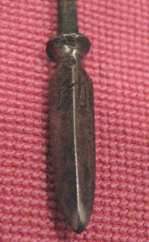
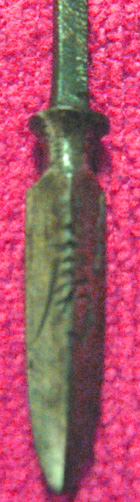
Maybe it’s true that every boy needs a hobby, but I don’t really have a proper one. No time. I do have interests, often sparked by research I’ve done for writing-related reasons. One of them is Japanese arms and armor before the Meiji Restoration. My most recent acquisition is a togari-ya style yanone, or arrowhead, probably from the Edo period(early 17th-mid 19th C), signed “Sukefusa.” Here’s where it gets interesting (to me, anyway. YMMV)—just because the arrowhead is signed with the name Sukefusa, it doesn’t mean it was actually made by a smith with the art name Sukefusa. Japanese smiths had a long history of signing the names of more famous smiths to the weapons they made, for the obvious reason that a more famous smith could command a higher price. Also, sometimes the samurai liked to carry a “famous name” weapon even if they knew it wasn’t legit, because such names were thought to bring luck. Weapons with false signatures are known as “Gimei” or “false name.” For example, I own a sword blade signed Ichinohira Yasuyo, who was a famous smith from Satsuma province in the 18th century. The sword was almost certainly not made by Yasuyo, and probably not even in Satsuma province. So how does one tell if the mei (name/signature) on the weapon is real? A proper expert can look at a sword blade and not only tell you roughly when it was made, but what school/tradition of swordsmiths made it, and sometimes the particular smith. The mei would be the last thing they look at, not the first, and then the mei would be compared to known signatures by that smith. Only then would there be a judgment on the authenticity of the signature.

Which brings me back to the yanone. Another one turned up about five years ago on a discussion group dedicated to this sort of thing. I’ve compared the signature on mine to that one, and I’m satisfied that they were done by the same smith. Considering the difficulty of getting information on him, odds are this smith is fairly obscure, and therefore less likely to have his mei copied. The catch is that no one’s sure who he is. As with most smith names, more than one smith worked under the name “Sukefusa,” the most famous one dating from the 13th century. I’m reasonably certain this arrowhead was not made by that one. The MMA in NY has a yanone in its collection also signed Sukefusa, which they date from the 18th century. Problem is, they don’t have a picture of it online, so I can’t compare this signature to that one. If I’m ever in New York, I’ll have to go look. In the meantime, and as time permits, it’s like doing detective work. I want to know who this particular Sukefusa was, where he worked, what other things he did.

The arrowhead is a lovely object just as an object, but that’s only half the fun.