Unknown's avatar

About ogresan

Richard Parks' stories have have appeared in Asimov's SF, Realms of Fantasy, Fantasy Magazine, Weird Tales, and numerous anthologies, including several Year's Bests. His first story collection, THE OGRE'S WIFE, was a finalist for the World Fantasy Award. He is the author of the Yamada Monogatari series from Prime Books.

How We Got Here

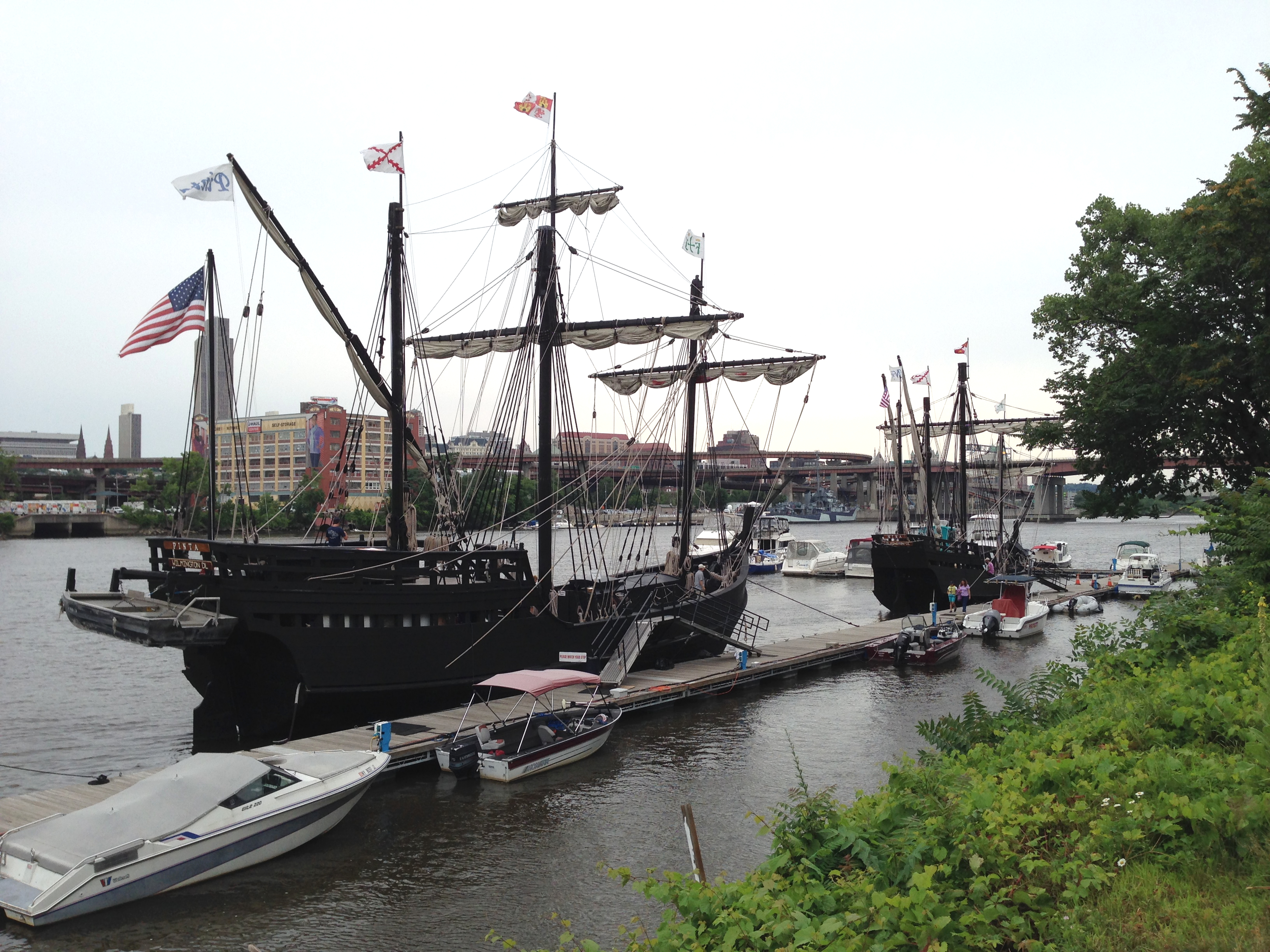
View of the Pinta and Nina Replicas, Hudson River 2017
Photo by Carol Parks

I blame the Matriarchy. Which is a silly way of saying it’s First Reader’s fault. She’s the one who bought me one of those DNA tests for Christmas. And yes, I know—they really can’t tell you a great deal of specifics, more in broad swaths, and to be fair this one didn’t say anything I either didn’t already know or strongly suspect, though I was open to surprises. There weren’t any, but that’s neither here nor there. The real trouble started because the test included a temporary membership in an online genealogy site.

Oh, dear.

One of my compulsions is research. It’s proved to be a very handy compulsion, especially in tackling projects like the Yamada saga, but unfocused it can be a time sink, and now I was staring right at one. Being a child of divorce was part of the problem, but even on my mother’s side the family memory didn’t go back much before the Depression. In short I grew up knowing almost nothing about the origins of either side of the family, and I admit to being curious. Anyway, combine opportunity with curiosity and there was no way I could resist.

So what did I learn? Bits of trivia of little interest to anyone else, really. Not that I’m not going to bore you with them.  I admit to being a little surprised—my father’s family emigrated much earlier than I’d supposed, mid 1600’s, and arrived just twenty years after Virginia was granted its royal charter. Right now I’m stuck at about 1595 on that side. My mother’s side, on the other hand, easily traces back to some guy named Ralph in the 14th century. The only surprise there was that they were of the knightly class and had a “seat” near London, which they later sold to the Tufnells. (Spinal Tap fans will appreciate the reference). They came over about the same time as my father’s family, or possibly a little earlier.

One thing both sides of the family had in common was just this—they were immigrants, arriving much to the annoyance of the people who were already here. And I don’t want to hear “legal vs illegal”–if you were able to (or forced to) come here, you did. That’s how it worked.

So maybe we should cut the new people a little slack? Just saying.

Story Time: Keeping Lalande Station

Today’s Story Time is something a little different–an actual science fiction story, “Keeping Lalande Station,” originally published in Future Orbits #2, back in 2001. I wish I had something relative to say about the story. I remember the process of writing it, but the genesis? No clue. Then again, it’s a story about illusion and reality, so whatever I think about it might not be relevant. I wrote it, I know that much. After that, it all gets a little fuzzy, not unlike my protagonist’s mental state.


Standard Note: “Keeping Lalande Station” will stay online until next Wednesday, February 28th, when it will be replaced by…something.

Process

I’m a little tardy with this today, but at least I have a good excuse—I was working through the editor’s notes on “An Account of the Madness of the Magistrate, Chengdhu Village.” Did anyone out there think the job was done once the story was written? Heh. Quite often, that’s the easy part. Then there’s marketing, deciding where you’d like a story to be published—and no, the answer is NOT “anywhere that will take it.” You have to be picky about those things, even from the beginning. If your first venue turns you down, then you consider where next, but only then. If you believe in your work, you want a showcase, not just a venue.

Then, if you’re lucky enough to get the story placed where you want it, odds are more than likely there will be galleys, probably electronic these days, and it’s time to revise the story again, this time taking into account where an editor thinks it can be improved. You can agree or not—it’s your story—but be very clear on what you’ll accept and what you won’t, and keep your ego out of it. The goal on both sides is to make the story the best it can possibly be, and there WILL be things you missed, points in the story where you didn’t consider all the implications of your text. Keep an open mind, but fight—politely—for your vision. A good editor will not try to turn the story into something you didn’t intend. She is your ally, not the enemy.

And, when all that is done and out of the way, comes the waiting. Again, though this time it’s for the story to be published. As with submissions, the time passes easier when you don’t have your eggs in that one basket. Write the next one.

Time to take my own advice.

Story Time: The Last Romantic

In honor of Valentine’s Day, this week’s Story Time is a love story…sort of. “The Last Romantic” originally appeared in MIke Allen’s MYTHIC #1 back in 2006. It was written long before that, a reminder that sometimes a story stays in your files because the right venue for it does not exist…yet. I’m not sure if patience really is a virtue, but it sure is necessary.


Standard Disclaimer: “The Last Romantic” will remain online until next Wednesday, February 21st. Then it won’t be.

Incapussitated

Incapussitated (n) The inability to do the thing because there’s a cat in your lap demanding all the attentions.

It’s not in the dictionary, but it should be.  Happens frequently here, but then there’s always an excuse not to do the thing, whatever it is.  Take this blog, for prime example. I didn’t write anything for twenty minutes because there was a cat on my lap. Now, technically I could have continued writing despite the constant pawing for attention, but I chose to respond to the demands of my fellow living creature. Who, it must be known, finally had enough and jumped down to go elsewhere. Incapussitated (alt. incapurritated) is always a temporary condition.

Blind, crippling self-doubt? Yeah, that one’s always around. Yes, of course it helps to know that you’ve done the thing before and very well and can surely do it again.

And yet….

It never goes away. Not completely. In some ways it gets worse. When you’re first trying to do the thing, you don’t know you can’t do it. You don’t know that you can. That uncertainty actually works in your favor as a partial antidote to crippling self-doubt because you don’t know, and so neither does crippling self-doubt, and maybe you’re both a bit curious. So why does it get worse after you’ve actually done the thing? (Pausing to note here the obvious point that “the thing” can be anything from writing a novel to learning to play a musical instrument. It doesn’t much matter what the thing is because there’s always a new thing, and crippling self-doubt trying to ruin it for you.) I think it’s easier to argue with yourself that a skill was lost rather than never being gained. Sure, you did it once—pure luck—but I bet you can’t do it again. Or, sure you’ve done it a dozen times—obviously you’re played out now, just repeating yourself, best quit while you’re ahead, et many a cetera.

If there’s a cure I don’t know what it is, except just to do the thing anyway, one battle at a time.

Allowing for incapussitation, of course