A Word About Conventions

WRITING 02If you’re a writer in the sf/f tradition, the subject of conventions is going to come up sooner or later. If you’re coming to writing through fandom, chances are that you’ve been attending conventions for a considerable length of time and what is there to talk about? And then there are those new authors who get told by their editors or other close associates that “You really need to attend conventions” and they go “Conventions? What’s that?”

What it is often called, or was before sub-genre fragmentation took over, is “A Gathering of the Tribes.” (Though some reserve that term for WorldCons) Fans and writers and artists and such folk gathering together on a weekend to meet each other, talk shop, drink in the bar, hang out with friends, sometimes attend panel discussions and readings, maybe meet your favorite author. That kind of thing. There’s usually one going on somewhere, most weekends.

I still remember my very first, long before I was selling. I was never a real fan, mind you. Probably for the same reasons that I’ll apply to the subject of conventions in a minute, but I was a reader and aspiring writer, and I knew about them. Usually they were taking place a long way from where I had just started work after college, and I had no travel budget to speak of. However, I learned of one within driving distance, and it was JUST IMAGICON, being held that year in Memphis, TN. It was back in 1978, and as for the convention itself, you can probably imagine what it was like for someone like me: Theodore Sturgeon. Kelly Freas. The de Camps. It was, and I say this without either irony or hyperbole, like walking among gods. Continue reading
Muse and Writer Dialogues #10

Chapter4FADE IN

 A room that passes for an office. There are bookshelves on one wall, a motley assortment of carvings, signed storyboards, and framed magazine covers on the free wall space. On the far wall is a medieval-style heraldic wall display of a cockatrice and a banner in bad Latin “Pullus non Est.”  Horizontal files sit beneath the window , and on top of those  there used to be a free-standing rack holding Japanese swords, only they had to be removed because of the cats. The computer desk is on the wall nearest the door, facing away from the window. Beside that is a printer on a stand. In the base of that is a PC and a PS3. The PS3 is not currently in use.

Enter the  MUSE, currently in her Greek goddess mode. Writer is sitting at the desk, watching an instructional video on the computer.

MUSE: What are you doing?

WRITER: Taking a music lesson. I’m learning to play “Bad Moon Rising.”

MUSE: You are not a musician. You are a writer, and you’ve got writing to do.

WRITER: First, I’m not a musician YET.

MUSE: Stop kidding yourself. You don’t have the knack. You know it and I know it. Continue reading

Good Literature Should Taste Good, Too

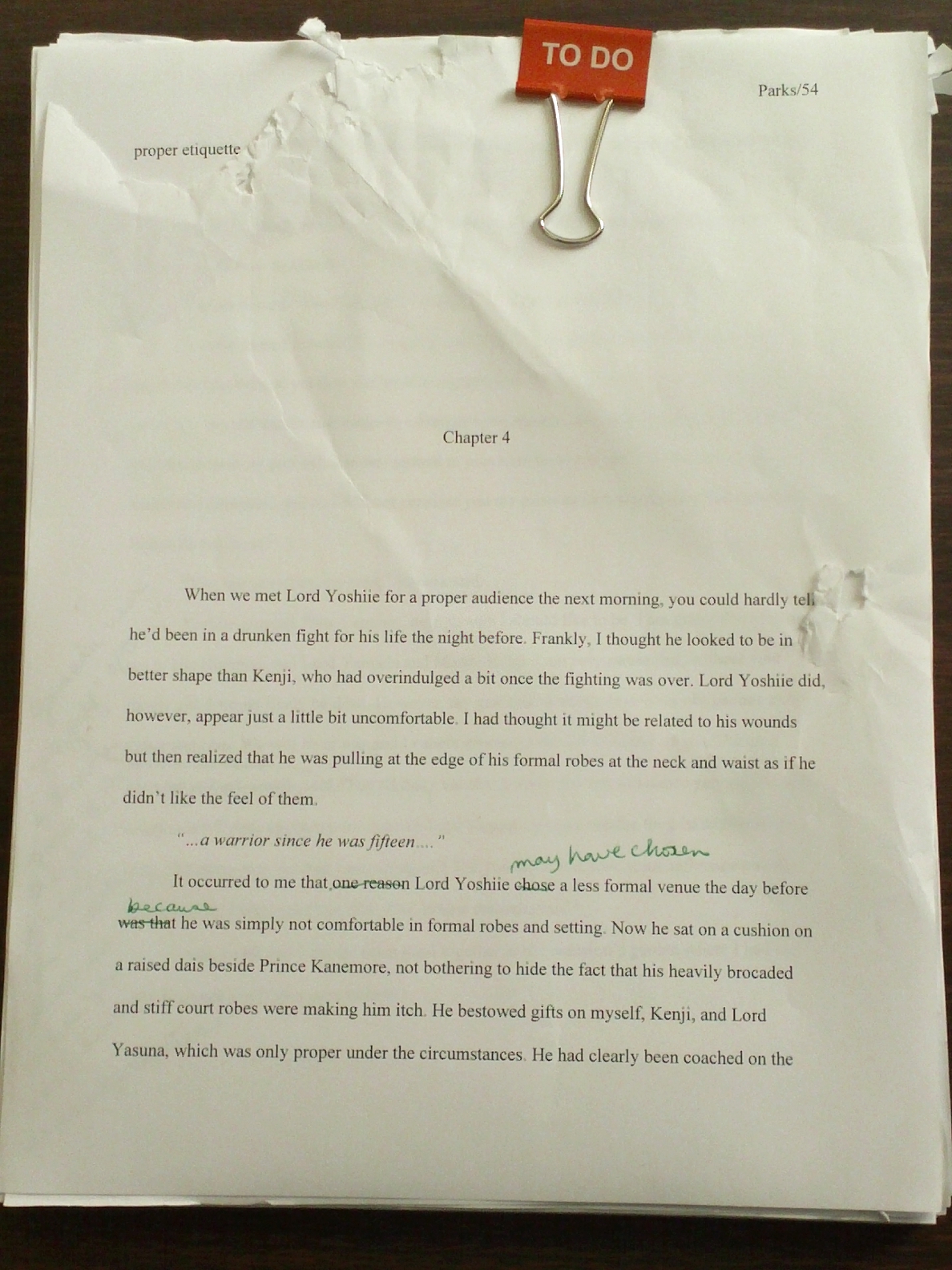
Chapter4Apparently First Reader is not the only resident who gets to have a say in regards to The War God’s Son. Sheffield the Cat had some incisive (incisors?) commentary on the lead to Chapter 4. You can see his commentary expressed with his usual directness. The green marks are from First Reader. There’s precedent, of course. The late great Early the Cat used to sit in my manuscript boxes, back when hardcopy was everything and I always printed out the day’s progress. I imagine to this day in some of my papers there are manuscripts with calico cat hair between the pages….

Oh right. Present day, if not present tense. As is pretty typical at this stage of the process, for my own part I have an alternating love/hate relationship with the text. Sometimes I just zip through revisions, and at others I can’t stand to look at it. Sometimes I think it’s among the best things I’ve ever done, at others, not so much.  As I said, typical. The jury’s still out with First Reader, though she is quick to point out that my punctuation is atrocious (her word, not mine). I beg to differ. My punctuation is not atrocious. It’s commas, mostly. I think commas should do what I want them to do, and I put them where I darn well want. She says commas do what they are grammatically required to do, belong only where they are required to belong. I think this is a philosophical divide that we may never manage to bridge.

As for Sheffield, he pronounces Chapter 4 “chewy.” Something he can really get his teeth into.

Surfing for Survival

FoxMaybe not literally, but as far as visibility and career are concerned. I’ve been thinking about the question of career survival because it finally occurred to me that I’ve been shifting gears a bit lately when it comes to my own writing, in that I’m doing more novels these days, and fewer short stories. Now, for many cases that’s just considered par for the course, and was once considered the only course—you started off writing short stories, with the intention of getting good enough to sell them to the major magazines, of which there were several. If you were planning any sort of career, then part of the plan was to build up your name recognition through short fiction and then use that visibility to transition to novels. Short stories were never considered to be an end in themselves in that scenario. Sure there were probably as many exceptions as not, and writers who started with novels from day one and were either barely or sometimes not at all aware that the magazines even existed. I wasn’t one of those. I discovered the magazines at about the same time that I started to write in the first place, and I began with short stories, and the first novel I ever wrote I thought was going to be another short story, until an editor took pity on me and informed me that what I had submitted was not a short story, but the opening chapter to a novel, and so it later proved. Regardless, the short story was my go-to form. Continue reading