
Me: I’m home!
She: Good. I finished painting the bathroom cabinet doors this afternoon. Can you put them back up for me?
Me: Okay.
(Note: Small bathroom. Room for me and the stepladder. No one else. Leftmost door hinges are two inches from the wall. Tricky. I shut the door because otherwise I can’t reach the cabinets)
Me: (grunting incoherently as I wrestle the first door into place)
She: (on the other side of the door) Can I help?
Me: Not unless you can reach through walls.
She: Ha ha.
Me: (More incoherent grunting.)
She: I’ve been thinking about the two shower curtains, trying to decide. Remember?
Me: (Grunt, wrestle, trying to think also) Umm… The owl and the bird?
She: Yeah. I’m leaning toward the owl.
Me: (dangerously leaning toward falling). Uh huh.
She: What do you think?
Me: (Now an incoherent mumble, because I’m trying to hold wood screws in my mouth while lining up one hinge).
She: What was that?
Me: (Thinking that this isn’t a good time to be discussing decor, keeping such thoughts to myself). Continue reading
Category Archives: real life
Muse and Writer Dialogues #6 – “Anger Management”
FADE IN
A room that passes for an office. There are bookshelves on one wall, a motley assortment of carvings, signed storyboards, and framed magazine covers on the free wall space. On the far wall is a medieval-style heraldic wall display of a cockatrice and a banner in bad Latin “Pullus non Est.” Horizontal files sit beneath the window , and on top of those a free-standing rack holding Japanese swords, and a pile of unsorted papers, old mail, receipts. The computer desk is on the wall nearest the door, facing away from the window. Beside that is a printer on a stand. It’s a bit dusty.
Enter the Muse. Her appearance tends to change every now and then, but mostly she appears as a Greek goddess type in a flowing chiton. She is glaring at Writer, who is sitting at his desk, but he’s not looking at the screen. He is also glaring, though at nothing in particular.
MUSE (tapping foot): Why am I here?
WRITER: You’re my muse.
MUSE: This I know. I mean why am I here now? You’ve got a project to write and you’re already well into it. I will appear at various times to give you little shoves in the right direction, but that’s it. Nothing of the sort is currently indicated.
WRITER: The Ideal of Inspiration is not confined to writerly projects. What if I need help with something else?
MUSE: Such as?
WRITER: Well…why am I so damn angry?
The Cute, it Burns Usssss
But you’ll have to take my word for it, since we have absolutely no pictures. We visited a friend this weekend, two of whose mares had just foaled less than a week ago. Two little paint foals, mostly long legs and big heads dashing around the paddock, trying to figure out why mom was so attracted to that dry grass stuff, discovering that the clear liquid in the trough was okay, but not nearly as good as what came out of mom’s spigots, and basically figuing things out. Both moms a little nippy where the younglings were concerned, so we all kept our distance so as not to make them nervous.
I do wish I’d brought a camera.
And Now For Something Completely Different – But Not Pythonesque
 Maybe it’s true that every boy needs a hobby, but I don’t really have a proper one. No time. I do have interests, often sparked by research I’ve done for writing-related reasons. One of them is Japanese arms and armor before the Meiji Restoration. My most recent acquisition is a togari-ya style yanone, or arrowhead, probably from the Edo period(early 17th-mid 19th C), signed “Sukefusa.” Here’s where it gets interesting (to me, anyway. YMMV)—just because the arrowhead is signed with the name Sukefusa, it doesn’t mean it was actually made by a smith with the art name Sukefusa. Japanese smiths had a long history of signing the names of more famous smiths to the weapons they made, for the obvious reason that a more famous smith could command a higher price. Also, sometimes the samurai liked to carry a “famous name” weapon even if they knew it wasn’t legit, because such names were thought to bring luck. Weapons with false signatures are known as “Gimei” or “false name.” For example, I own a sword blade signed Ichinohira Yasuyo, who was a famous smith from Satsuma province in the 18th century. The sword was almost certainly not made by Yasuyo, and probably not even in Satsuma province. So how does one tell if the mei (name/signature) on the weapon is real? A proper expert can look at a sword blade and not only tell you roughly when it was made, but what school/tradition of swordsmiths made it, and sometimes the particular smith. The mei would be the last thing they look at, not the first, and then the mei would be compared to known signatures by that smith. Only then would there be a judgment on the authenticity of the signature.
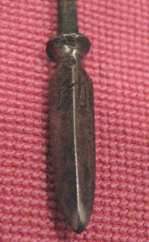 Which brings me back to the yanone. Another one turned up about five years ago on a discussion group dedicated to this sort of thing. I’ve compared the signature on mine to that one, and I’m satisfied that they were done by the same smith. Considering the difficulty of getting information on him, odds are this smith is fairly obscure, and therefore less likely to have his mei copied. The catch is that no one’s sure who he is. As with most smith names, more than one smith worked under the name “Sukefusa,” the most famous one dating from the 13th century. I’m reasonably certain this arrowhead was not made by that one. The MMA in NY has a yanone in its collection also signed Sukefusa, which they date from the 18th century. Problem is, they don’t have a picture of it online, so I can’t compare this signature to that one. If I’m ever in New York, I’ll have to go look. In the meantime, and as time permits, it’s like doing detective work. I want to know who this particular Sukefusa was, where he worked, what other things he did.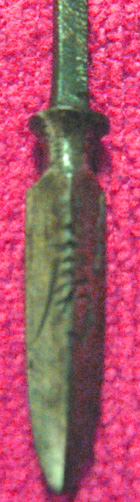
The arrowhead is a lovely object just as an object, but that’s only half the fun.
Scenes From a Marriage
At the last writer’s group I scribbled a note to myself on the back on a manuscript I was working on. First reader saw it lying face down on the printer with the note clearly visible.
She: “What’s this? ‘VooDoo Christmas’? Is this what this story’s about?”
Me: “No, that one’s not ready to show yet. The note is my assignment for next week. 500 words on the theme ‘VooDoo Christmas.’”
She: “You mean like Papa Legba meets Papa Noel?”
Me (Having that flash of RECOGNITION in mid sentence): “No…I mean YES! That’s it exactly!”
And it was. “Cold Christmas,” finished this morning. Only it was 1300 words, not 500. Whatever the story wants, the story gets, but still pretty short for a story from me. But all kudos to First Reader. My story, but her idea.
 Richard Parks