 Originally appeared in Science Fiction Age, May, 1994.
Proteus in the Underworld, by Charles Sheffield, Baen Books, 299 pages
Proteus in the Underworld is the latest in Charles
Sheffield’s Proteus series. For readers–like me–who discovered
this series late, it’s set in a future where a delicate balance
of hardware, software, and bio-feedback allow human beings to
transform themselves into a nearly infinite variety of
alternative physical forms. This has allowed humanity to adopt
specialized forms suited to almost every solar environment from
Mars to Saturn to the Oort Cloud. It also has extended human
life spans, nearly eliminated disease and deformity and rendered
cosmetic surgery both obsolete and superfluous.
Note the emphasis on ‘human.’ Only human beings have proved to
have the required combination of intelligence and will that
allows them to interact with form change machines and the
bio-feedback that is at their heart. This truism has been
formalized as the “humanity test,” and all children of a certain
age have to pass the test or be sent to the organ banks. For a
test with such potentially dire consequences to be acceptable it
has to be objective, accurate, and foolproof. So when several
so-called “feral forms”–little more than mutated monsters–born
in the outer solar system pass the humanity test handily but
prove to be neither human nor even sentient this presents a
problem.
Sondra Wolf Dearborn is the agent of The Office of Form
Control assigned to find the solution. Sondra has little field
experience and is in over her head. She’s smart enough to know
it and seeks help from her distant relative, the nearly legendary
Behrooz “Bey” Wolf. Bey wolf is the retired former head of the
Office of Form Control and a master of form change theory and
practice. He’s the perfect choice, only Bey Wolf is busy now
with his own private research and has no intention of being drawn
back into the problems and politics of his old department.
Of course things don’t work out that way. The mere fact
that Sondra contacted him at all sets in motion a chain of events
that draw them both deeper into the mystery of the feral forms,
and the onion layers of conspiracy within conspiracy that are at
its heart. Soon everyone from the Old Mars Policy Council to
Gertrude Zenobia Melford, head of the powerful Biological
Equipment Corporation and the richest person in the solar system,
are after Bey Wolf’s services. It doesn’t take a genius of Bey
Wolf’s caliber to see that something odd is going on. Just what
that is and the mostly separate paths Bey Wolf and Sondra
Dearborn take to piece the mystery together is at the heart of
this book.
There’s another emphasis. Mystery. Despite the sfnal
trappings I think the book also qualifies as a
mystery novel, in that the central puzzle is the driving force
behind most action. Charles Sheffield is a working scientist and
his affection for ideas and speculation shows clearly in this
book–his design for a form-changed human who can survive on the
surface of Mars is as neat a bit of speculation as you’ll
find–but here most of that serves as foundation for what is
essentially a mystery plot. At one point Robert Capman, a
form-changed human living on Saturn, goes so far as to inform
Sondra that “…Based upon what you have told me and what I have
told you, you have enough information to complete without
assistance from anyone the task assigned to you by the Office of
Form Control.” Shades of an Ellery Queen episode. “If you’ve
been watching–closely–you have all the clues you need” is how I
remember it, but the challenge is the same, for Sondra and the
reader. The information is there–solve the mystery.
This isn’t a condemnation by any means. Such cross-overs
have a long and distinguished history and if genre cross-over
leads to the kind of literary diversity that the genetic kind
creates in the biological sphere, I’m for it. The only question
remaining is how well this particular example works.
Pretty well, I think. One slight problem I had with the
book was in Sheffield’s handling of point-of-view. Scenes that
were told from one POV sometimes had little asides that were
clearly not from that character’s viewpoint. It tended to jar.
The story flow was strong enough to keep me going, but it would
have been a nicer trip without those little bumps. I also wish
he’d spent a little more time showing the effect of the
form-change technology on day to day life, but the book’s focus
is clearly elsewhere. The author’s interest is on the big
picture consequences of the technology, and that perspective
forms part of the denouement of the book.
Though it takes a little time for someone new to the series
to absorb the background, Sheffield makes it painless enough,
filling in what history is needed when it’s needed. Someone
already familiar with the series would doubtless have hit the
ground running. Sheffield also manages to include a few
interestingly oddball characters along the way, though it’s no
surprise that he’s at his very best when depicting scientists
happily working within their chosen specialties/obsessions.
It may be a stereotype that readers of hard sf like good ideas
better than good characters, but there’s enough of both here for
balance. There’s also a neat little tag at the end that’s not so
much a twist as an implied promise. I don’t know where or if
Sheffield plans to go with it, but I admit it–I’m curious.
Which may be the point.

 Some thoughts triggered by the Nightshade Books edition of the collected letters/correspondence between H.P. Lovecraft and Donald Wandrei, and something aside from HPL’s questionable attitudes for the moment. Rather, this is about something we share as writers. Now, it’s true that modern sf/f/mystery writers sometimes lament the passing of the old “glory days” of the pulps. We imagine a sort of golden age when people read instead of playing video games or zoning in front of the television, and there were literally hundreds of potential markets. We conjure by those ancient tomes: Weird Tales, Argosy, Amazing Stories, Black Cat, et many a cetera. While the pay wasn’t great except in the slicks, a person with a good work ethic could make a decent living writing short stories and novel serials and little else. And, I admit it, I’ve been guilty of looking backward with rose-tinted glasses myself, even though I know making that living required soul-crushing hackdom and turning out product by the ream. It’s nostalgia for a time I never knew and thus tends to ignore all the horrific truths of living in that time; it’s not supposed to be accurate.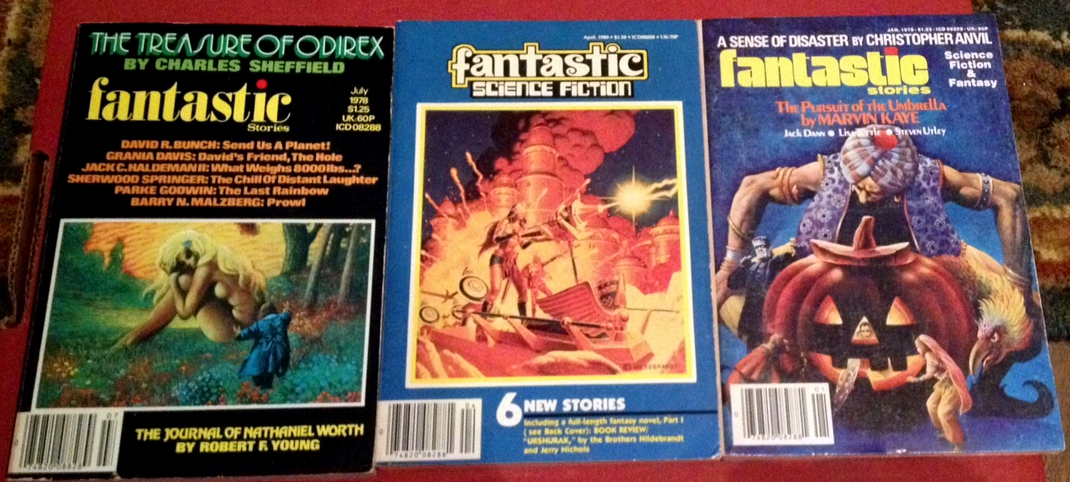



 Richard Parks