Yamada’s Saga – Timeline

Japanese Mask

It occurs to me, with the mixing of short fiction and novel-length stories that make up the Yamada timeline, that it might not be a bad idea to set this all out now, at least to the degree I understand it (and if you think the writer knows everything about what they’ve done, think again). Most of the stories occur in the timeline/continuity in the order that they were written, but the novels do throw one or two curves into the mix, so here goes:


“Fox Tails” – First Yamada story written. Knew it was a series then, didn’t know where it was going.

“Moon Viewing at Shijo Bridge” – Second Yamada story. Yamada’s sad history with Princess Teiko is revealed. This was the story where I think I first got a good handle on who Yamada was and what he was about.

YAMADA MONOGATARI: DEMON HUNTER.  First Yamada collection. The stories contained therein were usually a reader’s first introduction to the series and were published over a span of years and appear in the order they were written, but the continuity is not complete in them because….

Here’s where it gets a little complicated:

TO BREAK THE DEMON GATE.  First actual Yamada novel. TBTDG incorporates “Moon Viewing at Shijo Bridge” which forms the first section of the book, and no, I didn’t know that it was the first section of a novel when I wrote it. I figured that out later. The balance of the novel concerns the events leading up to Yamada’s final confrontation with Lord Sentaro. This was written after several of the stories appearing in YM:DH but before “The Ghost of Shinoda Forest,” which ends the collection, but in the continuity of the series, they all, except “Fox Tails” and “Moon Viewing at Shijo Bridge,” occur after the events of the novel. At the end of TO BREAK THE DEMON GATE, Yamada has still not made peace with the memory of Princess Teiko. That comes later (see “The Ghost of Shinoda Forest.”) I’m not sure when the PS Publishing limited edition is coming out, but Prime Books has the trade reprint scheduled for December 2014.

“The Sorrow of Rain” – If you have no idea what this story is, that is because it hasn’t been published yet. But it falls in the timeline before “The Ghost of Shinoda Forest” but after TO BREAK THE DEMON GATE.(Edited to note: Oops. It falls after “The Ghost of Shinoda Forest.”  I misremembered.)

THE WAR GOD’S SON – complete but under revision. The events of this book occur about seven years after “The Ghost of Shinoda Forest,” and take place after all the short stories written to date in the continuity. The novel is set during what is usually referred to as The Nine Years’ War in Japanese history (though, with delays and truces, it was more like twelve). The tearing of the social fabric that will eventually bring about the end of the Heian Period and the rise of the samurai is already evident, but won’t manifest completely for another hundred and twenty years. We also get to meet Yamada’s elder sister. There is no current publication date scheduled.

And that’s where it stands. Confused? I would be. I often am.
Muse and Writer Dialogues #10

Chapter4FADE IN

 A room that passes for an office. There are bookshelves on one wall, a motley assortment of carvings, signed storyboards, and framed magazine covers on the free wall space. On the far wall is a medieval-style heraldic wall display of a cockatrice and a banner in bad Latin “Pullus non Est.”  Horizontal files sit beneath the window , and on top of those  there used to be a free-standing rack holding Japanese swords, only they had to be removed because of the cats. The computer desk is on the wall nearest the door, facing away from the window. Beside that is a printer on a stand. In the base of that is a PC and a PS3. The PS3 is not currently in use.

Enter the  MUSE, currently in her Greek goddess mode. Writer is sitting at the desk, watching an instructional video on the computer.

MUSE: What are you doing?

WRITER: Taking a music lesson. I’m learning to play “Bad Moon Rising.”

MUSE: You are not a musician. You are a writer, and you’ve got writing to do.

WRITER: First, I’m not a musician YET.

MUSE: Stop kidding yourself. You don’t have the knack. You know it and I know it. Continue reading

Good Literature Should Taste Good, Too

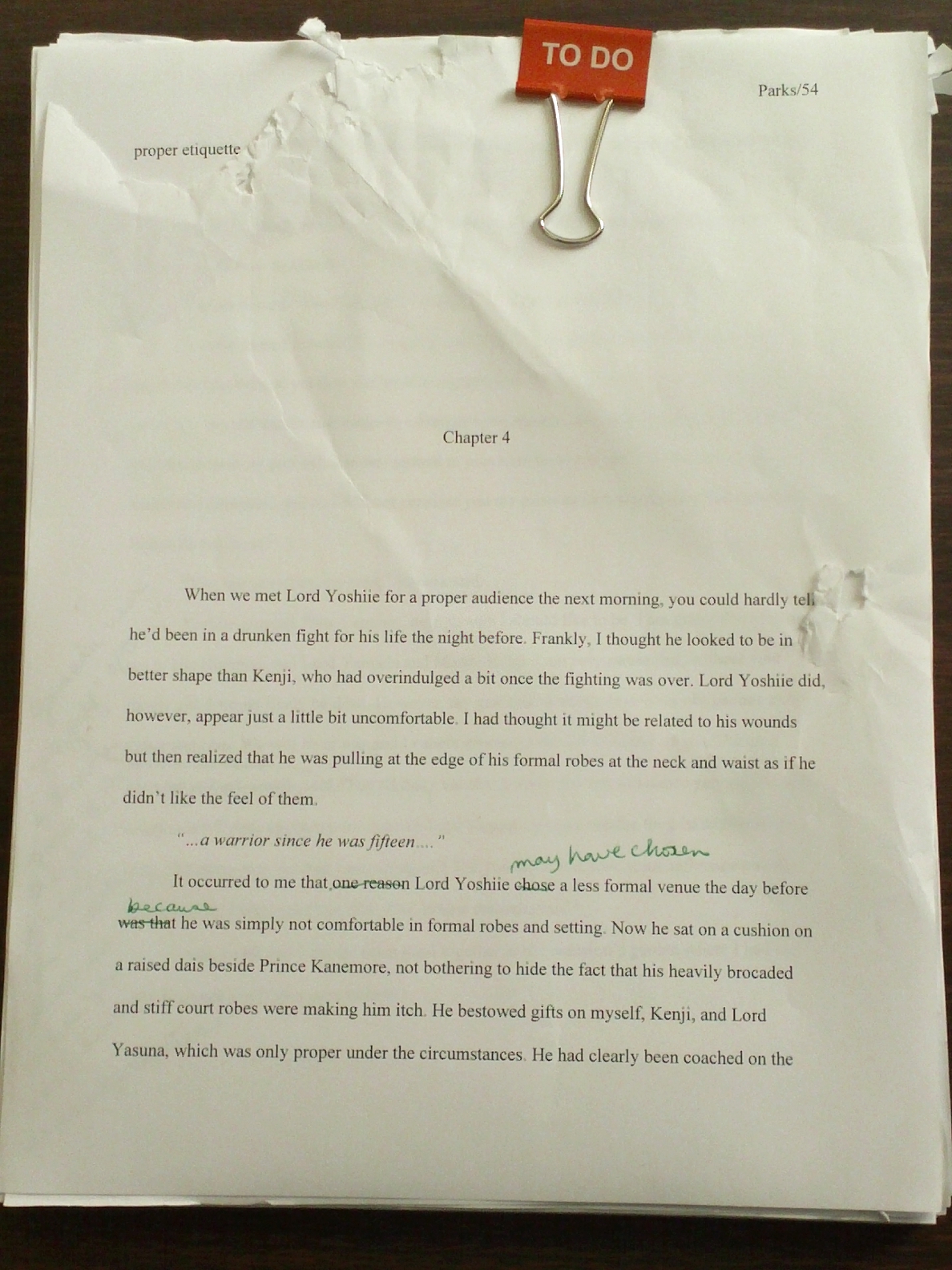
Chapter4Apparently First Reader is not the only resident who gets to have a say in regards to The War God’s Son. Sheffield the Cat had some incisive (incisors?) commentary on the lead to Chapter 4. You can see his commentary expressed with his usual directness. The green marks are from First Reader. There’s precedent, of course. The late great Early the Cat used to sit in my manuscript boxes, back when hardcopy was everything and I always printed out the day’s progress. I imagine to this day in some of my papers there are manuscripts with calico cat hair between the pages….

Oh right. Present day, if not present tense. As is pretty typical at this stage of the process, for my own part I have an alternating love/hate relationship with the text. Sometimes I just zip through revisions, and at others I can’t stand to look at it. Sometimes I think it’s among the best things I’ve ever done, at others, not so much.  As I said, typical. The jury’s still out with First Reader, though she is quick to point out that my punctuation is atrocious (her word, not mine). I beg to differ. My punctuation is not atrocious. It’s commas, mostly. I think commas should do what I want them to do, and I put them where I darn well want. She says commas do what they are grammatically required to do, belong only where they are required to belong. I think this is a philosophical divide that we may never manage to bridge.

As for Sheffield, he pronounces Chapter 4 “chewy.” Something he can really get his teeth into.

All the Gates of Hell – Incarnate Edition

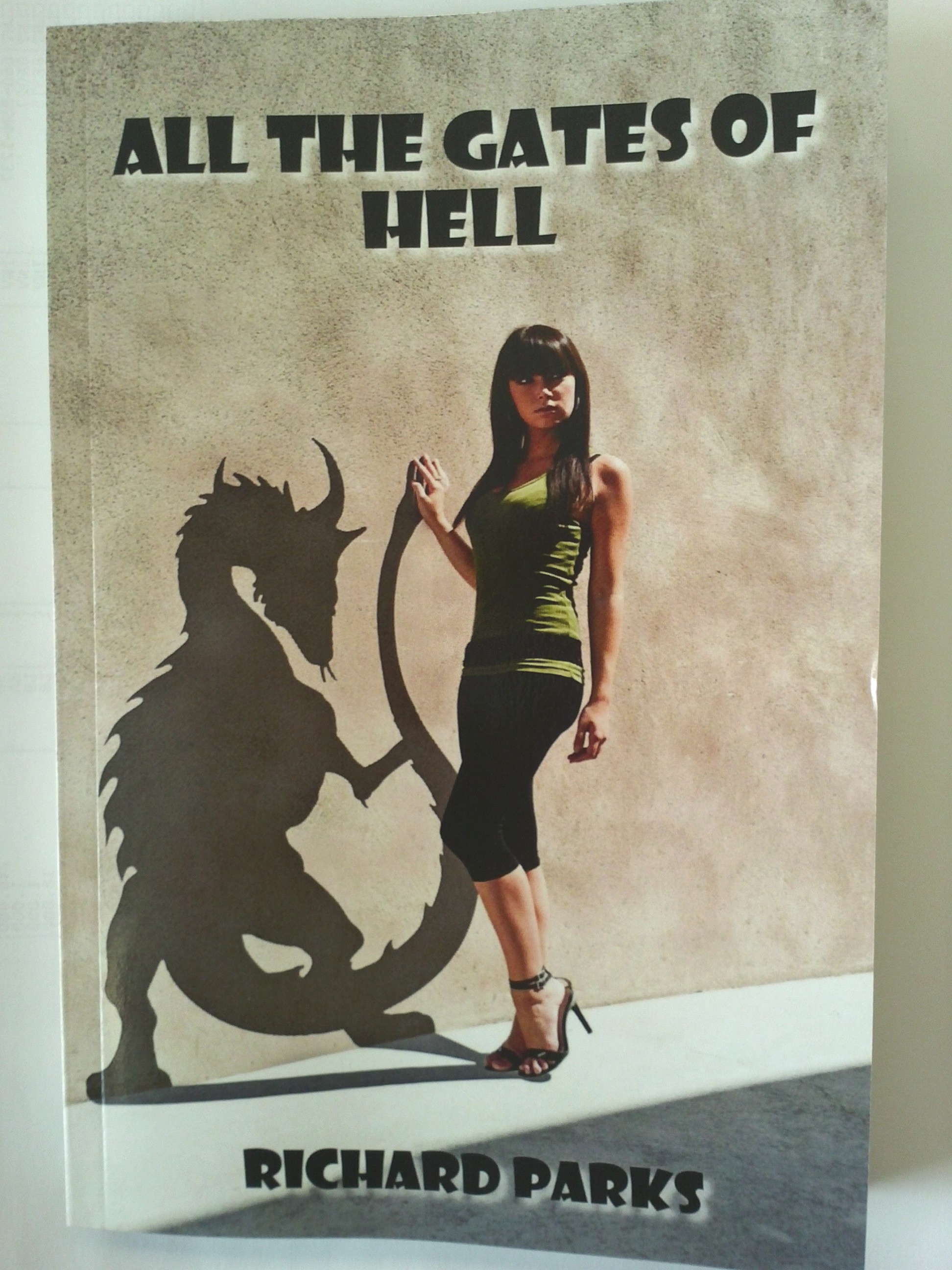
ATGOH-Proof CopyTo our left is a picture of the printed proof copy of All the Gates of Hell that arrived on my doorstep day before yesterday. The picture isn’t that great (cameraphone), but the book itself turned out pretty good, in my own opinion. So for anyone not yet ready to embrace the ebook revolution, there is now an actual, real book that you can hold in your hands and, you know, read. You can order from Amazon at the link above or directly from your favorite bookseller.

ISBN-10: 1492993263
ISBN-13: 978-1492993261
300 pages, $11.99

“Legal Assistant Jin Lee Hannigan thought she had problems enough as a single woman in rundown Medias, Mississippi. That was before Jin meets a homeless man on Pepper Street who just happens to be the King of Hell, and learns that she’s really the mortal incarnation of Guan Shi Yin, the Buddhist Goddess of Mercy, charged with the rescue of unfortunates trapped in the various — and nasty — hells scattered around the cosmos. That doesn’t even turn out to be her biggest problem. It seems that the Goddess of Mercy is on the run and in hiding, which is why she incarnated as a human in the first place. Hiding from what?
Love.
But why would anyone fear love? Jin already knows that love is powerful, but what she has to learn, and fast, is that the wrong kind of love is also potentially the most destructive force in all the universe and–even more important–how to stop it.”

Surfing for Survival

FoxMaybe not literally, but as far as visibility and career are concerned. I’ve been thinking about the question of career survival because it finally occurred to me that I’ve been shifting gears a bit lately when it comes to my own writing, in that I’m doing more novels these days, and fewer short stories. Now, for many cases that’s just considered par for the course, and was once considered the only course—you started off writing short stories, with the intention of getting good enough to sell them to the major magazines, of which there were several. If you were planning any sort of career, then part of the plan was to build up your name recognition through short fiction and then use that visibility to transition to novels. Short stories were never considered to be an end in themselves in that scenario. Sure there were probably as many exceptions as not, and writers who started with novels from day one and were either barely or sometimes not at all aware that the magazines even existed. I wasn’t one of those. I discovered the magazines at about the same time that I started to write in the first place, and I began with short stories, and the first novel I ever wrote I thought was going to be another short story, until an editor took pity on me and informed me that what I had submitted was not a short story, but the opening chapter to a novel, and so it later proved. Regardless, the short story was my go-to form. Continue reading