There Are Five Lines

As I’ve mentioned before, not terribly long after I moved north I joined a local writer’s group. I’ve belonged to a few before, and while the experience hasn’t always been a complete success, usually the presence of other writers and the sharing of works supplies a boost of motivation to get my own work done, and that’s something we all need now and again. The difference this time is that this group specializes in flash fiction, which is new(ish) for me and under the aegis of the local library, with links to the wider community.

In short, the library and a local theater group leader are collaborating to turn some of the work from the flash fiction group into podcasts. There are grants involved and other official stuff, but mostly it will involve the members reading their own work, either as part of audio anthologies or even single author audio collections. A lot of this hasn’t been worked out yet, but it appears promising. In preparation we were asked to list some of our favorite lines from the flash pieces we’d done within group.

I mean, sure, I’m doing it, but I have to admit these sort of listings make me a little uncomfortable. First, in any unified (I hope) work, a single sentence out of context loses…well, context. Some of my favorite sentences make absolutely no sense if separated from the sentences around them, so I had to take that into account. Then again, I’m reminded of Damon Knight’s opinion of “killer” first lines, in that the problem with those is that you spend the rest of the time trying to justify the line rather than just telling the F%%%#G STORY. So my openings tend not to be so killer, just, I hope, grabbing enough to get you to the next line, and the next, and so on until the end. So I couldn’t just pull out opening lines…except sometimes. Hey, no one’s perfect.

Regardless, and with all the caveats listed or implied above, here are the five lines I’ve chosen:

Sentence 1:

“There’s a crow’s nest in the crow’s nest, sir.”

Sentence 2:

“I wasn’t sure what a secret was, but apparently it was some sort of dangerous animal that needed confining.”

Sentence 3:

“I’m going to tell you three stories, only two of which are true.”

Sentence 4:

“Everyone dances…sooner or later.”

Sentence 5:

“Right, of course it was—all I had to do was tell the Queen of bloody Elfland to sod off and everything would have been jolly.”


Present…With an Explanation

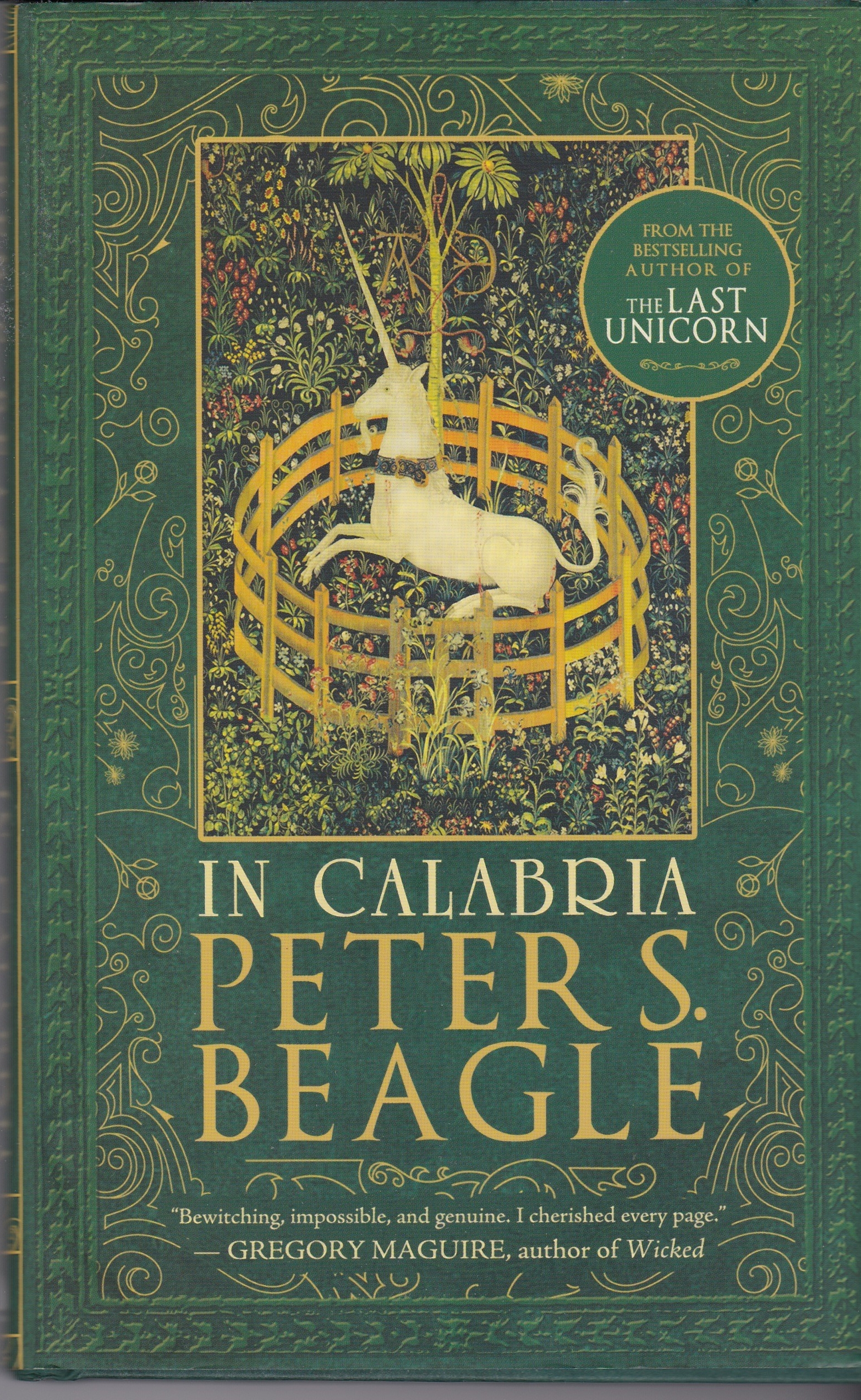
All right, I’ll cut right to it–I had planned to have a review of Peter S. Beagle’s In Calabria (Tachyon, February 2017) before now. That the book is over a year old is as good an example as any of how useless I am to anyone as a review blogger, which makes me no never mind since that was never my intention here in the first place. Once I reviewed for magazines with deadlines and everything and I never missed one, but then I was usually getting paid for it. Now I pay for my own books, I review what I want to when I want to, thanks very much, and that’s all there is to it.

Ahem. Slight digression there. Regardless, I’m not ready to review the book because I’m not through reading it. That’s taking a while, and not because it’s a doorstop. It is definitely not. It’s a slim volume beautifully produced by Tachyon Publications, lovely to look at, and at first glance the sort of thing any halfway decent reader could tear through in an afternoon. So could I, if it was a book by almost anyone other than Peter Beagle. So some of you might understand that I am going slowly, savoring, and am in no bloody hurry to finish.

Another reason is that I always–always–approach Beagle’s work with a bit of caution, if not trepidation. Peter Beagle is never a light read, and I never come to it lightly. I understand that I might have my heart ripped out; it’s a risk that comes with anything of emotional depth and utter truth. I’m embarrassed to say how long it took me to get to his The Innkeeper’s Song, but in my defense I did so, but long after any such review would have served either the author or the publisher’s interest nearly as much as something less reverent but more relevant and–most important–timely might have. I’ll have to give my regrets in advance here, too.

Will I have it next time? Doubtful. But I’ll likely be a chapter or two closer, for what little that may be worth to anyone other than myself.

Sorry (Not a Bit Sorry).

Everything’s Conditional

Weird weather yesterday. First it snowed for fifteen minutes to a half hour, then the sun came out and melted the snow, then the clouds came back and it snowed again. Lather, rinse, repeat all day long. It felt something like being back in MS, getting the remnants of whatever latest hurricane had just pounded the coast. What we got further inland (other than wind) were bands of cloud and rain, one after the other until the storm completely dissipated. Substitute snow for rain and you get the same effect.

Speaking of conditions—other than weather—I’m going to talk a little about writing conditions, as in conditions favorable for getting something, anything, done. It’s a bit Captain Obvious to point out that this varies. Some people can work anywhere, such as a bookstore display window, which Harlan Ellison has famously done. Or in crowded, noisy coffee shops, which is so common as to be a cliché, these days. I’ve never needed an ivory tower myself, which is a darn good thing considering the rent. My only real need, however, I have to express as a negative.

I do not need a television screen anywhere within sight of me.

See, I was a TV baby, one of the generation that grew up after the darn things were ubiquitous. My earliest exposure to f/sf was not Ray Bradbury, Andre Norton, or Robert Heinlein. Nope. It was (really dating myself even more now) The Twilight Zone, The Outer Limits, and Fireball XL-5 (to this day I can still sing that hokey theme song). Books came later, but at least they did arrive, thank goodness, but I never did completely escape the boob tube’s clutches. To this day, if one is on within sight of me it draws my attention, no matter what crap is on. I’m not proud of it, but that’s just the way it is. When I was a kid I would often do homework watching the Adam West Batman or Dark Shadows with no problem at all. However, I’ve tried writing in front of a TV and it’s just impossible. The best I ever managed was, while living in a small apartment, writing with my back turned to it where it functioned more like a radio. In that configuration I could turn it into background noise and get on with working. Anywhere in front of me? Forget about it, and that holds true even today.

There are times when it would be more social and certainly convenient to work in front of one of those things, but it’s just impossible. Which is why I have to keep a library/study room wherever I am with no TV in sight. Computer screen? No problem, even with video streaming available, since it’s not the same thing. A TV?

That would be a “no.”

Story Time: What Power Holds

Today’s Story Time is from Dragon Magazine #209, September 1994, back when Barbara Young was fiction editor and before TSR was bought out by (ugh) Wizards of the Coast. The story itself was the first in the “Laws of Power” universe that eventually led to the novel series.

Treedle was first. The character, like Golden Bell from “Golden Bell, Seven, and the Marquis of Zeng,” was from a dream. He and Black Kath appeared, along with elements that eventually came together into the very first scene. It was all about Treedle in the beginning, but it was only when Marta showed up that the story came together and I knew it was a series. Treedle’s part was done once the first few stories became part of Black Kath’s Daughter, which, oddly enough is the second book in the series, not the first, because later I figured out that The Long Look was really the first book in the series, and Tymon the Black was in the same universe (yeah, I know. Sometimes I’m a little slow that way). “What Power Holds” remains the actual first story written in that universe.

Confused? Me too. I just go with it, and things usually work out. My subconscious is way smarter than I am.

Standard Note: “What Power Holds” will stay up until next Wednesday, April 4th. And then, not.

Cutting to the Chase, or Chasing Cuts

Yesterday I wrote a short fairy tale, because I had a deadline and I like fairy tales. Either is reason enough on their own, but together? Kind of compelling. The story is about a girl and a magic fife, or rather it concerns those two; what it’s really about is a separate matter. It’s kind of like most stories that way.

See what I did there? I rambled a bit. Went off on a rather wordy tangent. Drifted from the point somewhat. Repeated myself, and then got redundant. All perfectly acceptable things to do, I might add, in a rough draft of a story. Because, as I’ve pointed out before, the job of a rough draft is not to be good. The job of a rough draft is to be done. “Good” is what the rewrite is about, and aside from continuity, structure, and thousands of other fiddly bits, one of the most important skills when approaching “good” is knowing when you’ve repeated yourself, gotten wordy, gone off on tangents, etc., and cutting it out mercilessly.

Lest you think I’m lecturing you, I will hasten to point out that I’m simply reminding myself of something I need reminding about every so often. See, when I wrote the story yesterday it only went about 700 words. Too short, right? Nope. The problem was it was too long. The strict length requirement was 500 words, and I had 200 more words than I could use. And it wasn’t a “simple” matter of cutting out 200 words; we also have to take into account the fact that any story is likely to need more words in certain spots, such as where a reasoning must be clarified, or a connection needs to be made explicit. Suddenly that 200 words is starting to look more like 300, to make room for words that are needed, or over 42% of the entire draft.

Here’s the first paragraph as I originally wrote it:

“Once upon a time there was a girl named Callie who played the fife. It was an old fife, a bit battered yet still capable of sweet music in the right hands. It had belonged to her grandfather. He taught her to play, and when he felt his time approaching, passed the instrument down on the condition that she care for it until her time came, when she was to pass it along as he had done. Cassie loved her grandfather and she loved playing the fife, so she agreed to everything he said.”

A bit wordy but not terrible. But I had to get those words from somewhere, and Callie’s relationship—and agreement—with her grandfather is already both implied and made explicit at other points in the story, where they serve better. So….

“Once upon a time there was a girl named Callie who played an old fife she had from her grandfather. She played for local dances and gatherings, and the people swore they had never heard sweeter music.”

Ninety-four words down to thirty-seven. The kick is that the first paragraph actually got longer than what you see here, because I combined the original first three paragraphs into one no longer than the original first. Which had the double virtue of removing excess words and getting to the story’s main conflict a lot sooner(kind of important in a 500 word story). For anyone who preferred the first paragraph the way it was, I’ll just point out that a piece of fiction, just like a sonnet, has to fit the parameters. When something has to go, it’s the writer’s sole judgment call as to what works and what doesn’t, and right or wrong doesn’t enter into it.

Only the reader gets to decide that part.