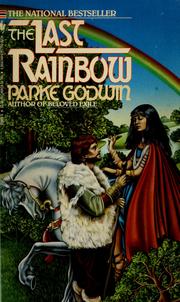
Review: The Last Rainbow by Parke Godwin

Continuing the purge of my old writing files after a hiatus to paint the master bath. Not only am I finding stories I never published (no surprise there, not every story is a winner), I’m finding stories and articles I’d forgotten I’d written. One of which was a fairly detailed review of Parke Godwin’s The Last Rainbow. I was reviewing for the long gone Fantasy Review at the time, and as I was going through my old file I found a letter from the editor telling me they already had a review of the book, so my review was never published and I’m including it here. There are a couple of spoilers, for those among you who believe that what happens in a book is what the book is really about, so fair warning.

The Last Rainbow. Originally published by Bantam Spectra Books,
1985.

Parke Godwin’s The Last Rainbow is subtitled “A Novel of Saint Patrick” and that’s certainly true—in the same sense that Firelord was about King Arthur and Beloved Exile, Guenivere. As in it’s true so far as it goes, but it doesn’t go nearly far enough.

Novels about legendary figures are nothing new—the bare bones of fact and myth always beg for the flesh of the storyteller’s art, but to say that the vein has been mined before is to completely miss the point. What sets our best writers apart is not chosen genre, social consciousness, or even prose style. It is their ability to look at a subject, any subject, from their own unique perspective and let the rest of us see what they see. Communication is the heart and soul of any good story. Anything less is just ‘connect the dots’ and word games. T.H. White used “The Matter of Britain” in his The Once and Future King to reflect his own society, and if the images in his mirror are cloaked in fancy they’re never hidden. John Gardner took the Anglo-Saxon epic Beowulf and turned it on its head, telling the story from the monster’s point of view in the masterful Grendel, and suddenly we’ll never again be quite so righteously complacent in the hero’s triumph. Agree or not, we will look again, and wonder.

All of which is a roundabout way to point out that Godwin works a kindred magic in The Last Rainbow. He takes the stone statue life of Saint Patrick, and with a superb artist’s eye, patiently chips away the gilt of time and dogma to reveal the living flesh beneath. Continue reading →

Year’s Best Science Fiction & Fantasy 2015

rh-ybsff2015Friday’s mail brought my contributor’s copies of Rich Horton’s Year’s Best Science Fiction & Fantasy 2015. I’m in there with “The Manor of Lost Time,” which originally appeared in Beneath Ceaseless Skies. The book also has stories by Robert Reed and Kelly Link and Jo Walton and Elizabeth Bear and Yoon Ha Lee and Ken Liu and Cory Doctorow and…well, you get the idea. Lots of people. It also includes a summary of the year and a recommended reading list, in all 575 pages packed. You could do worse.

I heard back from Paula Guran at Prime Books that the revisions to The War God’s Son are good and therefore complete, and it’s off for a final copyedit and typeset, so we’re on schedule for the October release. I’ve also been admonished to get started on the next one which, assuming I can get myself together, will be out in 2016. The revisions to Power’s Shadow have run into the same delay that’s put pretty much everything on hold, but I’m hoping it won’t be too much longer.

The downed tree has been removed and we’re still getting our house ready to sell. Besides boxing up our lives we’ve been painting for the past week. Also sniffing a lot of paint fumes, though not by choice. It’s all part of the process.

Review: Legends, Edited by Robert Silverberg

WRITING 02Note and Disclaimer: This review originally appeared in SF AGE back around 1998, and I’m not changing a word of it. I think of these as much as time capsules as reviews. Speculations that panned out or didn’t, hopes dashed, whatever, are par for the course of time.


LEGENDS edited by Robert Silverberg, Tor Books, September 1998,
hc, 703 pp, $27.95, ISBN: 0-312-86787-5

In LEGENDS, Robert Silverberg has brought together eleven of
the most currently famous and best-selling authors in sf&f, each
telling a new story set in their own chosen milieu. It’s a great
idea in theory, and couldn’t have been easy to manage, yet manage
he has. Let’s see if the fox was worth the chase.
Stephen King leads with a new tale of Roland of Gilead and
his quest for the Dark Tower. In “Little Sisters of Eluria,”
Roland arrives at a dead town on a dying horse. Eluria is empty,
save for one dead body and an oddly marked dog. Or rather,
seemingly empty. After an attack my mutant monsters, Roland
awakens to find himself in the tender care of the Little Sisters
of Eluria, an order of hospitalers. Such care as would soon make
the tender mercies of the monsters look good by comparison.
King can always work the horror element, that’s a given, but
sometimes I don’t think he gets enough credit for the range he
shows, with more or less mainstream work like The Body or his
idiosyncratic take on a fantasy world with The Dark Tower
stories. Those tired of generic fantasy, who sometimes think
that’s all fantasy is, or can be, should really give this
series a try. Continue reading →

Back to Press, and the Great Cleanup

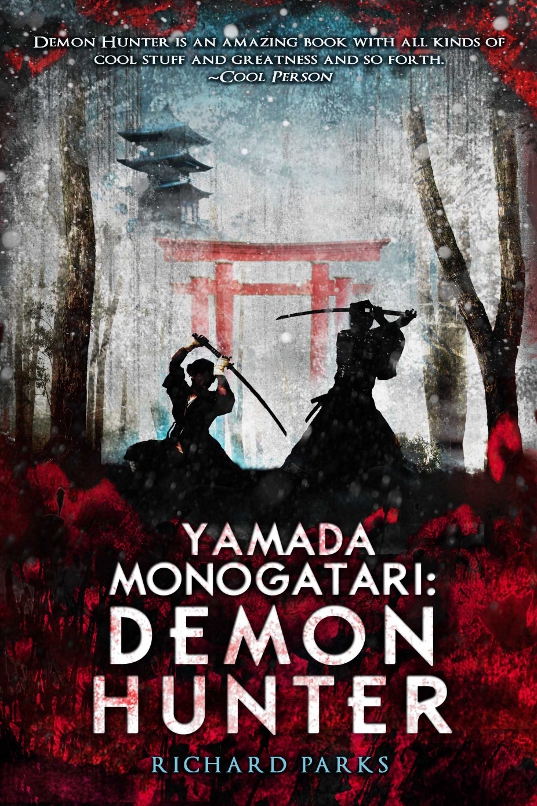
Step4-YamadaFirst off, I got the news a few days ago that Yamada Monogatari: Demon Hunter is going back to press. This makes the third printing. Not too shabby for a book that is, in essence, a themed collection.

Just in time for the 4th, what should appear in my inbox but the copyedited version of the third book in the series,  Yamada Monogatari: The War God’s Son, which both Prime Books and Audible Books are waiting on. Oof. It did remind me of why I usually don’t show first drafts to anybody. It appears that there are certain words and phrases I’m waaay too fond of. “That” is one. There are others. Lots of them. Paula Guran at Prime pronounced the manuscript “structurally perfect,” but stylistically? Not so much until I clean up some of this. Okay, a lot of this. We suffer so that you don’t have to.

Well, not much in the way of suffering, really. While I am embarrassed by some of my writing quirks, re-reading the book in the process is reminding me of how pleased I was with it, overall. Not “satisfied,” because one never is, but pleased none the less. Coming back to it cold after this time away I’m a little relieved to say that I still like it, and maybe some of you will too. It moves Yamada’s story arc forward quite a bit. Plus you get to meet Yamada’s elder sister.

The great file purge is still in progress. I was one of those sods who held onto everything: rough drafts, rejection letters, correspondence, contracts…keeping the contracts, naturally. And some of the correspondence. The rest is either tossed or put through the shredder, depending. It wasn’t as depressing as if could have been, especially when I was reminded of who rejected what story, and with hindsight could either see that they were right or “You passed on that one? WTF were you thinking?”

My shelves are almost bare. Most of my books are already packed away, minus the ones I’m debating whether or not to keep. I hope I won’t need any of my references for a while, though I do need some information on Empress Sadako for the next project. Which I need to get busy on. Which has to wait for the current revisions to be done.

Which means back to work.

Review–Proteus in the Underworld by Charles Sheffield

WRITING 02Originally appeared in Science Fiction Age, May, 1994.

Proteus in the Underworld, by Charles Sheffield, Baen Books, 299 pages

Proteus in the Underworld is the latest in Charles
Sheffield’s Proteus series.  For readers–like me–who discovered
this series late, it’s set in a future where a delicate balance
of hardware, software, and bio-feedback allow human beings to
transform themselves into a nearly infinite variety of
alternative physical forms.  This has allowed humanity to adopt
specialized forms suited to almost every solar environment from
Mars to Saturn to the Oort Cloud.  It also has extended human
life spans, nearly eliminated disease and deformity and rendered
cosmetic surgery both obsolete and superfluous.

Note the emphasis on ‘human.’  Only human beings have proved to
have the required combination of intelligence and will that
allows them to interact with form change machines and the
bio-feedback that is at their heart.  This truism has been
formalized as the “humanity test,” and all children of a certain
age have to pass the test or be sent to the organ banks.  For a
test with such potentially dire consequences to be acceptable it
has to be objective, accurate, and foolproof.  So when several
so-called “feral forms”–little more than mutated monsters–born
in the outer solar system pass the humanity test handily but
prove to be neither human nor even sentient this presents a
problem.

Sondra Wolf Dearborn is the agent of The Office of Form
Control assigned to find the solution.  Sondra has little field
experience and is in over her head.  She’s smart enough to know
it and seeks help from her distant relative, the nearly legendary
Behrooz “Bey” Wolf.  Bey wolf is the retired former head of the
Office of Form Control and a master of form change theory and
practice.  He’s the perfect choice, only Bey Wolf is busy now
with his own private research and has no intention of being drawn
back into the problems and politics of his old department.
Of course things don’t work out that way.  The mere fact
that Sondra contacted him at all sets in motion a chain of events
that draw them both deeper into the mystery of the feral forms,
and the onion layers of conspiracy within conspiracy that are at
its heart.  Soon everyone from the Old Mars Policy Council to
Gertrude Zenobia Melford, head of the powerful Biological
Equipment Corporation and the richest person in the solar system,
are after Bey Wolf’s services.  It doesn’t take a genius of Bey
Wolf’s caliber to see that something odd is going on.  Just what
that is and the mostly separate paths Bey Wolf and Sondra
Dearborn take to piece the mystery together is at the heart of
this book.

There’s another emphasis.  Mystery.  Despite the sfnal
trappings I think the book also qualifies as a
mystery novel, in that the central puzzle is the driving force
behind most action.  Charles Sheffield is a working scientist and
his affection for ideas and speculation shows clearly in this
book–his design for a form-changed human who can survive on the
surface of Mars is as neat a bit of speculation as you’ll
find–but here most of that serves as foundation for what is
essentially a mystery plot.  At one point Robert Capman, a
form-changed human living on Saturn, goes so far as to inform
Sondra that “…Based upon what you have told me and what I have
told you, you have enough information to complete without
assistance from anyone the task assigned to you by the Office of
Form Control.”  Shades of an Ellery Queen episode.  “If you’ve
been watching–closely–you have all the clues you need” is how I
remember it, but the challenge is the same, for Sondra and the
reader.  The information is there–solve the mystery.

This isn’t a condemnation by any means.  Such cross-overs
have a long and distinguished history and if genre cross-over
leads to the kind of literary diversity that the genetic kind
creates in the biological sphere, I’m for it.  The only question
remaining is how well this particular example works.

Pretty well, I think.  One slight problem I had with the
book was in Sheffield’s handling of point-of-view.  Scenes that
were told from one POV sometimes had little asides that were
clearly not from that character’s viewpoint.  It tended to jar.
The story flow was strong enough to keep me going, but it would
have been a nicer trip without those little bumps.  I also wish
he’d spent a little more time showing the effect of the
form-change technology on day to day life, but the book’s focus
is clearly elsewhere.  The author’s interest is on the big
picture consequences of the technology, and that perspective
forms part of the denouement of the book.

Though it takes a little time for someone new to the series
to absorb the background, Sheffield makes it painless enough,
filling in what history is needed when it’s needed.  Someone
already familiar with the series would doubtless have hit the
ground running.  Sheffield also manages to include a few
interestingly oddball characters along the way, though it’s no
surprise that he’s at his very best when depicting scientists
happily working within their chosen specialties/obsessions.

It may be a stereotype that readers of hard sf like good ideas
better than good characters, but there’s enough of both here for
balance.  There’s also a neat little tag at the end that’s not so
much a twist as an implied promise.  I don’t know where or if
Sheffield plans to go with it, but I admit it–I’m curious.
Which may be the point.