
 A Natural History of Hell: Stories by Jeffrey Ford, Small Beer Press, 2016
It’s more than a bit awkward at this point, wanting to get on with the review and wondering if I should first introduce the author, Jeffrey Ford, knowing all the while I shouldn’t have to do anything of the sort. Ford is, no exaggeration, one of the finest writers working in the field he’s chosen to be associated with. Or the field that chose him, since in our culture the kind of thing he tends to do has no real framework outside that of the fabulist. If he’d been born in South America he’d probably be considered a magical realist instead. No matter. It’s all pigeonholes and ways of talking about a thing, rather than the thing itself.
Did I just say all that? My apologies. But that’s what Ford’s work tends to do—send the reader off on tangents of thought and realms hitherto unexplored. After the story ends, of course. Until that moment, the story pretty much has you where it wants you.
There are thirteen stories in this collection, and all of recent vintage. Here you will find modern fairy tales, metafictions where a character named Jeff Ford is part of the story, biting commentaries on modern politics and insanity—lately almost one and the same thing–, observations on wealth and class, and none of the above. What you will really find, excusing the short-hand descriptive phrases attempting to categorize them, are stories. That’s what they are, first and foremost. The words attempting to categorize them above are cheerful failures. The stories are not. Nor are they cheerful.
Seriously. With a title like “A Natural History of Hell,” you were expecting sweetness and light? Oh, you’ll get that, too, but sparingly. There’s a dark, unflinching heart at the center of these stories. It looks in humanity’s mirror and describes what it sees, with neither fear nor pity to hinder it. There’s “The Thyme Fiend,” where only a cup of tea brewed from the herb of the title keeps the horrors at bay, until the time comes when they simply must be let in. Or “Blood Drive,” when an insane premise is logically followed to its insane conclusion and the world turns merrily on. One of my personal favorites, “The Angel Seems,” where common sense humanity shows that it has learned the proper way to treat a god.
Quibbles? Okay, fine. One or two of the endings did not quite come together for me. I only mention this at all because those cases were one of the few times I was forced out of the story into a consideration of plot, which normally you don’t even notice in a Ford story, even though it’s always there. Whatever strangeness is going on, you just go with it. If, for an instant, you can’t, it is noticeable. Fortunately, it is also very rare.
As much as I enjoyed this book, I do confess to being slightly put out by one story. We tend to get that way when we read a story someone else has written and sigh, “Damn. Why didn’t I think of that?” This happened in the centerpiece story, “A Terror,” where Emily Dickinson takes that famed carriage ride with Death. That line from HS English –“Because I could not stop for Death, he kindly stopped for me” is all it takes to set it off. Not that my complaint matters. If I had written a story on this premise, it would not have been like this. Ford did it his own way, which now seems to me the only way, and he owns it.
He owns all of it. Thirteen stories only Jeffrey Ford could have written. Fortunately for us, he was around to do it. May he write many more.
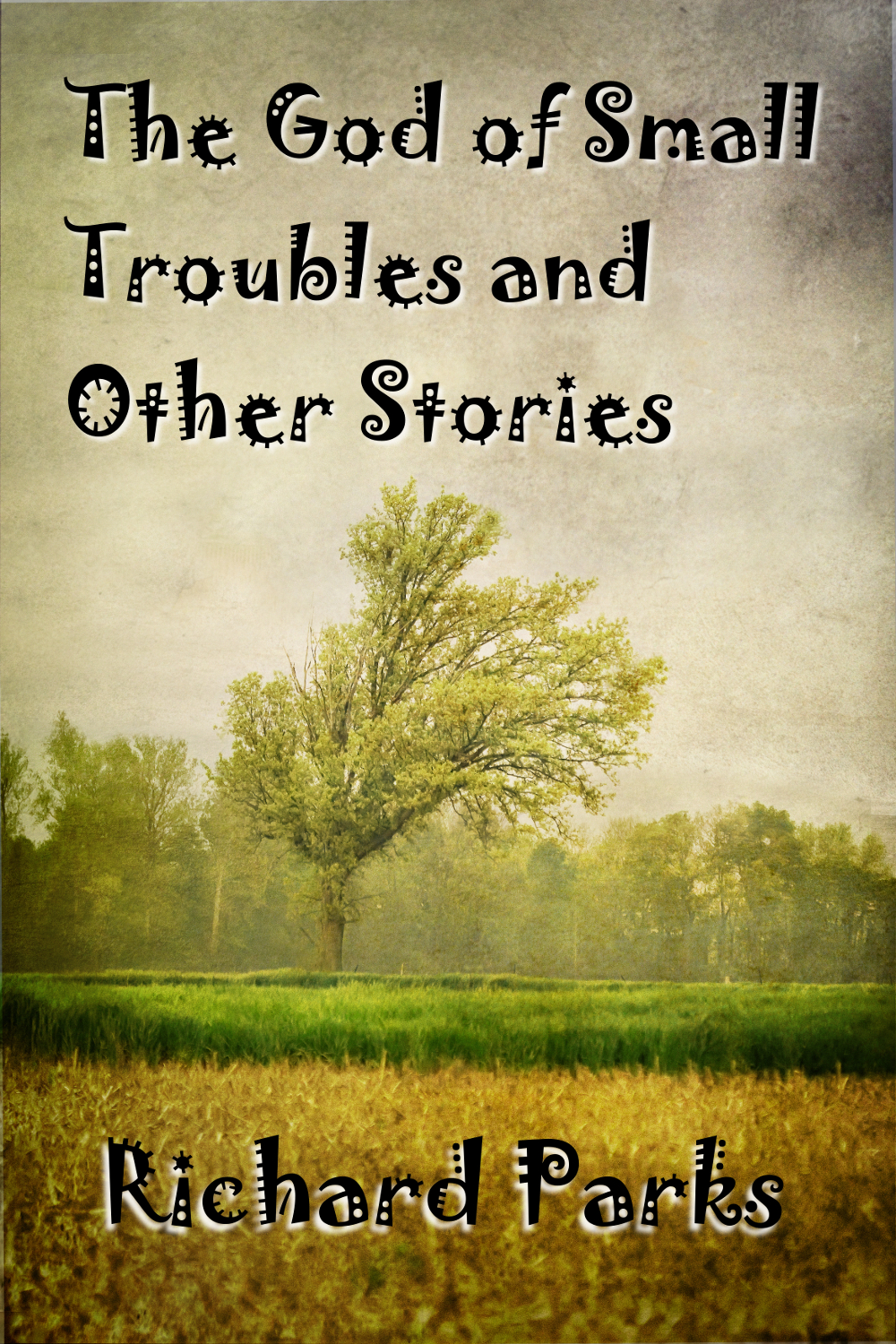
 To the left is the cover of my third story collection, issued in 2010, On the Banks of the River of Heaven, which is the title cut. Not only was it the third collection in ten years, but it was my first hardcover collection. As of a week or so ago, it’s out of print. If you look on Amazon it will say that it’s “Temporarily Out of Stock,” but this isn’t so. There may or may not be a few stragglers with the publisher and a few more with me, some in the used market, but basically it’s gone. We’ve talked about that whole thing where publishing short stories is like “throwing rose petals in the Grand Canyon and listening for the thud.” It was definitely true here. I can’t complain too much, as the book sold well enough to finish out its run, which is something a lot of print books never do, but in five years it never got a single Amazon review. Things like that tend to make a writer feel unwanted. Whereas on GoodReads it had sixteen ratings and a score of 4.5 out of 5.0, and anyone on GoodReads knows what a tough crowd they are. It is a good book, and I’m not going to let the fact that I wrote it stop me from saying that, but its time on the physical plane is over. It will live on, possibly forever, in ebook form.

 Richard Parks