The Parts You Don’t See

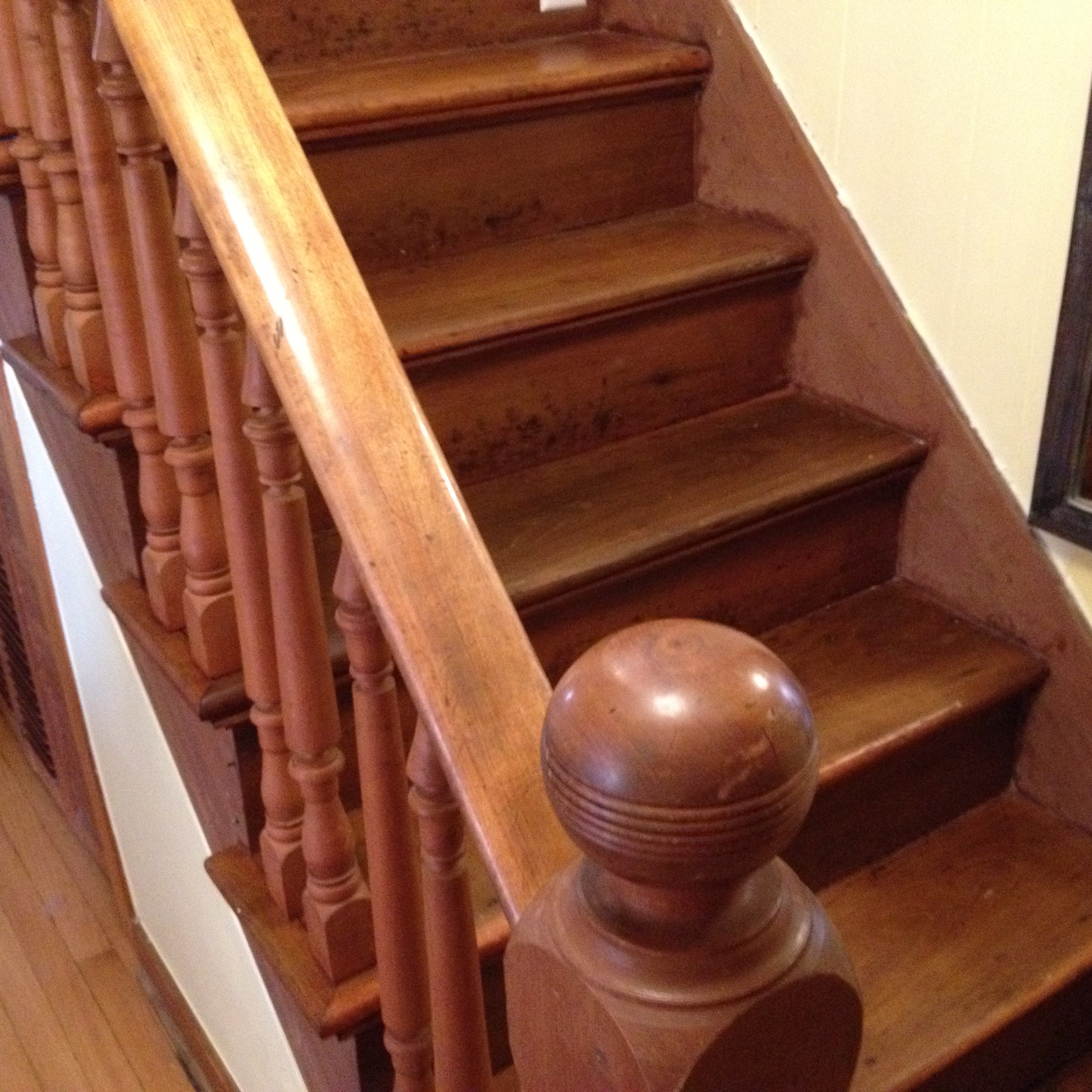
StairsOur “new” house was built in 1900, so naturally it has a few quirks. Some of those are of the “just the way it is” variety, and you learn to appreciate them because they’re not changing. Others require modification, like a replacement window or installing a vent to bring a bathroom up to code. The usual things. In a house this old, a lot has changed of necessity over the years, but I’ve recently had reason to notice one thing that has not–the staircase. It is all original.

Three things brought this to our attention, other than its obvious age and patina. The first was when Carol noted that the spindles on the banister were not all exactly the same shape, as they would have been with CNC machine-cut spindles. These were done individually on a lathe by hand. Then I noticed a faint but distinct pattern of radial lines on top of the banister that ran the length of the rail, and realized they were the trails left by planing where the curve of the railing had been shaped by hand. The third confirmation came when I was coming down the stairs in my sock feet and slipped, knocking a couple of the spindles loose from the tread as I slid down the stairs on my butt. Fortunately there was no permanent damage either to me or the stairs, but now I could see that the spindles ended in hand-cut dovetails that fit into the side of the step and were held in place with a mitered cap fastened with square–not drawn wire–nails. This was something the homeowner was never supposed to see, that construction beneath the surface that just does its job, has to be done right, but by design will never show.

Which reminded me–and you just knew I was going there, didn’t you?–of something similar in the act of writing, in that a lot of what makes a piece of writing work is usually below the surface, doing its job but not, by design, drawing attention to itself. Even though the Yamada books are pure fantasy, they are set in a specific time and place that is well-documented. Many if not most of the people who come on stage or get mentioned in the books were real people, holding the positions I said they did, sometimes even doing the things I attribute to them. Not always, but often enough. So why is that important? Simple–it helps me anchor the narrative to the time and place where the events are set. It sometimes even suggests events that fit the narrative and give it direction.

For instance, in the late Heian  period the mighty Fujiwara Clan is losing its influence over the court of the Emperor for a lot of reasons, not the least of which is the rising power of the warrior clans (foreshadowing the later samurai class). At this point in history the two clan leaders, Yorimichi and Norimichi, get into a feud which prevented them from acting together effectively to curb the rise of the Emperor’s faction opposing them. Family squabbles happen all the time, but this one occurred just when the reigning Emperor was in a position to take full advantage of it. Does the reader need to know this? Nope. But I did, because it pointed the current story toward a particular path that, in my opinion, made for a better story as well as following the actual historical timeline. It informs everything that follows in the book, like those invisible dovetails in the spindles that keep the railing on the stairs in place.

That railing has stood for over a century, despite clumsy clods in their sock feet. I took a lesson.

Spring? Almost? Really?

IMG_0486

My guitars are up and my rug is down. Other than that, most of the last few weeks have gone by in a blur. Still haven’t been able to do anything about the ugly curtains in the library, mostly because they’re currently blocked by a bookcase which I can’t move until we know where it’s going, and room is cleared in that space for the going thereof. Wish I could keep it in here, but there’s no room. I’m planning a couple of low profile bookcases but otherwise, I have to work with what I have. Still too much stuff for the space. Can’t make more space, so the solution is painful, but obvious.

Part of the reason for the blur is that most of the mornings have been turned over to the book, which doesn’t leave a lot of energy in the afternoon for getting the house where we want it. Still a ton of stuff to do. On the plus side, we seem to have survived our first New York winter. I’m told this was a rather mild one (coldest night was a mere -19 F). Fine with us. We were hoping for a training winter, so I could develop my snow shoveling and salt spreading chops. Very different from the south. In Mississippi we were losing the concept of seasons. It was either Summer-like or Winter-ish, and Winter-ish was losing ground steadily. A lot of places don’t even have seasons anymore, at least not like they once did. Up here in Central NY, that’s not the case. At least for now.

Enough with the boring domestic details. I have a book to write, and that’s taking all the brainpower I have left. So in lieu of anything actually inciteful or interesting, snippet time:


“Yamada-sama, I was instructed to give this to you personally,” Hiroshi said.

He held out both hands palm up, and resting there was a small sheet of washi neatly folded into the form sometimes referred to as a “lover’s knot,” since it was nearly impossible to re-fold properly once opened, and so had the virtue of making it extremely difficult for anyone else to read the message without the intended recipient knowing that the communication had been compromised. I took the paper and unfolded it carefully to read:

“Autumn wind rushes past
An empty garden where once
The peony bloomed.”

After the poem, there was a simple message: “I would speak with you in private.” I dismissed Hiroshi then showed the paper to Kenji, who frowned.

“It seems you will be allowed an audience with the High Priestess of Ise,” he said.

“Allowed? It sounded rather more like a command.”

“It also sounded as if we—well, you—were expected. That poem….”

I nodded. “Yes. It’s a reference to the death of Princess Teiko. “Peony” was her nickname at court. She held it from at least the age of seven. Not just anyone would know that, especially now, but Princess Tagako is one who would. Without mentioning either of our names, it was clear the message was for me.”

My time at court had been so long ago that I sometimes forgot the way the mind of someone raised in the emperor’s circle tended to work. The message would have seemed innocuous enough to anyone else who discovered it, yet to the intended recipient—myself, in this case—there was far more to be read. Princess Tagako’s note reminded me of Teiko in more ways than simply the poem.

Kenji frowned. “Why would she bring up Teiko? That seems rather indelicate.”

It was more than indelicate. It was deliberate, implied far more than it said, and was aimed precisely at me.

“Indelicacy with a purpose, I think, though what that purpose is, I cannot fathom. I must go speak to the saiō.”

“You must also finish the tanka.”

I winced, but Kenji was right. The form of the poem required an answer, or rather, a shimo-no-ku, a lower phrase, which must also be in the proper form. Princess Teiko had always been somewhat amused at my attempts at poetry, but this occasion called for me to try. I sent for a portable writing table and quickly prepared the ink. First I copied Princess Tagako’s poem as best I could and, after many hesitations and false starts, wrote down this:

“Autumn yields to winter’s cloak,
In Spring, flowers bloom again.”

Kenji looked at what I had done. “Lord Yamada, for you that almost sounded hopeful.”

I sighed. “Yes. If I had more time…well, it still wouldn’t be any better.”


History Lesson

Library

Library

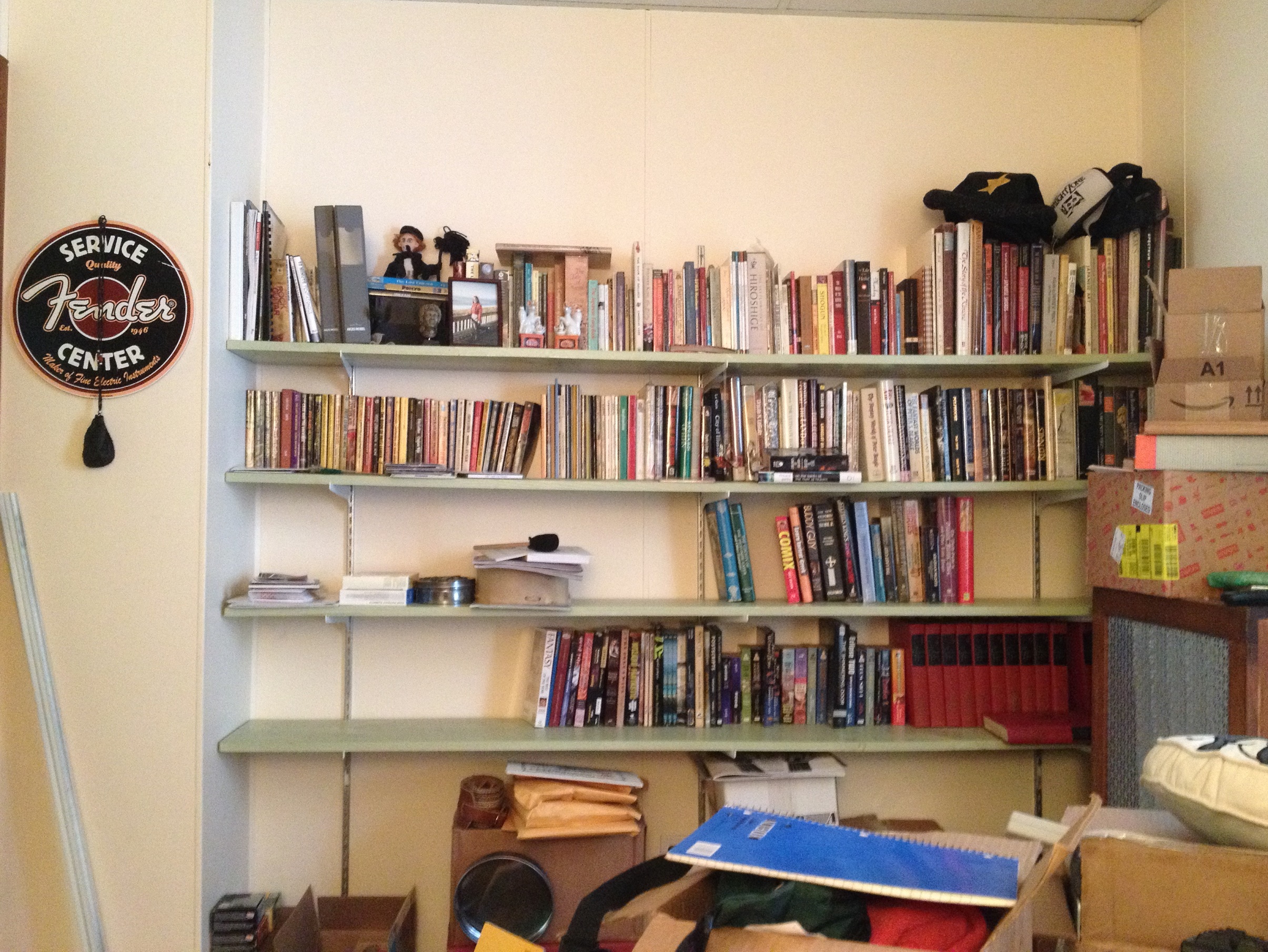
Believe it or not, that mess on the left actually represents progress. There hasn’t been a lot of that, at least in the library. I can see about a third of the bare floor now. I also know that, judging the remaining books with the remaining shelf space, the numbers just don’t work, and I can’t add more shelves…well, maybe one.

That’s for later. Part of the point of at least attempting to get organized is that I have a book to finish, a book set in a specific historical period and at a very important historical crisis point. In short, my references—and one specifically—were packed up, and I needed them. Not to get into many details, but there was a particular point in the story where Imperial and clan politics interacted in a very specific way, and in order to understand how that all fit into the narrative, I needed a specific book. That is, I thought I did. Until I was able to unpack said book.

Funny thing about that—what one person considers important, another just skims past. In other words, the book I was depending on was no help at all. I shouldn’t have been too surprised. What I was looking for was a fairly obscure series of events that happened over nine hundred years ago. Unless you happen to have a large university reference library at your disposal, you’re probably not going to find what you’re looking for. I don’t happen to have that. Nor do I have the shelf space to stock every reference I might possibly need, even if they did exist in translation, and usually the ebook edition in any language simply doesn’t exist.

What I do have is Google. I’m almost embarrassed to admit it, but online it took me maybe twenty minutes, tops, to track down what I was looking for, thanks to a Japanese site pulling from primary sources, with English translation provided. The internet does make some things more difficult with its constant distractions. But it also makes a lot of things possible. The information I needed simply wouldn’t have been available to me without it. Fortunately, I am not without it, so no problem.

Also no excuses. Funny how that works.

Whispering Pines

WRITING 02

One thing I’m going to miss up here. Have you ever heard the expression, “Whispering Pines”? It’s a real thing. The wind makes a distinctive sound when it blows through a forest of Southern Longleaf Pines. Listen long enough and you’d swear they were talking. There are evergreens here, too. Maybe one day I’ll find a grove and try them out, but I don’t think it’s going to be the same.

Still adjusting to life in central New York. In some ways it’s a lot different. In others, not so much. For instance, “redneck” is apparently a lifestyle choice. Now, in a sense I’ve always known that. Wherever I’ve been in the country, I’ve run into them. Remember, I’m from Mississippi, where the dichotomy was much simpler—you either were, or you weren’t. And birth, education, economic level, etc. had almost nothing to do with it. Like the alleged Progressive/Conservative split, it had a lot more to do with how your brain was wired than any well-reasoned philosophical position. However, I had always thought that the particular manner in which it expressed itself in the South was, pardon the expression, our own saltire to bear. So imagine my surprise the first time I saw the Confederate Battle Flag proudly displayed on a local pickup truck.

I have to admit, my gut reaction was WTF???

I figured it must have been another transplant from my general area, shrugged, and went on my way. Then I saw it again. And again. One? Okay, sure. Two? Maybe. Three? Hmmm. I’m seeing a pattern here. Granted, there were not nearly as many around as I was used to, but it was throwing me for a loop that I saw any at all. After all, this is New York. I mean, aside from New England, could you get more Yankee? What could the Battle Flag possibly mean to the people here?

Where I come from, people have given lots of reasons for flying the flag. Other than the real one, I mean, but “Heritage” is the favorite these days. So? From that standpoint it really is my heritage. I own that. I respect the people who fought and died for a cause they believed in. The Cause itself? Not so much. Bigotry and fear convinced a bunch of poor whites to ignore their own best interests to protect the livelihood of a bunch of rich slave owners who, to be charitable, didn’t give a tinker’s damn about them. Looking at the current political situation, you start to see that not a lot has changed. So that whole “Heritage, not Racism” thing? Yeah. Gonna have to call bullshit on that.

Unless by “Heritage” you mean “Got Fooled Again.”