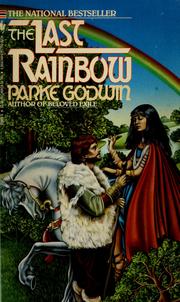
Review: The Last Rainbow by Parke Godwin

Continuing the purge of my old writing files after a hiatus to paint the master bath. Not only am I finding stories I never published (no surprise there, not every story is a winner), I’m finding stories and articles I’d forgotten I’d written. One of which was a fairly detailed review of Parke Godwin’s The Last Rainbow. I was reviewing for the long gone Fantasy Review at the time, and as I was going through my old file I found a letter from the editor telling me they already had a review of the book, so my review was never published and I’m including it here. There are a couple of spoilers, for those among you who believe that what happens in a book is what the book is really about, so fair warning.

The Last Rainbow. Originally published by Bantam Spectra Books,
1985.

Parke Godwin’s The Last Rainbow is subtitled “A Novel of Saint Patrick” and that’s certainly true—in the same sense that Firelord was about King Arthur and Beloved Exile, Guenivere. As in it’s true so far as it goes, but it doesn’t go nearly far enough.

Novels about legendary figures are nothing new—the bare bones of fact and myth always beg for the flesh of the storyteller’s art, but to say that the vein has been mined before is to completely miss the point. What sets our best writers apart is not chosen genre, social consciousness, or even prose style. It is their ability to look at a subject, any subject, from their own unique perspective and let the rest of us see what they see. Communication is the heart and soul of any good story. Anything less is just ‘connect the dots’ and word games. T.H. White used “The Matter of Britain” in his The Once and Future King to reflect his own society, and if the images in his mirror are cloaked in fancy they’re never hidden. John Gardner took the Anglo-Saxon epic Beowulf and turned it on its head, telling the story from the monster’s point of view in the masterful Grendel, and suddenly we’ll never again be quite so righteously complacent in the hero’s triumph. Agree or not, we will look again, and wonder.

All of which is a roundabout way to point out that Godwin works a kindred magic in The Last Rainbow. He takes the stone statue life of Saint Patrick, and with a superb artist’s eye, patiently chips away the gilt of time and dogma to reveal the living flesh beneath. Continue reading

Review: Legends, Edited by Robert Silverberg

WRITING 02Note and Disclaimer: This review originally appeared in SF AGE back around 1998, and I’m not changing a word of it. I think of these as much as time capsules as reviews. Speculations that panned out or didn’t, hopes dashed, whatever, are par for the course of time.


LEGENDS edited by Robert Silverberg, Tor Books, September 1998,
hc, 703 pp, $27.95, ISBN: 0-312-86787-5

In LEGENDS, Robert Silverberg has brought together eleven of
the most currently famous and best-selling authors in sf&f, each
telling a new story set in their own chosen milieu. It’s a great
idea in theory, and couldn’t have been easy to manage, yet manage
he has. Let’s see if the fox was worth the chase.
Stephen King leads with a new tale of Roland of Gilead and
his quest for the Dark Tower. In “Little Sisters of Eluria,”
Roland arrives at a dead town on a dying horse. Eluria is empty,
save for one dead body and an oddly marked dog. Or rather,
seemingly empty. After an attack my mutant monsters, Roland
awakens to find himself in the tender care of the Little Sisters
of Eluria, an order of hospitalers. Such care as would soon make
the tender mercies of the monsters look good by comparison.
King can always work the horror element, that’s a given, but
sometimes I don’t think he gets enough credit for the range he
shows, with more or less mainstream work like The Body or his
idiosyncratic take on a fantasy world with The Dark Tower
stories. Those tired of generic fantasy, who sometimes think
that’s all fantasy is, or can be, should really give this
series a try. Continue reading

Publisher’s Weekly Comes Through

Yamada_BTG_cover-V06b-PrimeOne problem with the writer existence is that it’s feast or famine, and there is an awful lot of famine. But, now and then, a feast. Last night I got an IM from my publisher telling me to check my email, and sitting there was a link to a Star Review in Publisher’s Weekly for Yamada Monogatari: To Break the Demon Gate. I’ve only gotten one of those before. You can read the entire review here, but one takeaway is in the final line.

Playing with Japanese demonology and political scandal, Parks creates an absorbing and original tale.”

I’d only quibble with the first line of the review, wherein I am proclamined to be “prolific,” which I know I am not, or at least not nearly enough. As for the rest, you can’t beat that, not even with a really big stick.

Doc, It Hurts When I Do This….

WRITING 02Yeah, I know. Old joke, but then old jokes come to mind when I find myself repeating old mistakes. Stale humor goes with stale habits.

Some time ago a friend asked me to comment on another story in a magazine I was also in, and I did. Regretted it immediately, and belatedly remembered why I stopped doing that. I see it as no win, at least from my own perspective. Whether I honestly like a story or not, and especially when I have a “stake” in the issue I can’t see it as anything other than 1) sucking up to my peers or 2) dissing the competition. You see the problem — I don’t trust my motives. I consider this wise, because anything I write about the issue will involve my own writerly ego, which is an extremely unreliable narrator. The ego is important and extremely useful, but move it out of its proper sphere (getting the work done, dealing with either the hostility or (worse) indifference that usually follows) and it becomes a liability. By extension and in hindsight this is why I stopped reviewing, period (though of course I never reviewed a magazine issue I was in). Now, reviewing was a useful phase and I’m glad I did it when I did. It helped me analyze my own work when I had to figure out what was wrong (or right) with a story I was reviewing. I think I was a very decent reviewer while it lasted, never pulled a punch or skimped on praise when appropriate. But then it was time to stop, and wanting more time for my own work was only part of the reason. I just didn’t want to do it anymore. I was never comfortable with it and was never going to be. I will do it now and again, but only when I can’t help myself. The infrequency of reviews posted here should attest.

Oddly enough, in the context of a writer’s group I have no problem at all giving very harsh criticsm when I think it’s required. That, of course, is when the story can still be saved. Sometimes, it comes down to telling a proud parent that their baby is really, really, ugly. I have a problem with this. Other writers don’t.

Shrug.

Annual Locus List Arrives Annually

WRITING 02For those who don’t know, Locus Magazine does an annual Recommended Reading list of stories and books from the previous year. The list is chosen by reviewers and industry professionals and generally requires more than one vote to make the list. So permit me the minor brag of mentioning that two of my short stories made the list from 2014, The Manor of Lost Time and The Sorrow of Rain, both from Beneath Ceaseless Skies. A famous sf writer once famously noted that “The Blank of Blank” titles were the titles away from which to stay, but I dunno. They’re not terribly exciting as titles, I agree, but evocative and they did seem to fit.

You can see the full list at the link below. Lots of great reading to be found there, from Mary Rickert, Jay Lake, K.J. Parker, Robert Reed, Aliette de Bodard, and well, far too many to list here. That’s why there’s such a thing as the Locus Recommended Reading List.